LeetCode Entry
1498. Number of Subsequences That Satisfy the Given Sum Condition
Precompute the 2-powers
1498. Number of Subsequences That Satisfy the Given Sum Condition medium
fun numSubseq(nums: IntArray, target: Int): Int {
    val m = 1_000_000_007
    nums.sort()
    val cache = IntArray(nums.size + 1) { 0 }
    cache[1] = 1
    for (i in 2..nums.size) cache[i] = (2 * cache[i - 1]) % m
    var total = 0
    nums.forEachIndexed { i, n ->
        var lo = 0
        var hi = i
        var removed = cache[i + 1]
        while (lo <= hi) {
            val mid = lo + (hi - lo) / 2
            if (nums[mid] + n <= target) {
                removed = cache[i - mid]
                lo = mid + 1
            } else hi = mid - 1
        }
        total = (total + cache[i + 1] - removed) % m
    }
    if (total < 0) total += m
    return total
}
Join me on Telegram
https://t.me/leetcode_daily_unstoppable/204
Intuition
- We can safely sort an array, because order doesn’t matter for finding
maxorminin a subsequence. - Having increasing order gives us the pattern:
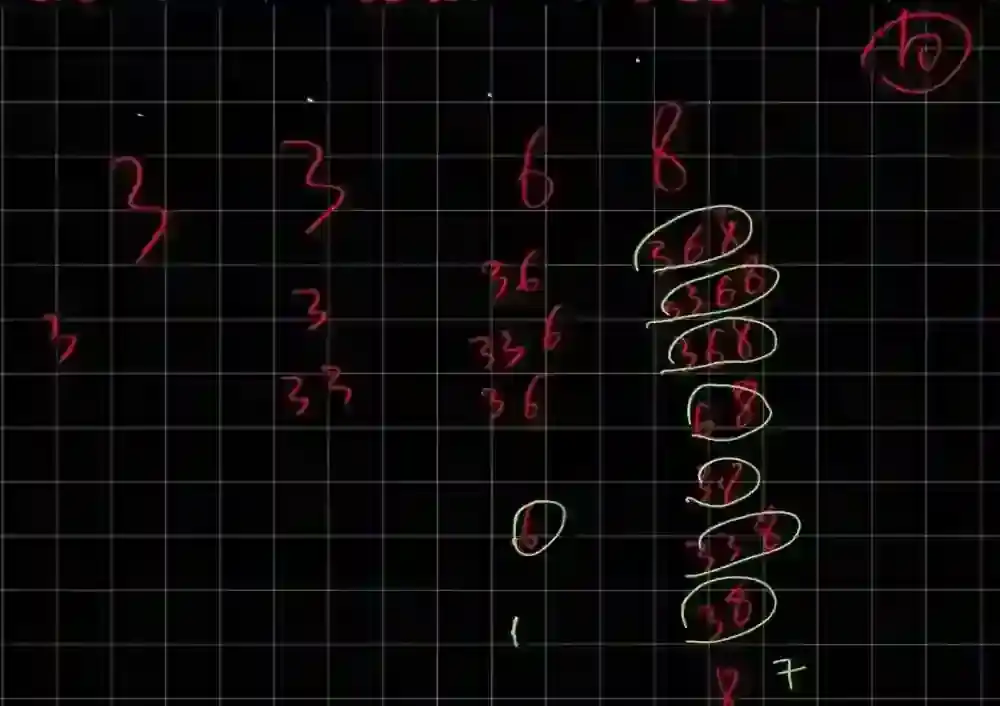 Ignoring the
 target, each new number adds previous value to the sum: \(sum_2 = sum_1 + (1 + sum_1)\), or just \(2^i\). - Let’s observe the pattern of the removed items:
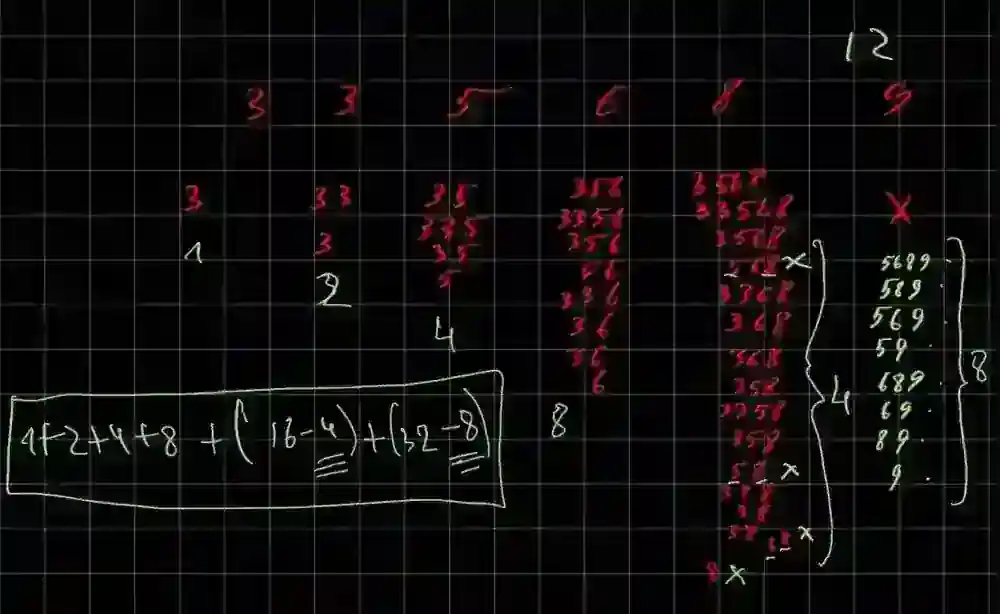 For example,
 target = 12, for number8, count of excluded values is4= [568, 58, 68, 8]; for number9, it is8= [5689, 589, 569, 59, 689, 69, 89, 9]. We can observe, it is determined by the sequence5 6 8 9, where all the numbers are bigger, thantarget - 9. That is, the law for excluding the elements is the same: \(r_2 = r_1 + (1 + r_1)\), or just \(2^x\), where x - is the count of the bigger numbers.
Approach
- Precompute the 2-powers
- Use binary search to count how many numbers are out of the equation
n_i + x <= target - A negative result can be converted to positive by adding the modulo
1_000_000_7Complexity
- Time complexity: \(O(nlog(n))\)
- Space complexity: \(O(n)\)
Comments