LeetCode Entry
1751. Maximum Number of Events That Can Be Attended II
Max sum of at most k values from non-intersecting array of (from, to, value) items
1751. Maximum Number of Events That Can Be Attended II hard
blog post
substack
Join me on Telegram
https://t.me/leetcode_daily_unstoppable/276
Problem TLDR
Max sum of at most k values from non-intersecting array of (from, to, value) items
Intuition
Let’s observe example:
        // 0123456789011
        // [     4 ]
        // [1][2][3][2]
        //      [4][2]
If k=1 we choose [4]
if k=2 we choose [4][2]
if k=3 we choose [2][3][2]
What will not work:
- sweep line algorithm, as it is greedy, but there is an only
kitems we must choose and we must do backtracking - adding to Priority Queue and popping the lowest values: same problem, we must backtrack
What will work:
- asking for a hint: this is what I used
- full search: at every
indexwe canpickorskipthe element - sorting: it will help to reduce irrelevant combinations by doing a Binary Search for the next non-intersecting element
We can observe, that at any given position the result only depends on the suffix array. That means we can safely cache the result by the current position.
Approach
For more robust Binary Search code:
- use inclusive
lo,hi - check the last condition
lo == hi - always write the result
next = mid - always move the borders
lo = mid + 1,hi = mid - 1
Complexity
-
Time complexity: \(O(nklog(n))\)
-
Space complexity: \(O(nk)\)
Code
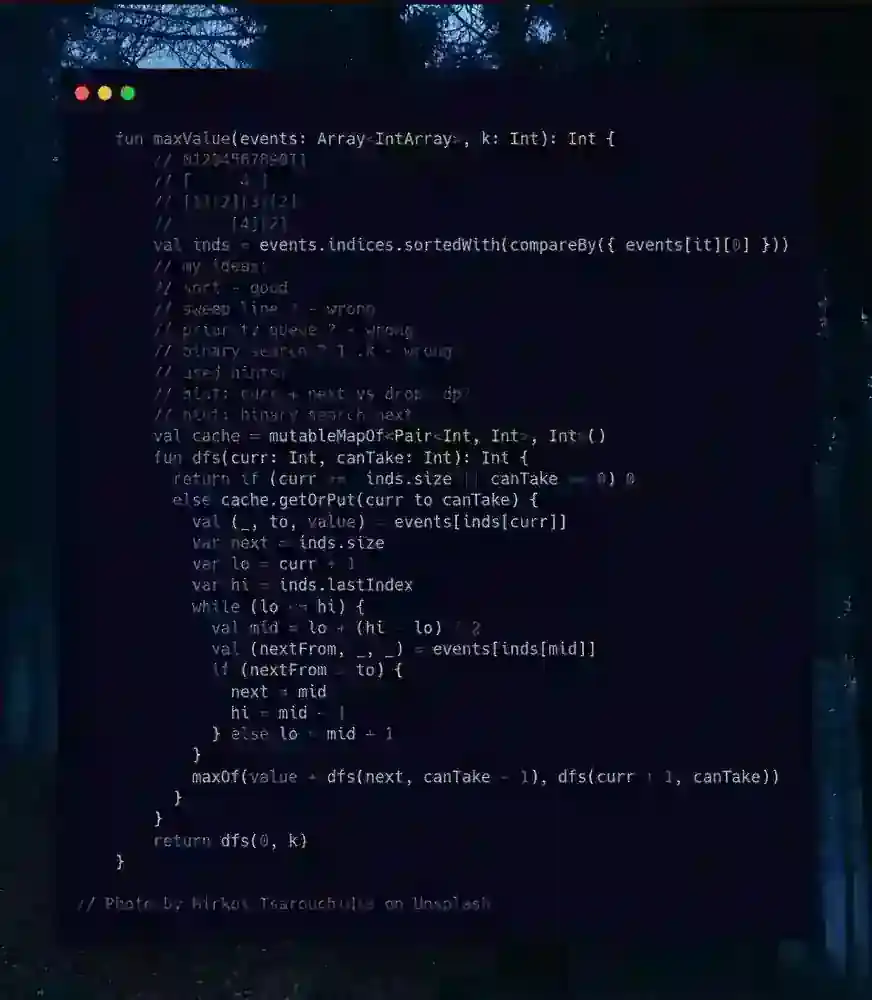
    fun maxValue(events: Array<IntArray>, k: Int): Int {
        // 0123456789011
        // [     4 ]
        // [1][2][3][2]
        //      [4][2]
        val inds = events.indices.sortedWith(compareBy({ events[it][0] }))
        // my ideas:
        // sort - good
        // sweep line ? - wrong
        // priority queue ? - wrong
        // binary search ? 1..k - wrong
        // used hints:
        // hint: curr + next vs drop  dp?
        // hint: binary search next
        val cache = mutableMapOf<Pair<Int, Int>, Int>()
        fun dfs(curr: Int, canTake: Int): Int {
          return if (curr ==  inds.size || canTake == 0) 0
          else cache.getOrPut(curr to canTake) {
            val (_, to, value) = events[inds[curr]]
            var next = inds.size
            var lo = curr + 1
            var hi = inds.lastIndex
            while (lo <= hi) {
              val mid = lo + (hi - lo) / 2
              val (nextFrom, _, _) = events[inds[mid]]
              if (nextFrom > to) {
                next = mid
                hi = mid - 1
              } else lo = mid + 1
            }
            maxOf(value + dfs(next, canTake - 1), dfs(curr + 1, canTake))
          }
        }
        return dfs(0, k)
    }
Comments