LeetCode Entry
1425. Constrained Subsequence Sum
Max sum of subsequence i - j <= k
1425. Constrained Subsequence Sum hard
blog post
substack
Join me on Telegram
https://t.me/leetcode_daily_unstoppable/377
Problem TLDR
Max sum of subsequence i - j <= k
Intuition
The naive DP approach is to do DFS and memoization:
    fun constrainedSubsetSum(nums: IntArray, k: Int): Int {
      val dp = mutableMapOf<Int, Int>()
      fun dfs(i: Int): Int = if (i >= nums.size) 0 else dp.getOrPut(i) {
        var max = nums[i]
        for (j in 1..k) max = max(max, nums[i] + dfs(i + j))
        max
      }
      return (0..<nums.size).maxOf { dfs(it) }
    }
This solution takes O(nk) time and gives TLE.
Let’s rewrite it to the iterative version to think about further optimization:
    fun constrainedSubsetSum(nums: IntArray, k: Int): Int {
      val dp = mutableMapOf<Int, Int>()
      for (i in nums.indices)
        dp[i] = nums[i] + (i - k..i).maxOf { dp[it] ?: 0 }
      return dp.values.max()
    }
Next, read a hint :) It will suggest to use a Heap. Indeed, looking at this code, we’re just choosing a maximum value from the last k values:
    fun constrainedSubsetSum(nums: IntArray, k: Int): Int =
    with (PriorityQueue<Int>(reverseOrder())) {
      val dp = mutableMapOf<Int, Int>()
      for (i in nums.indices) {
        if (i - k > 0) remove(dp[i - k - 1])
        dp[i] = nums[i] + max(0, peek() ?: 0)
        add(dp[i])
      }
      dp.values.max()
    }
This solution takes O(nlog(k)) time and still gives TLE.
Let’s look at other’s people solutions, just take a hint: decreasing queue. This technique must be remembered, as it is a common trick to find a maximum in a sliding window with O(1) time.
Approach
Decreasing queue flushes all the values that smaller than the current.
- we’ll store the indices to remove them later if out of
k - careful with indices
Complexity
-
Time complexity: \(O(n)\)
-
Space complexity: \(O(k)\)
Code
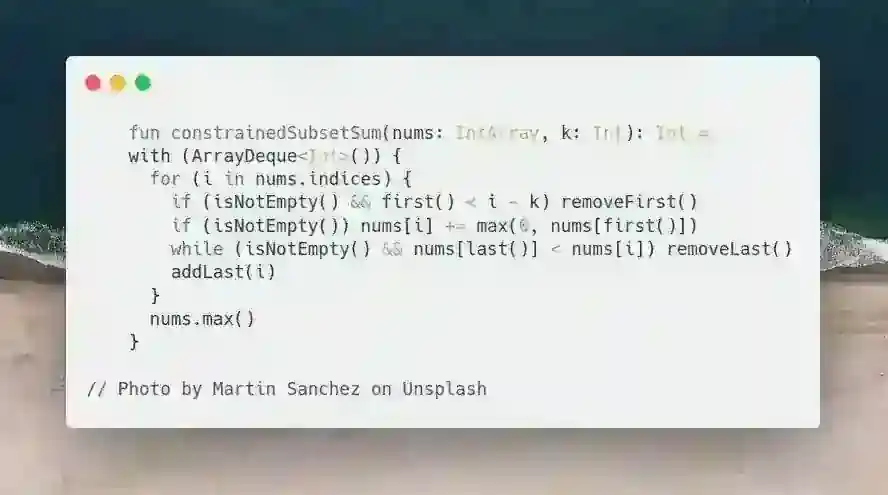
    fun constrainedSubsetSum(nums: IntArray, k: Int): Int =
    with (ArrayDeque<Int>()) {
      for (i in nums.indices) {
        if (isNotEmpty() && first() < i - k) removeFirst()
        if (isNotEmpty()) nums[i] += max(0, nums[first()])
        while (isNotEmpty() && nums[last()] < nums[i]) removeLast()
        addLast(i)
      }
      nums.max()
    }
Comments