LeetCode Entry
1611. Minimum One Bit Operations to Make Integers Zero
Minimum rounds of inverting rightmost bit or left of the rightmost 1 bit to make n zero
1611. Minimum One Bit Operations to Make Integers Zero hard
blog post
substack
youtube
Join me on Telegram
https://t.me/leetcode_daily_unstoppable/421
Problem TLDR
Minimum rounds of inverting rightmost bit or left of the rightmost 1 bit to make n zero
Intuition
Let’s observe the example:
  // 6
  // 110
  // 010 b
  // 011 a
  // 001 b
  // 000 a
  // 10 = 2 + f(1) = 2^1 + f(2^0)
  // 11 a
  // 01 b -> f(1)
  // 100 = 4 + f(10) = 2^2 + f(2^1)
  // 101 a
  // 111 b
  // 110 a
  // 010 b -> f(10)
  // 1000 = 8 + f(100) = 2^3 + f(2^2)
  // 1001 a
  // 1011 b
  // 1010 a
  // 1110 b
  // 1111 a
  // 1101 b
  // 1100 a
  // 0100 b -> f(100)
There are two tricks we can derive:
- Each signle-bit number has a recurrent count of operations: f(0b100) = 0b100 + f(0b10) and so on.
- The hard trick: when we consider the non-single-bit number, like
1101, we dof(0b1101) = f(0b1000) - f(0b100) + f(0b1).
Complexity
-
Time complexity: \(O(log(n))\)
-
Space complexity: \(O(log(n))\)
Code
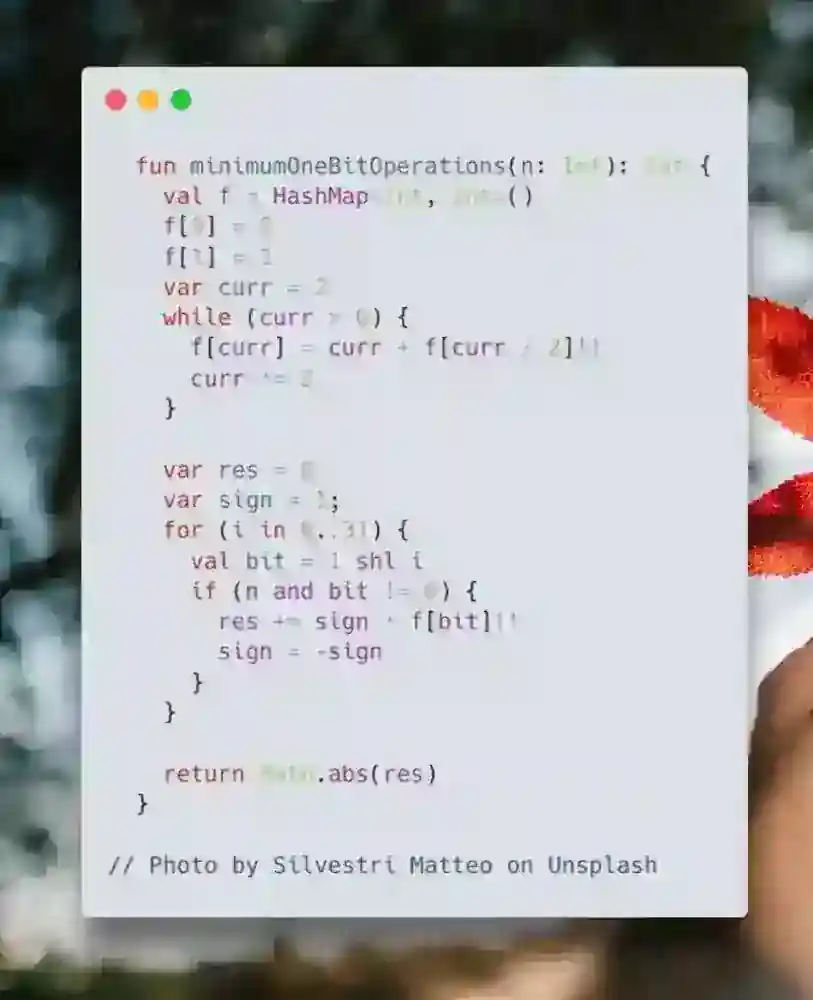
  fun minimumOneBitOperations(n: Int): Int {
    val f = HashMap<Int, Int>()
    f[0] = 0
    f[1] = 1
    var curr = 2
    while (curr > 0) {
      f[curr] = curr + f[curr / 2]!!
      curr *= 2
    }

    var res = 0
    var sign = 1;
    for (i in 0..31) {
      val bit = 1 shl i
      if (n and bit != 0) {
        res += sign * f[bit]!!
        sign = -sign
      }
    }

    return Math.abs(res)
  }
Comments