LeetCode Entry
1531. String Compression II
Min length of run-length encoded aabcc -> a2bc3 after deleting at most k characters
1531. String Compression II hard
blog post
substack
youtube
Join me on Telegram
https://t.me/leetcode_daily_unstoppable/453
Problem TLDR
Min length of run-length encoded aabcc -> a2bc3 after deleting at most k characters
Intuition
Let’s consider starting from every position, then we can split the problem: result[i] = some_function(i..j) + result[j].
The hardest part is to find an optimal j position.
The wrong way: trying to count how many s[j]==s[i], and to keep them, removing all other chars s[j]!=s[i]. This didn’t give us the optimal solution for s[i..j], as we forced to keep s[0].
The correct way: keeping the most frequent char in s[i..j], removing all other chars.
Approach
Spend 1-2.5 hours max on the problem, then steal someone else’s solution. Don’t feel sorry, it’s just a numbers game.
Complexity
-
Time complexity: \(O(kn^2)\)
-
Space complexity: \(O(kn)\)
Code
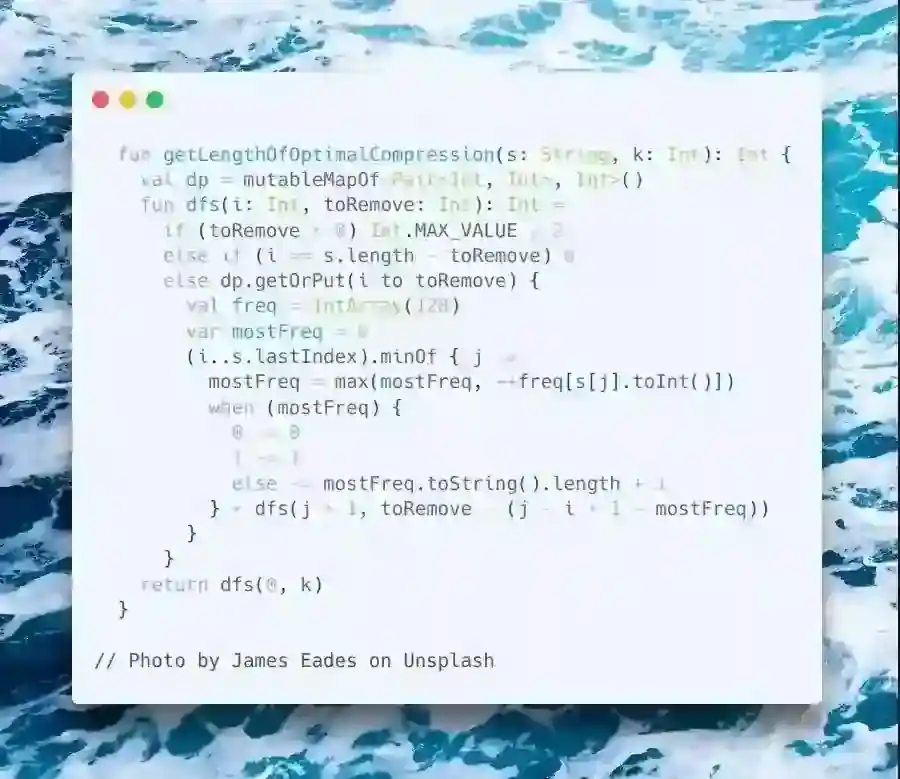
  fun getLengthOfOptimalCompression(s: String, k: Int): Int {
    val dp = mutableMapOf<Pair<Int, Int>, Int>()
    fun dfs(i: Int, toRemove: Int): Int =
      if (toRemove < 0) Int.MAX_VALUE / 2
      else if (i >= s.length - toRemove) 0
      else dp.getOrPut(i to toRemove) {
        val freq = IntArray(128)
        var mostFreq = 0
        (i..s.lastIndex).minOf { j ->
          mostFreq = max(mostFreq, ++freq[s[j].toInt()])
          when (mostFreq) {
            0 -> 0
            1 -> 1
            else -> mostFreq.toString().length + 1
          } + dfs(j + 1, toRemove - (j - i + 1 - mostFreq))
        }
      }
    return dfs(0, k)
  }
Comments