LeetCode Entry
1143. Longest Common Subsequence
Longest common subsequence of two strings.
1143. Longest Common Subsequence medium
blog post
substack
youtube
Join me on Telegram
https://t.me/leetcode_daily_unstoppable/483
Problem TLDR
Longest common subsequence of two strings.
Intuition
We can start from a brute force solution: given the current positions i and j we take them into common if text1[i] == text2[j] or choose between taking from text1[i] and text2[j] if not. The result will only depend on the current positions, so can be cached. From this, we can rewrite the solution to iterative version.
Approach
- use
len + 1dp size to avoid boundary checks - forward iteration is faster, but
dp[0][0]must be the out of boundary value foldcan save us some lines of code- there is a 1D-memory dp solution exists
Complexity
-
Time complexity: \(O(n^2)\)
-
Space complexity: \(O(n^2)\)
Code
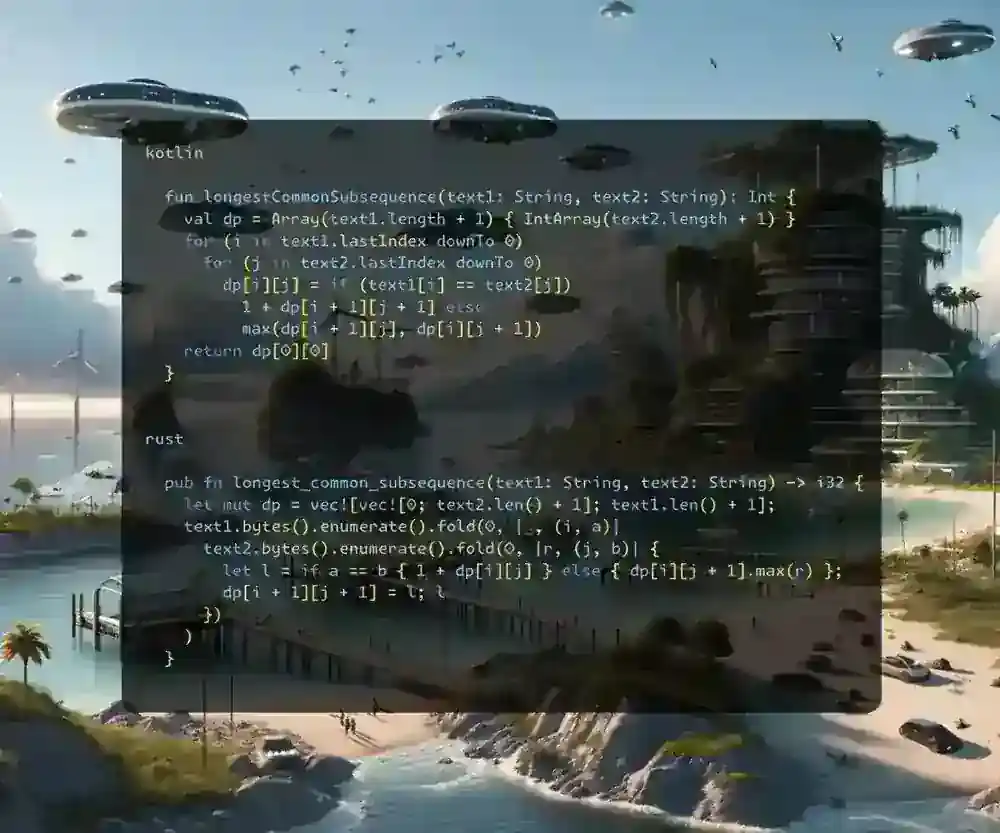
  fun longestCommonSubsequence(text1: String, text2: String): Int {
    val dp = Array(text1.length + 1) { IntArray(text2.length + 1) }
    for (i in text1.lastIndex downTo 0)
      for (j in text2.lastIndex downTo 0)
        dp[i][j] = if (text1[i] == text2[j])
          1 + dp[i + 1][j + 1] else
          max(dp[i + 1][j], dp[i][j + 1])
    return dp[0][0]
  }
  pub fn longest_common_subsequence(text1: String, text2: String) -> i32 {
    let mut dp = vec![vec![0; text2.len() + 1]; text1.len() + 1];
    text1.bytes().enumerate().fold(0, |_, (i, a)|
      text2.bytes().enumerate().fold(0, |r, (j, b)| {
        let l = if a == b { 1 + dp[i][j] } else { dp[i][j + 1].max(r) };
        dp[i + 1][j + 1] = l; l
      })
    )
  }
Comments