LeetCode Entry
368. Largest Divisible Subset
Longest subset of divisible by s[i] % s[j] == 0 || s[j] % s[i] == 0.
368. Largest Divisible Subset medium
blog post
substack
youtube
Join me on Telegram
https://t.me/leetcode_daily_unstoppable/500
Problem TLDR
| Longest subset of divisible by s[i] % s[j] == 0 | s[j] % s[i] == 0. |
Intuition
Sort always helps, so do it. Let’s imagine a sequence of numbers like this:
    // 1 3 9 15 27 30 60
    // 1 3 9    27
    // 1 3   15    30 60
    // 3 4 8 16
There is a choice to be made: take 9 or 15. So we can search with DFS and try to take each number.
Also, there are some interesting things happening: for every position there is only one longest suffix subsequence. We can cache it.
Approach
I didn’t solve it the second time, so I can’t give you the working approach yet. Try as hard as you can for 1 hour, then give up and look for solutions. My problem was: didn’t considered DP, but wrote working backtracking solution. Also, I have attempted the graph solution to find a longest path, but that was TLE.
Complexity
-
Time complexity: \(O(n^2)\)
-
Space complexity: \(O(n^2)\)
Code
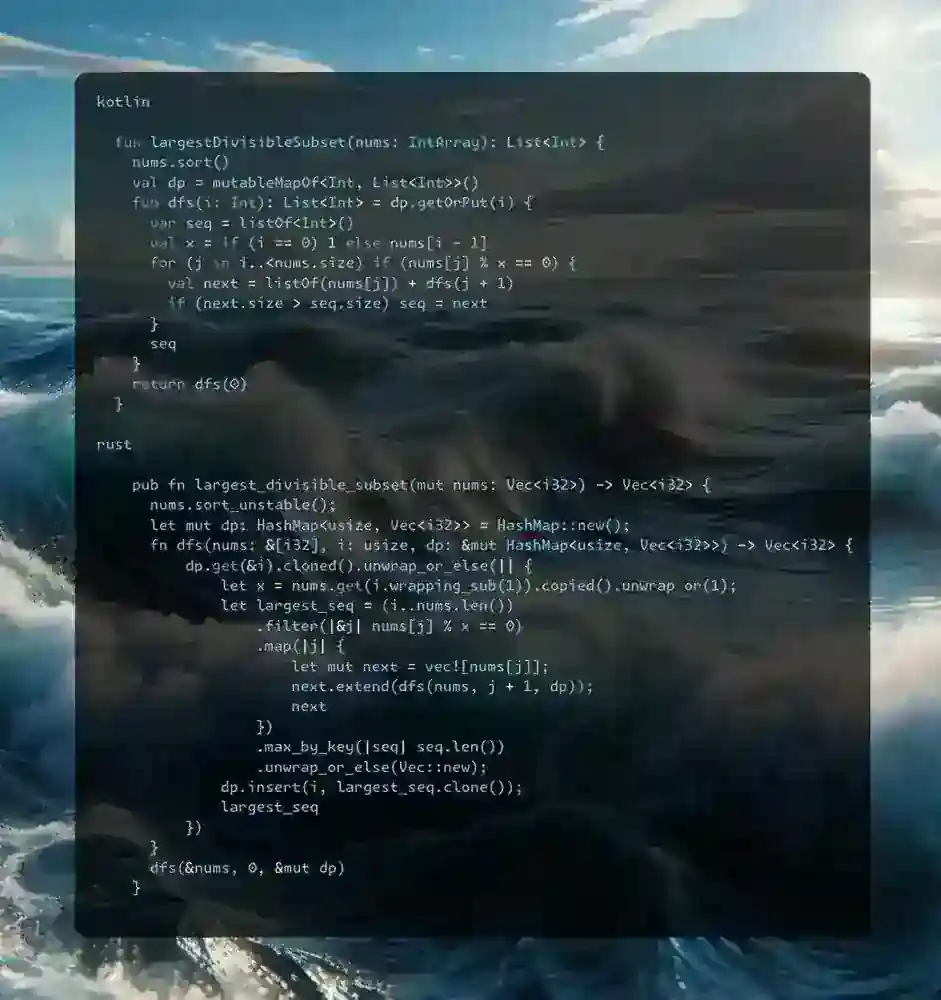
  fun largestDivisibleSubset(nums: IntArray): List<Int> {
    nums.sort()
    val dp = mutableMapOf<Int, List<Int>>()
    fun dfs(i: Int): List<Int> = dp.getOrPut(i) {
      var seq = listOf<Int>()
      val x = if (i == 0) 1 else nums[i - 1]
      for (j in i..<nums.size) if (nums[j] % x == 0) {
        val next = listOf(nums[j]) + dfs(j + 1)
        if (next.size > seq.size) seq = next
      }
      seq
    }
    return dfs(0)
  }
    pub fn largest_divisible_subset(mut nums: Vec<i32>) -> Vec<i32> {
      nums.sort_unstable();
      let mut dp: HashMap<usize, Vec<i32>> = HashMap::new();

      fn dfs(nums: &[i32], i: usize, dp: &mut HashMap<usize, Vec<i32>>) -> Vec<i32> {
          dp.get(&i).cloned().unwrap_or_else(|| {
              let x = nums.get(i.wrapping_sub(1)).copied().unwrap_or(1);
              let largest_seq = (i..nums.len())
                  .filter(|&j| nums[j] % x == 0)
                  .map(|j| {
                      let mut next = vec![nums[j]];
                      next.extend(dfs(nums, j + 1, dp));
                      next
                  })
                  .max_by_key(|seq| seq.len())
                  .unwrap_or_else(Vec::new);

              dp.insert(i, largest_seq.clone());
              largest_seq
          })
      }

      dfs(&nums, 0, &mut dp)
    }
Comments