LeetCode Entry
621. Task Scheduler
Count CPU cycles if task can't run twice in n cycles
621. Task Scheduler medium
blog post
substack
youtube
 https://youtu.be/8t1KNa9iZjA
Join me on Telegram
https://t.me/leetcode_daily_unstoppable/543
Problem TLDR
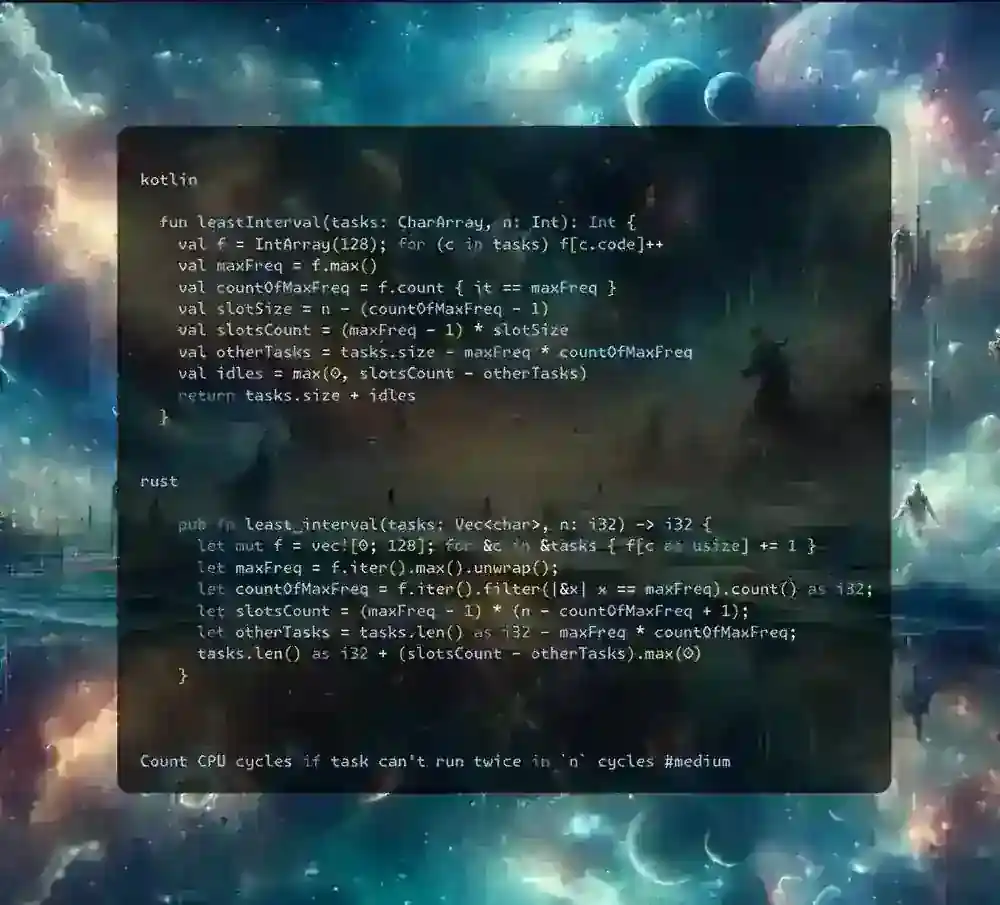
Count CPU cycles if task can’t run twice in n cycles #medium
Intuition
Let’s try to understand the problem first, by observing the example:
    // 0 1 2 3 4 5 6 7
    // a a a b b b c d n = 3
    // a . . . a . . . a
    //   b . . . b . . . b
    //     c d     i i
One inefficient way is to take tasks by thier frequency, store availability and adjust cycle forward if no task available. This solution will take O(n) time but with big constant of iterating and sorting the frequencies [26] array.
The clever way is to notice the pattern of how tasks are: there are empty slots between the most frequent task(s).
Approach
In the interview I would choose the first way.
Complexity
-
Time complexity: \(O(n)\)
-
Space complexity: \(O(1)\)
Code
  fun leastInterval(tasks: CharArray, n: Int): Int {
    val f = IntArray(128); for (c in tasks) f[c.code]++
    val maxFreq = f.max()
    val countOfMaxFreq = f.count { it == maxFreq }
    val slotSize = n - (countOfMaxFreq - 1)
    val slotsCount = (maxFreq - 1) * slotSize
    val otherTasks = tasks.size - maxFreq * countOfMaxFreq
    val idles = max(0, slotsCount - otherTasks)
    return tasks.size + idles
  }
    pub fn least_interval(tasks: Vec<char>, n: i32) -> i32 {
      let mut f = vec![0; 128]; for &c in &tasks { f[c as usize] += 1 }
      let maxFreq = f.iter().max().unwrap();
      let countOfMaxFreq = f.iter().filter(|&x| x == maxFreq).count() as i32;
      let slotsCount = (maxFreq - 1) * (n - countOfMaxFreq + 1);
      let otherTasks = tasks.len() as i32 - maxFreq * countOfMaxFreq;
      tasks.len() as i32 + (slotsCount - otherTasks).max(0)
    }
Comments