LeetCode Entry
992. Subarrays with K Different Integers
Count subarrays with k distinct numbers
992. Subarrays with K Different Integers hard
blog post
substack
youtube
Join me on Telegram
https://t.me/leetcode_daily_unstoppable/554
Problem TLDR
Count subarrays with k distinct numbers #hard
Intuition
We surely can count at most k numbers using sliding window technique: move the right pointer one step at a time, adjust the left pointer until condition met. All subarrays start..k where start in 0..j will have more or equal than k number of distincts if j..k have exatly k of them, so take j at each step.
To count exactly k we can remove subset of at least k from at least k - 1. (The trick here is that the number of at least k - 1 is the bigger one)
Approach
Let’s use a HashMap and some languages sugar:
- Kotlin:
sumOf - Rust: lambda to capture the parameters,
entry.or_insert
Complexity
-
Time complexity: \(O(n)\)
-
Space complexity: \(O(n)\), we have a frequencies stored in a map, can be up to
n
Code
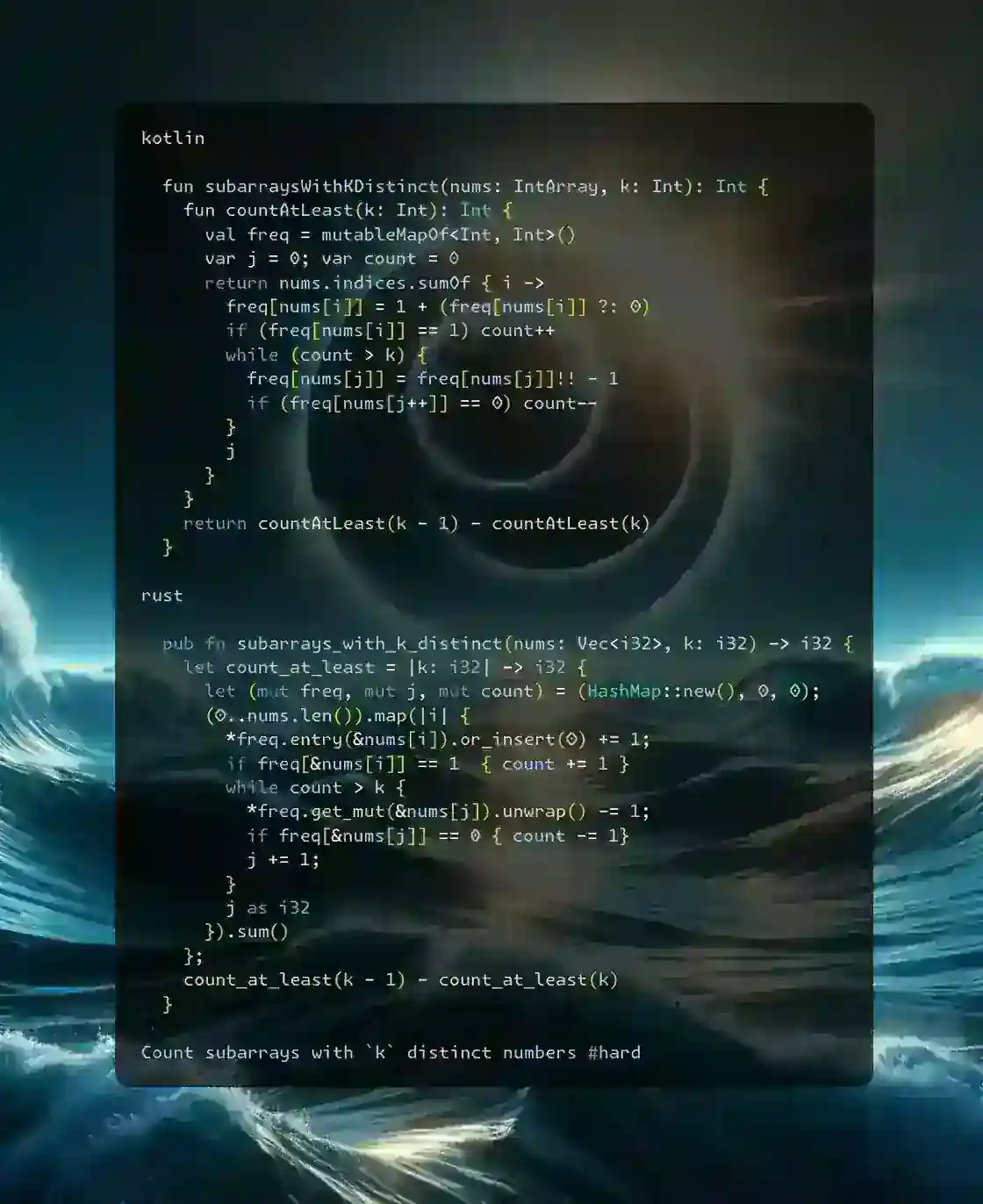
  fun subarraysWithKDistinct(nums: IntArray, k: Int): Int {
    fun countAtLeast(k: Int): Int {
      val freq = mutableMapOf<Int, Int>()
      var j = 0; var count = 0
      return nums.indices.sumOf { i ->
        freq[nums[i]] = 1 + (freq[nums[i]] ?: 0)
        if (freq[nums[i]] == 1) count++
        while (count > k) {
          freq[nums[j]] = freq[nums[j]]!! - 1
          if (freq[nums[j++]] == 0) count--
        }
        j
      }
    }
    return countAtLeast(k - 1) - countAtLeast(k)
  }
  pub fn subarrays_with_k_distinct(nums: Vec<i32>, k: i32) -> i32 {
    let count_at_least = |k: i32| -> i32 {
      let (mut freq, mut j, mut count) = (HashMap::new(), 0, 0);
      (0..nums.len()).map(|i| {
        *freq.entry(&nums[i]).or_insert(0) += 1;
        if freq[&nums[i]] == 1  { count += 1 }
        while count > k {
          *freq.get_mut(&nums[j]).unwrap() -= 1;
          if freq[&nums[j]] == 0 { count -= 1}
          j += 1;
        }
        j as i32
      }).sum()
    };
    count_at_least(k - 1) - count_at_least(k)
  }
Comments