LeetCode Entry
85. Maximal Rectangle
Max 1-only area in a 0-1 matrix
85. Maximal Rectangle hard
blog post
substack
youtube
Join me on Telegram
https://t.me/leetcode_daily_unstoppable/570
Problem TLDR
Max 1-only area in a 0-1 matrix #hard
Intuition
The n^4 solution is kind of trivial, just precompute the prefix sums, then do some geometry:
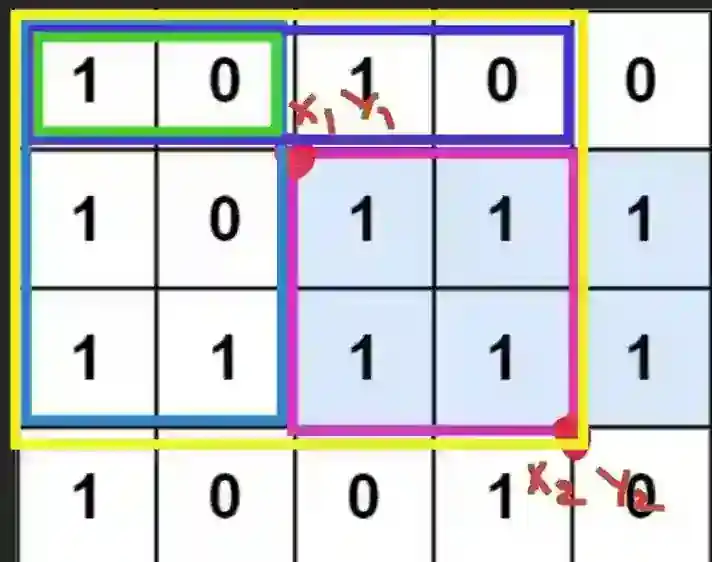
The trick here is to observe a subproblem (https://leetcode.com/problems/largest-rectangle-in-histogram/):
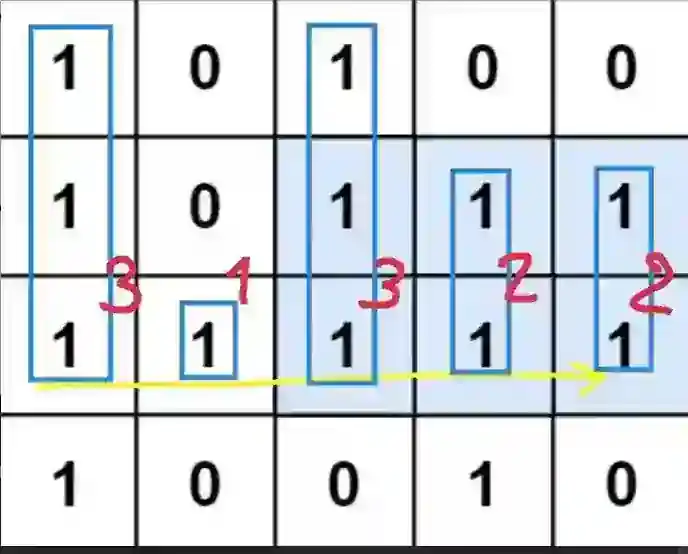 This can be solved using a
 Monotonic Increasing Stack technique:
    //i0 1 2 3 4
    // 3 1 3 2 2
    //0*          3
    //1  *        1
    //2    *      1 3
    //3      *    1 3 2  -> 1 2
    //4        *  1 2 2
    //           * empty
Pop all positions smaller than the current heights. Careful with the area calculation though, the height will be the popping one, and the width is a distance between popped and a new top.
Approach
There are some tricks:
- using a sentinel 0-height at the end of
hwill help to save some lines of code - Stack object can be reused
Complexity
-
Time complexity: \(O(nm)\)
-
Space complexity: \(O(m)\)
Code
```kotlin []
fun maximalRectangle(matrix: Array<CharArray>): Int = with(Stack<Int>()) {
    val h = IntArray(matrix[0].size + 1)
    var max = 0
    for (y in matrix.indices) for (x in h.indices) {
        if (x < h.size - 1) h[x] = if (matrix[y][x] > '0') 1 + h[x] else 0
        while (size > 0 && h[peek()] > h[x])
            max = max(max, h[pop()] * if (size > 0) x - peek() - 1 else x)
        if (x < h.size - 1) push(x) else clear()
    }
    max
}
```rust

    pub fn maximal_rectangle(matrix: Vec<Vec<char>>) -> i32 {
        let (mut st, mut h, mut max) = (vec![], vec![0; matrix[0].len() + 1], 0);
        for y in 0..matrix.len() {
            for x in 0..h.len() {
                if x < h.len() - 1 { h[x] = if matrix[y][x] > '0' { 1 + h[x] } else { 0 }}
                while st.len() > 0 && h[*st.last().unwrap()] > h[x] {
                    let l = st.pop().unwrap();
                    max = max.max(h[l] * if st.len() > 0 { x - *st.last().unwrap() - 1 } else { x })
                }
                if x < h.len() - 1 { st.push(x) } else { st.clear() }
            }
        }
        max as i32
    }
Comments