LeetCode Entry
2370. Longest Ideal Subsequence
Max length of less than k adjacent subsequence programming
2370. Longest Ideal Subsequence medium
blog post
substack
youtube
Join me on Telegram
https://t.me/leetcode_daily_unstoppable/583
Problem TLDR
Max length of less than k adjacent subsequence #medium #dynamic_programming
Intuition
Examining some examples, we see some properties:
    // acfgbd   k=2
    // a             a
    //  c            ac
    //   f           f
    //    g          fg
    //     b         acb
    //      d        acbd
- we must be able to backtrack to the previous subsequences, so this is full search or at least memoization problem
- at particular position, we know the result for the suffix given the starting char, so we know 26 results
- we can memoise it by (pos, char) key
Approach
There are some optimizations:
- current result only depends on the next result, so only [26] results are needed
- we can rewrite memoisation recursion with iterative for-loop
- changing the direction of loop is irrelevant, so better iterate forward for cache friendliness
- the clever trick is to consider only adjacent
kchars and only update the current char
Complexity
-
Time complexity: \(O(n)\), assuming the alphabet size is constant
-
Space complexity: \(O(1)\)
Code
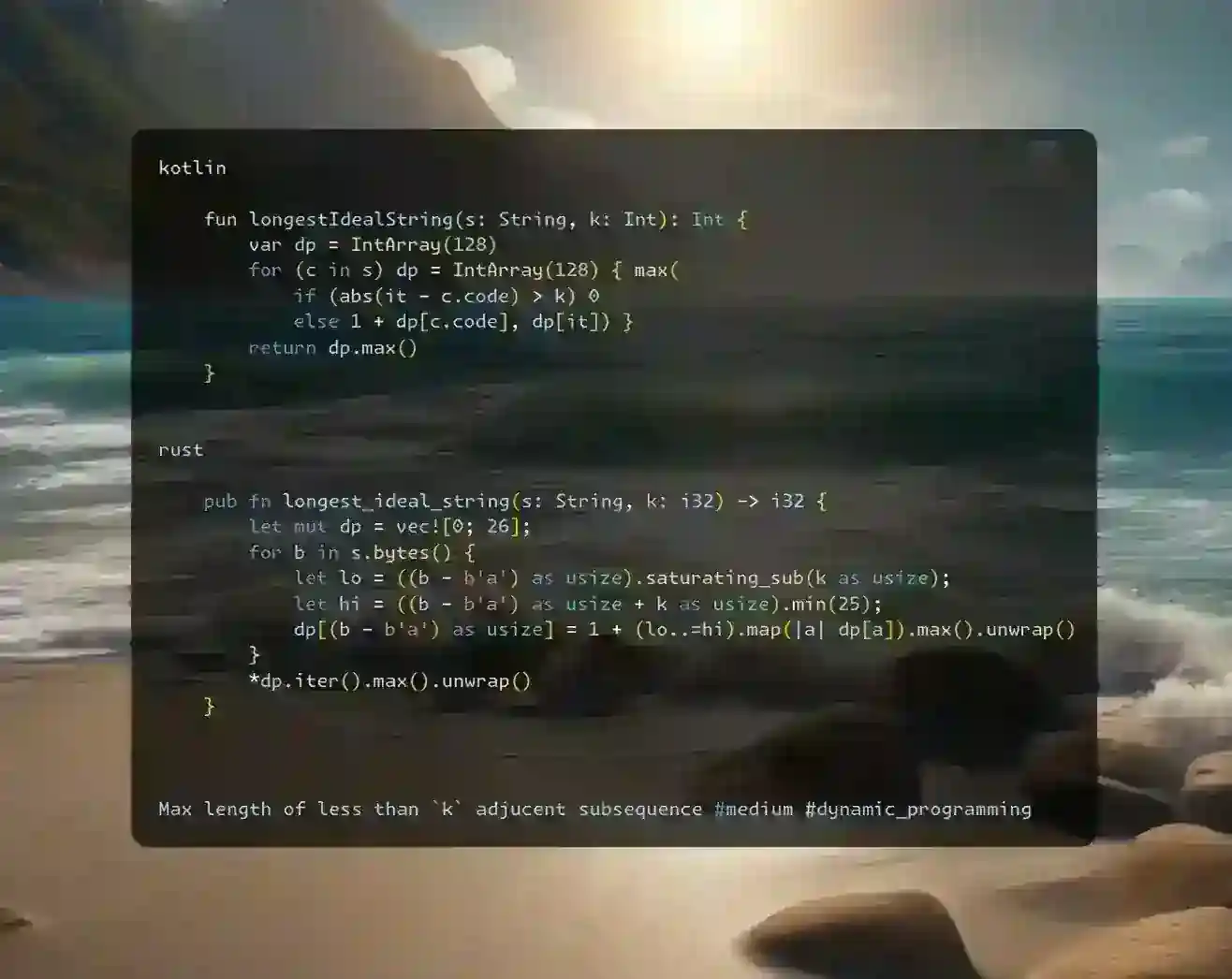
    fun longestIdealString(s: String, k: Int): Int {
        var dp = IntArray(128)
        for (c in s) dp = IntArray(128) { max(
            if (abs(it - c.code) > k) 0
            else 1 + dp[c.code], dp[it]) }
        return dp.max()
    }
    pub fn longest_ideal_string(s: String, k: i32) -> i32 {
        let mut dp = vec![0; 26];
        for b in s.bytes() {
            let lo = ((b - b'a') as usize).saturating_sub(k as usize);
            let hi = ((b - b'a') as usize + k as usize).min(25);
            dp[(b - b'a') as usize] = 1 + (lo..=hi).map(|a| dp[a]).max().unwrap()
        }
        *dp.iter().max().unwrap()
    }
Comments