LeetCode Entry
1915. Number of Wonderful Substrings
Count substrings with at most one odd frequency manipulation
1915. Number of Wonderful Substrings medium
blog post
substack
youtube
Join me on Telegram
https://t.me/leetcode_daily_unstoppable/588
Problem TLDR
Count substrings with at most one odd frequency #medium #bit_manipulation
Intuition
This is a hard problem. Let’s try to look at the problem with our bare hands:
    // aba
    // a     a
    // ab    -
    //  b    b
    //  ba   -
    // aba   aba

    // aab
    // a     +    xor = a
    // aa    +    xor = 0
    //  a    +    xor = a
    // aab   +    xor = b
    //  ab   -    xor = ab
    //   b   +    xor = b
    //   * = (aa, a) + b

    // dp or two-pointers?
    // dp: f(aabb) = f(aab)? + b
    // two pointers:
    // aabb
    //    i  move i: a + a + b + b + aa + aab + aabb
    //    j  move j: abb + bb
    //  skip ab?
We quickly run out of possible solutions patterns: neither dp or two pointers approach would work. However, there are some thoughts:
- only odd-even matters, so, we can somehow use
xor xorworks well for intervali..jwhen we pre-compute all the prefixes:xor i..j = xor 0..j xor xor 0..i
This is where my brain has stopped, and I used the hints:
- use prefix’s bitmask, as we only have
10unique chars
Let’s try to make use of the prefix’s bitmasks:
    // bitmask           00
    // a                 01
    //  a                00
    //   b               10  m[ab] = m[aab] xor m[a]
    //    b              00  m[abb] = m[aabb] xor m[a]
    //     how many previous masks have mismatched bits?
    //                                  ~~~~~~~~~~
We know the current prefix’s bitmask m and our interest is how many subarrays on the left are good. We can xor with all the previous masks to find out the xor result of subarrays: this result must have at most one 1 bit. We can compress this search by putting unique masks in a counter HashMap.
    // mismatched = differs 1 bit or equal
    //
    // ab                m
    //                   00
    // a                 01 +1(00)
    //  b                11 +1(01)

    // 0123
    // aabb              m   res
    //                   00
    //0a                 01  +1(00)
    //1 a                00  +2(00,01)
    //2  b               10  +2(00,00)
    //3   b              00  +4(00,01,00,10)
    //
Approach
- Another neat trick: we don’t have to check all the masks from a HashMap, just check by changing every of the
10bits of mask. - array is faster, we have at most
2^10unique bits combinations
Complexity
-
Time complexity: \(O(n)\)
-
Space complexity: \(O(2^k)\), k - is an alphabet, at most 2^10 masks total
Code
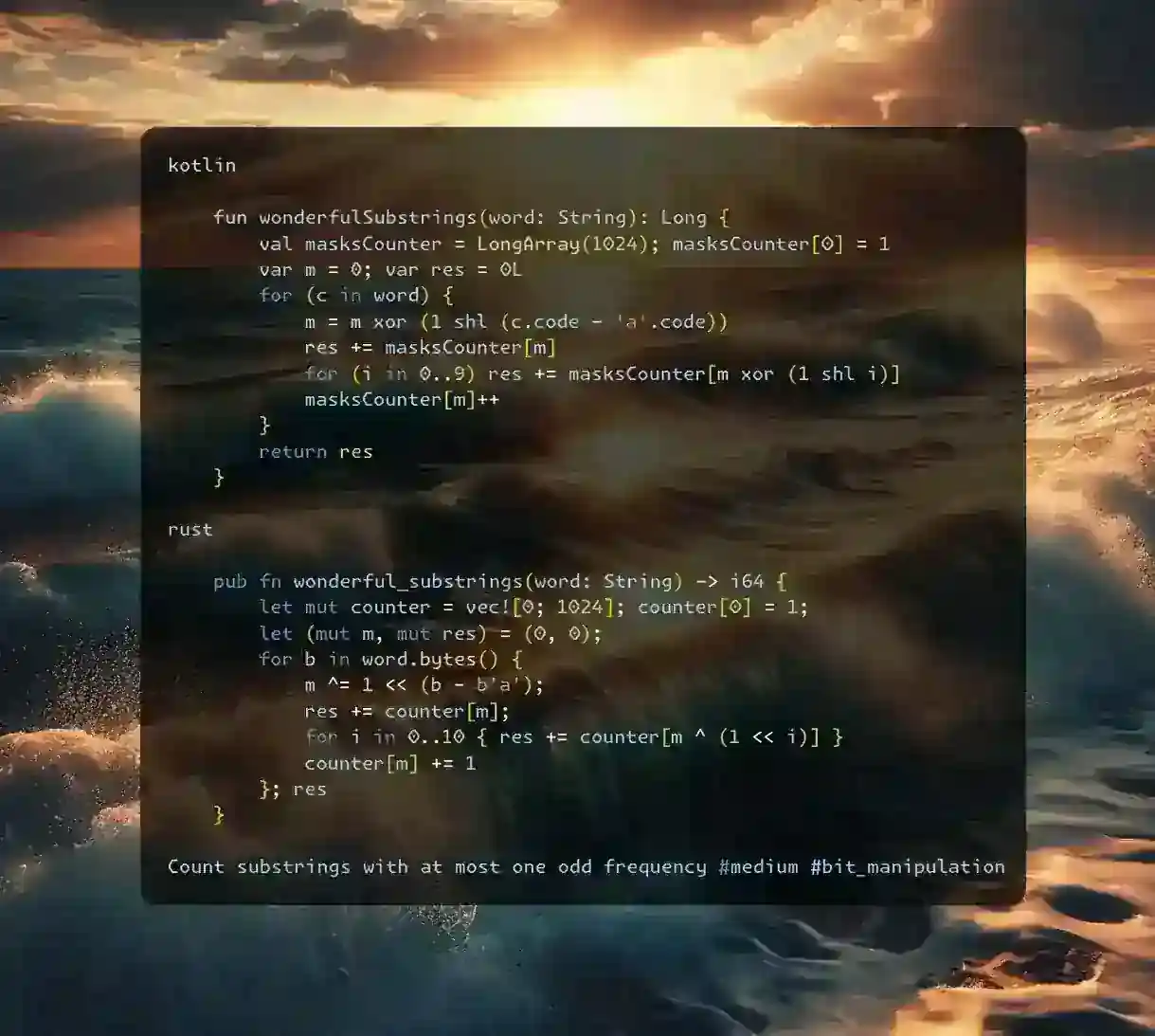
    fun wonderfulSubstrings(word: String): Long {
        val masksCounter = LongArray(1024); masksCounter[0] = 1
        var m = 0; var res = 0L
        for (c in word) {
            m = m xor (1 shl (c.code - 'a'.code))
            res += masksCounter[m]
            for (i in 0..9) res += masksCounter[m xor (1 shl i)]
            masksCounter[m]++
        }
        return res
    }
    pub fn wonderful_substrings(word: String) -> i64 {
        let mut counter = vec![0; 1024]; counter[0] = 1;
        let (mut m, mut res) = (0, 0);
        for b in word.bytes() {
            m ^= 1 << (b - b'a');
            res += counter[m];
            for i in 0..10 { res += counter[m ^ (1 << i)] }
            counter[m] += 1
        }; res
    }
Comments