LeetCode Entry
3075. Maximize Happiness of Selected Children
Sum of k maximums decreasing each step
3075. Maximize Happiness of Selected Children medium
blog post
substack
youtube
Join me on Telegram
https://t.me/leetcode_daily_unstoppable/597
Problem TLDR
Sum of k maximums decreasing each step #medium #sorting #heap #quickselect
Intuition
By the problem definition we may assume that optimal solution is to take the largest values first, as smaller values will not decrease the result after reaching zero.
There are several ways to take k largest values: sort the entire array, use Heap (PriorityQueue) or use QuickSelect and sort partially.
Approach
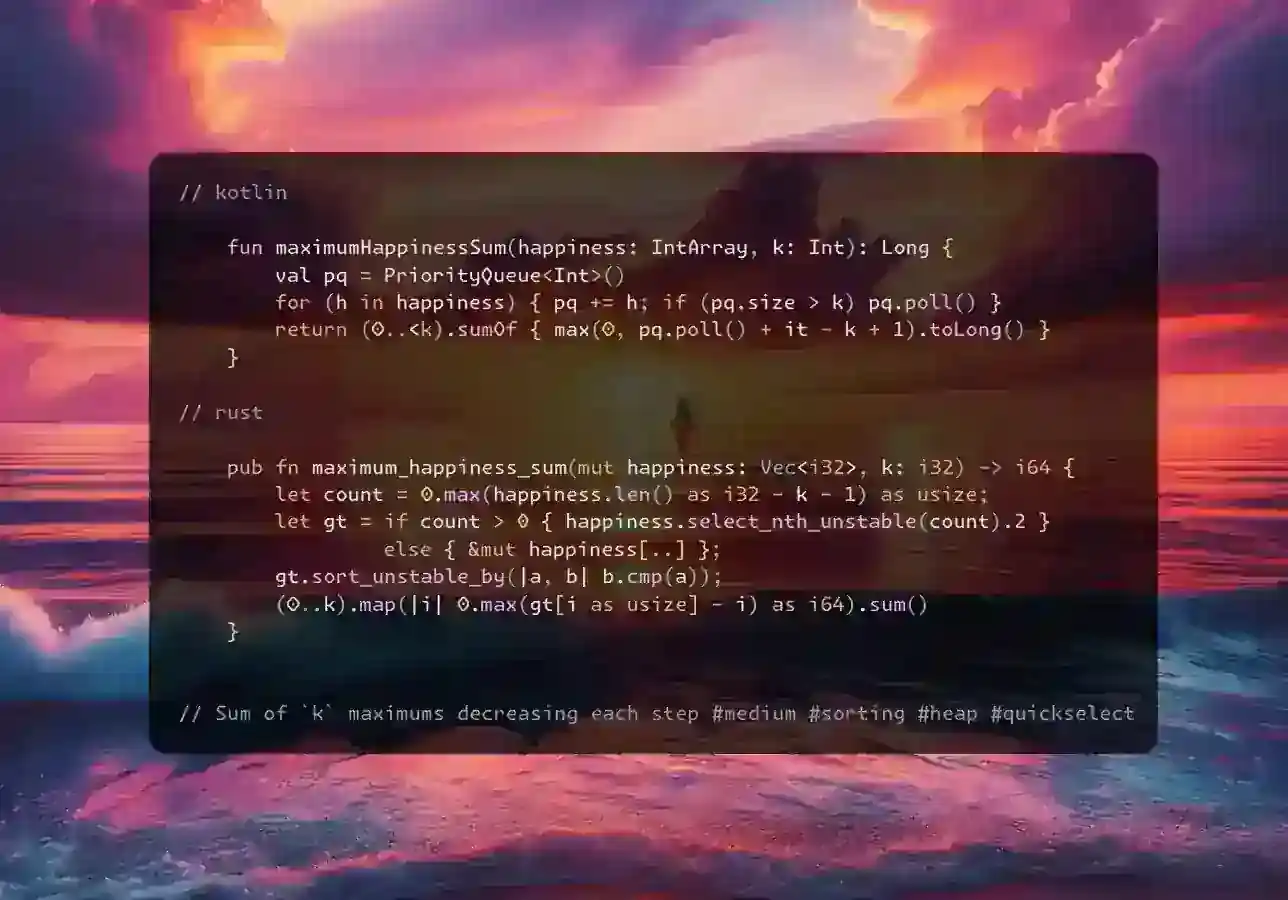
Let’s use PriorityQueue in Kotlin (min heap) and QuickSelect in Rust (select_nth_unstable).
- when using heap we can take at most
kvalues into it to save space and time - Rust’s
select_nth_unstableresult tuple is not very easy to use (do you know a better way?)
Complexity
-
Time complexity: \(O(n + klog(k))\) for the Heap and for the QuickSelect
-
Space complexity: \(O(n)\) for the Heap, \(O(1)\) for the QuickSelect
Code
    fun maximumHappinessSum(happiness: IntArray, k: Int): Long {
        val pq = PriorityQueue<Int>()
        for (h in happiness) { pq += h; if (pq.size > k) pq.poll() }
        return (0..<k).sumOf { max(0, pq.poll() + it - k + 1).toLong() }
    }
    pub fn maximum_happiness_sum(mut happiness: Vec<i32>, k: i32) -> i64 {
        let count = 0.max(happiness.len() as i32 - k - 1) as usize;
        let gt = if count > 0 { happiness.select_nth_unstable(count).2 }
                 else { &mut happiness[..] };
        gt.sort_unstable_by(|a, b| b.cmp(a));
        (0..k).map(|i| 0.max(gt[i as usize] - i) as i64).sum()
    }
Comments