LeetCode Entry
131. Palindrome Partitioning
All palindrome partitions programming
131. Palindrome Partitioning medium
blog post
substack
youtube
Join me on Telegram
https://t.me/leetcode_daily_unstoppable/610
Problem TLDR
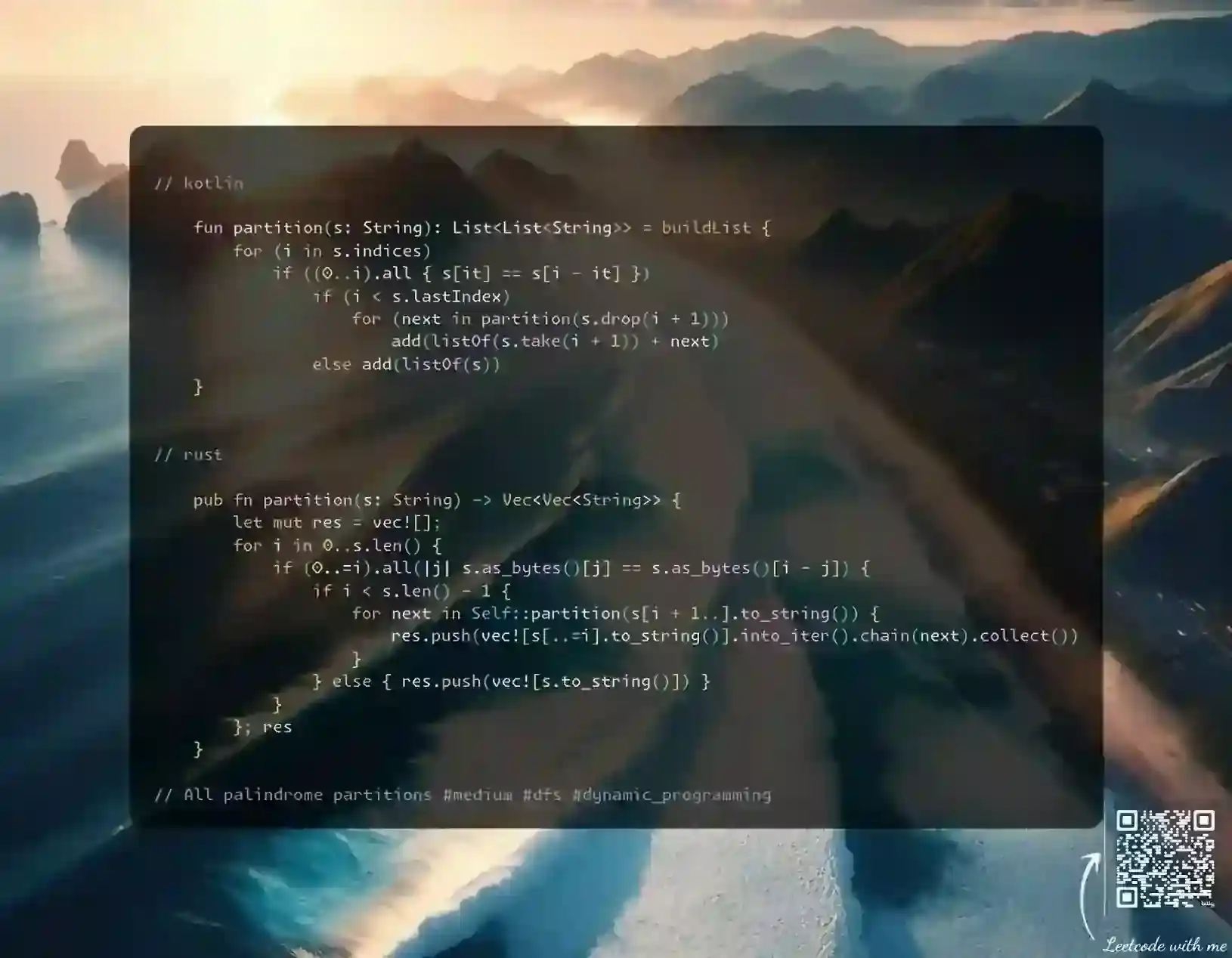
All palindrome partitions #medium #dfs #dynamic_programming
Intuition
The backtracking solution is trivial: do a full Depth-First Search over indices, take substring start..i if it is a palindrome, collect at the end. We can also precalculate all palindromes in a dp[i][j] = s[i] == s[j] && dp[i + 1][j - 1]
Approach
However, there is a clever approach to reuse the existing method signature: we can define Dynamic Programming problem as a subproblem for the palindrome_substring + DP(rest of the string). Where + operation would include current palindrome substring in all the suffix’s solutions.
Given the problem size, let’s skip the memoization part to save lines of code (weird decision for the interview).
Complexity
-
Time complexity: \(O(2^n)\), the worst case is
aaaaaall chars the same -
Space complexity: \(O(2^n)\)
Code
    fun partition(s: String): List<List<String>> = buildList {
        for (i in s.indices)
            if ((0..i).all { s[it] == s[i - it] })
                if (i < s.lastIndex)
                    for (next in partition(s.drop(i + 1)))
                        add(listOf(s.take(i + 1)) + next)
                else add(listOf(s))
    }
    pub fn partition(s: String) -> Vec<Vec<String>> {
        let mut res = vec![];
        for i in 0..s.len() {
            if (0..=i).all(|j| s.as_bytes()[j] == s.as_bytes()[i - j]) {
                if i < s.len() - 1 {
                    for next in Self::partition(s[i + 1..].to_string()) {
                        res.push(vec![s[..=i].to_string()].into_iter().chain(next).collect())
                    }
                } else { res.push(vec![s.to_string()]) }
            }
        }; res
    }
Comments