LeetCode Entry
2597. The Number of Beautiful Subsets
Count subsets without k difference in them
2597. The Number of Beautiful Subsets medium
blog post
substack
youtube
Join me on Telegram
https://t.me/leetcode_daily_unstoppable/611
Problem TLDR
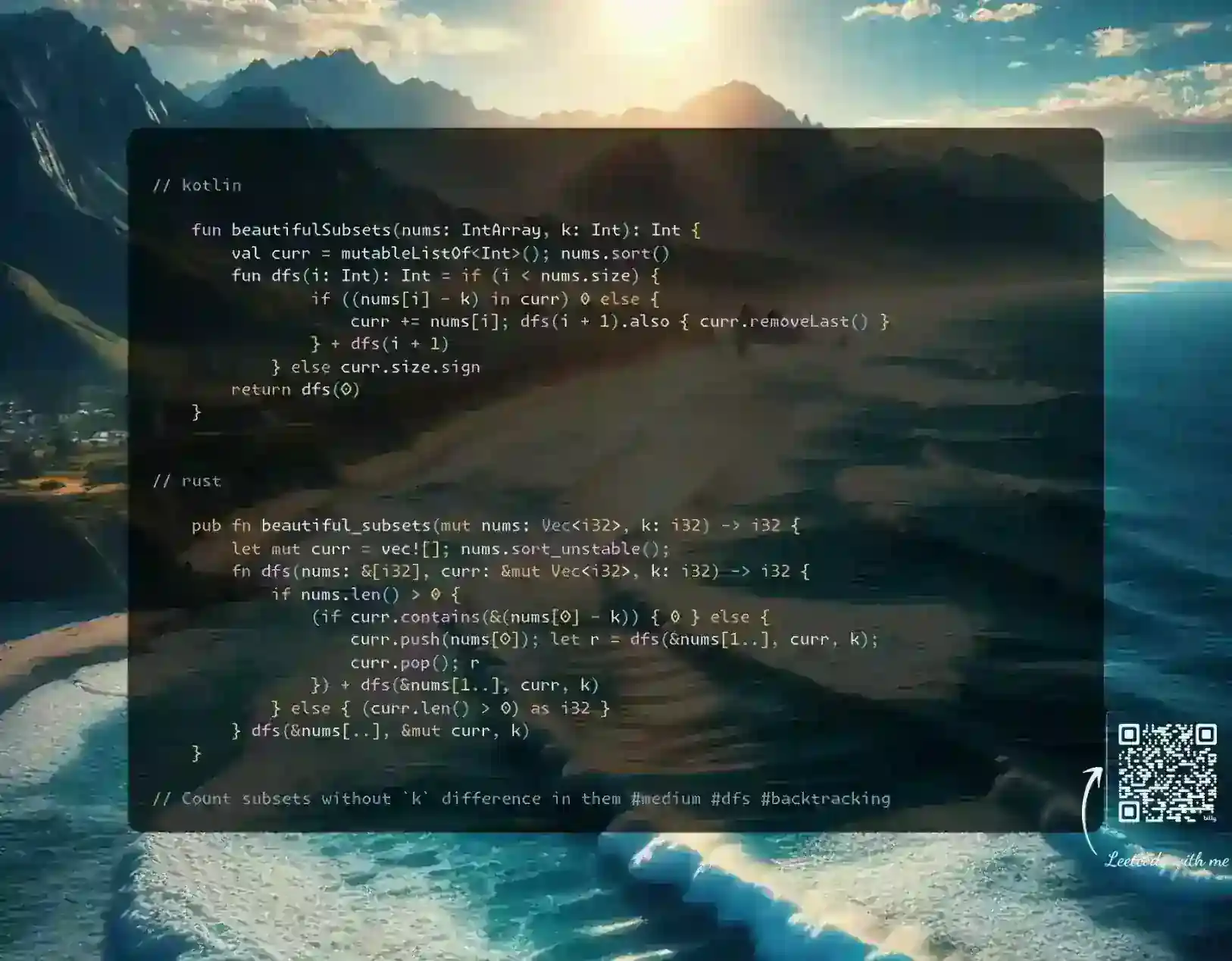
Count subsets without k difference in them #medium #dfs #backtracking
Intuition
There are a DP solutions, but a simple brute-force backtracking is also works. Do a Depth-First search, check element (n-k) not added, add element, go deeper, remove element. To get the intuition about how to count subsets, consider this example:
// 1 1 1 =(111)+(1)+(1)+(1)+(11)+(11)+(11)
For each subset of size n there are 2^n - 1 subsets. We can sum the on the finish line, or just add on the fly.
One way to optimize this is to use a HashMap and a counter instead of just list. Another optimization is a bitmask instead of list.
Approach
Some tricks here:
- sorting to check just the lower num
n - k signto shorten theif (size > ) 1 else 0as i32do the same in Rust[i32]slice and[1..]next window without the index variable
Complexity
-
Time complexity: \(O(n2^n)\)
-
Space complexity: \(O(n)\)
Code
    fun beautifulSubsets(nums: IntArray, k: Int): Int {
        val curr = mutableListOf<Int>(); nums.sort()
        fun dfs(i: Int): Int = if (i < nums.size) {
                if ((nums[i] - k) in curr) 0 else {
                    curr += nums[i]; dfs(i + 1).also { curr.removeLast() }
                } + dfs(i + 1)
            } else curr.size.sign
        return dfs(0)
    }
    pub fn beautiful_subsets(mut nums: Vec<i32>, k: i32) -> i32 {
        let mut curr = vec![]; nums.sort_unstable();
        fn dfs(nums: &[i32], curr: &mut Vec<i32>, k: i32) -> i32 {
            if nums.len() > 0 {
                (if curr.contains(&(nums[0] - k)) { 0 } else {
                    curr.push(nums[0]); let r = dfs(&nums[1..], curr, k);
                    curr.pop(); r
                }) + dfs(&nums[1..], curr, k)
            } else { (curr.len() > 0) as i32 }
        } dfs(&nums[..], &mut curr, k)
    }
Comments