LeetCode Entry
552. Student Attendance Record II
N times: A -> LP, L -> AP, P -> AL, at most one A, no LLL programming
552. Student Attendance Record II hard blog post substack youtube
Join me on Telegram
https://t.me/leetcode_daily_unstoppable/618
Problem TLDR
N times: A -> LP, L -> AP, P -> AL, at most one A, no LLL #hard #dynamic_programming
Intuition
The key to solving this is to detect each kind of a unique generator. From this example we can separate several unique rules - a, l, p, al, ll, all:
    // 1 -> A L P
    //      good = 3
    //      a = 1 l = 1 p = 1
    // 2 ->
    //    a A -> AP AL (AA)
    //    l L -> LP LL LA
    //    p P -> PP PL PA
    //      good = 8
    //      a = 3    l = 1    p = 2   al = 1   ll = 1
    //    a AP     p PL     l LP    a AL     l LL
    //    l LA              p PP
    //    p PA
    //
    // 3 ->
    //   a  AP -> APP APL(APA)
    //  al  AL -> ALP ALL(ALA)
    //   p  LP -> LPP LPL LPA
    //  ll  LL -> LLP(LLL)LLA
    //   a  LA -> LAP LAL(LAA)
    //   p  PP -> PPP PPL PPA
    //   l  PL -> PLP PLL PLA
    //   a  PA -> PAP PAL(PAA)
    //      good = 19
    //      a = 8    l = 2     p = 4    al = 3    ll = 1    all = 1
    //   a  APP    p LPL    p  LPP    a APL     l PLL    al ALL
    //  al  ALP    p PPL    ll LLP    a LAL
    //  ll  LLA             p  PPP    a PAL
    //   a  LAP             l  PLP
    //   p  PPA
    //   l  PLA
    //   a  PAP
    //   p  LPA
    //
    //   a1 = (a + l + p + al + ll + all)
    //                     p1 = (p + l + ll)
    //                                         ll = l
    //            l = p
    //                                                  all = al
    //                               al = a
These rules can be described as the kingdoms where each have a unique properties:
a- theonly one 'a' possiblekingdom rule, it will not allow any otherato happenl- theending with 'l'rule, will generatellin the next roundp- theI am a simple guy here, abide all the rulesruleal- thebusy guy, he will makeallin the next round, also noais allowed nextll- theguard, will not permitlin the next roundall- theserial killer, noland noawill survive next round
After all the rules are detected, we have to notice the pattern of how they pass to the next round.
Approach
Somebody find this problem easy, but I have personally failed to detect those rules under 1.5 hours mark.
Complexity
-
Time complexity: \(O(n)\)
-
Space complexity: \(O(1)\)
Code
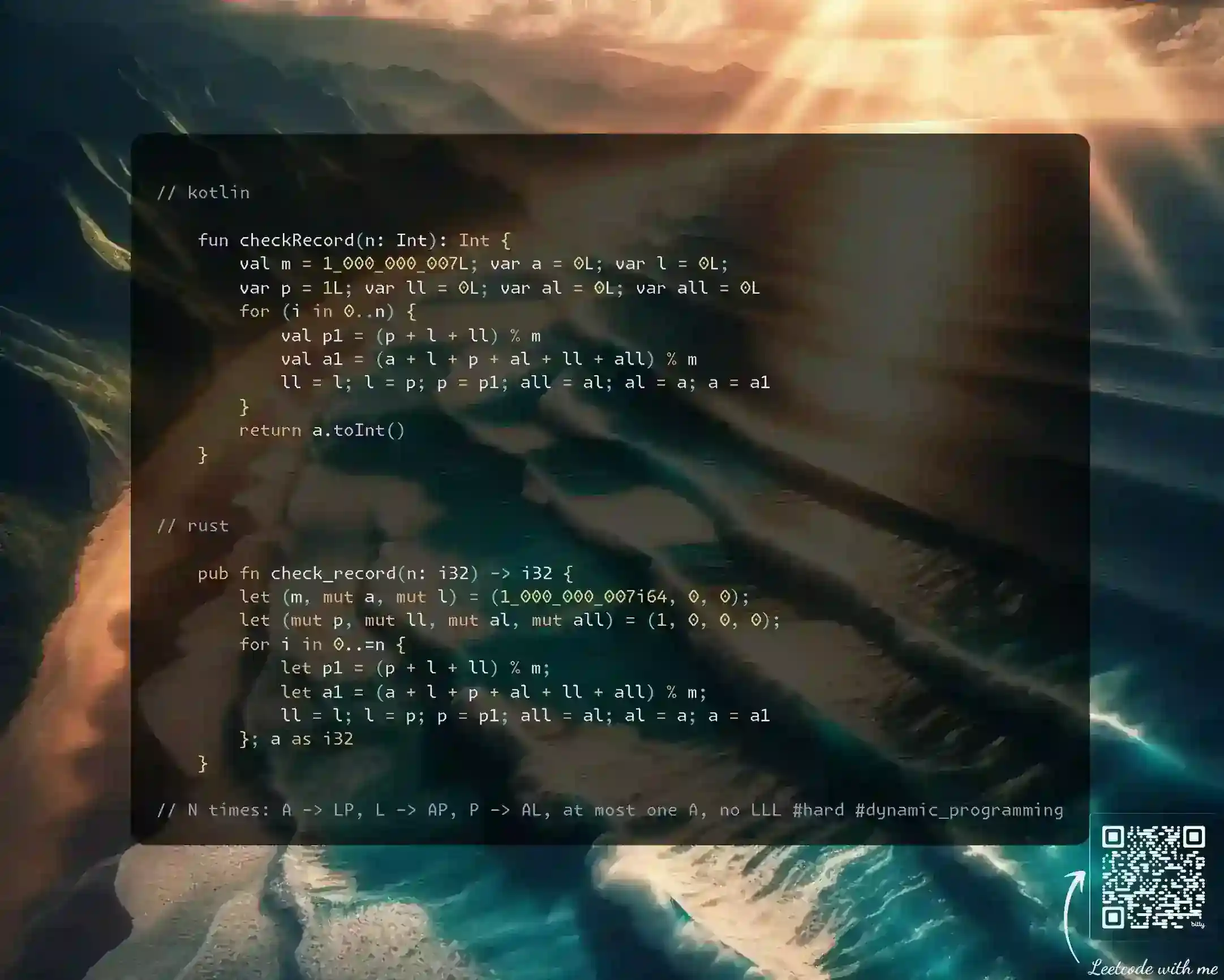
    fun checkRecord(n: Int): Int {
        val m = 1_000_000_007L; var a = 0L; var l = 0L;
        var p = 1L; var ll = 0L; var al = 0L; var all = 0L
        for (i in 0..n) {
            val p1 = (p + l + ll) % m
            val a1 = (a + l + p + al + ll + all) % m
            ll = l; l = p; p = p1; all = al; al = a; a = a1
        }
        return a.toInt()
    }
    pub fn check_record(n: i32) -> i32 {
        let (m, mut a, mut l) = (1_000_000_007i64, 0, 0);
        let (mut p, mut ll, mut al, mut all) = (1, 0, 0, 0);
        for i in 0..=n {
            let p1 = (p + l + ll) % m;
            let a1 = (a + l + p + al + ll + all) % m;
            ll = l; l = p; p = p1; all = al; al = a; a = a1
        }; a as i32
    }
Comments