LeetCode Entry
523. Continuous Subarray Sum
Any subarray sum % k = 0
523. Continuous Subarray Sum medium
blog post
substack
youtube
Join me on Telegram
https://t.me/leetcode_daily_unstoppable/633
Problem TLDR
Any subarray sum % k = 0 #medium #hashmap
Intuition
Let’s observe the problem examples:
    // 5 0 0 0       k = 3   true?? --> [0 0] % 3 = 0
    //
    // 23   2   6   2   5    k = 8
    // 23                    23 % 8 = 0
    //     25                25 % 8 = 7
    //         31            31 % 8 = 7  (31-25)%8=31%8-25%8=0
    //             33
    //                 38
    //
    // 0 1 0 3 0 4 0 4 0  k = 7
    // 23 2   4  6  6
    // 23
    //    25
    //       29
    //          35
We can’t just use two pointers here, because every subarray to the left can give the result in the future.
However, we can store subarray sums. But what to do with them next? If we look at example 23 2 6 2 5, k = 8, subarray [2 6] is good, and it is made from sums 31 and 23: 31 - 23 = 8 -> (31 - 23) % k = 8 % k -> 31 % k - 23 % k = k % k = 0 -> 31 % k == 23 % k. So, our subarray sums % k must be equal for subarray between them be good.
The corener cases:
- For the case
5 0 0 0result is true because there is[0, 0]subarray which gives0 % k = 0. That mean, we should store the first occurence index to check the length later. - For the case
2 6, k = 8we must consider entire array, so we must store the first occurence of0at position-1.
Approach
getOrPutandentry.or_insertin Kotlin & Rust saves us some keystrokes
Complexity
-
Time complexity: \(O(n)\)
-
Space complexity: \(O(n)\)
Code
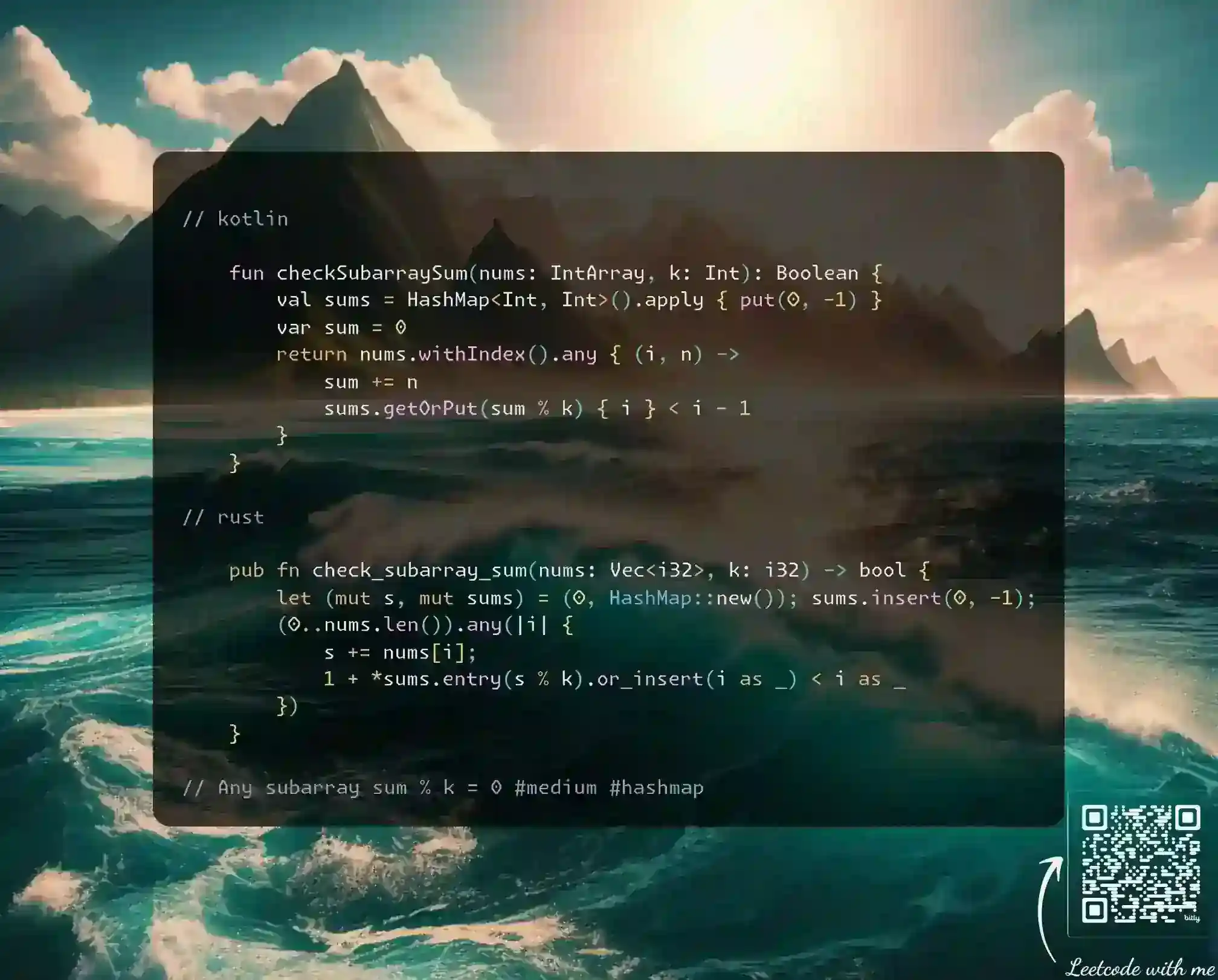
    fun checkSubarraySum(nums: IntArray, k: Int): Boolean {
        val sums = HashMap<Int, Int>().apply { put(0, -1) }
        var sum = 0
        return nums.withIndex().any { (i, n) ->
            sum += n
            sums.getOrPut(sum % k) { i } < i - 1
        }
    }
    pub fn check_subarray_sum(nums: Vec<i32>, k: i32) -> bool {
        let (mut s, mut sums) = (0, HashMap::new()); sums.insert(0, -1);
        (0..nums.len()).any(|i| {
            s += nums[i];
            1 + *sums.entry(s % k).or_insert(i as _) < i as _
        })
    }
Comments