LeetCode Entry
40. Combination Sum II
Unique target sum subsequences
40. Combination Sum II medium
blog post
substack
youtube
Join me on Telegram
https://t.me/leetcode_daily_unstoppable/701
Problem TLDR
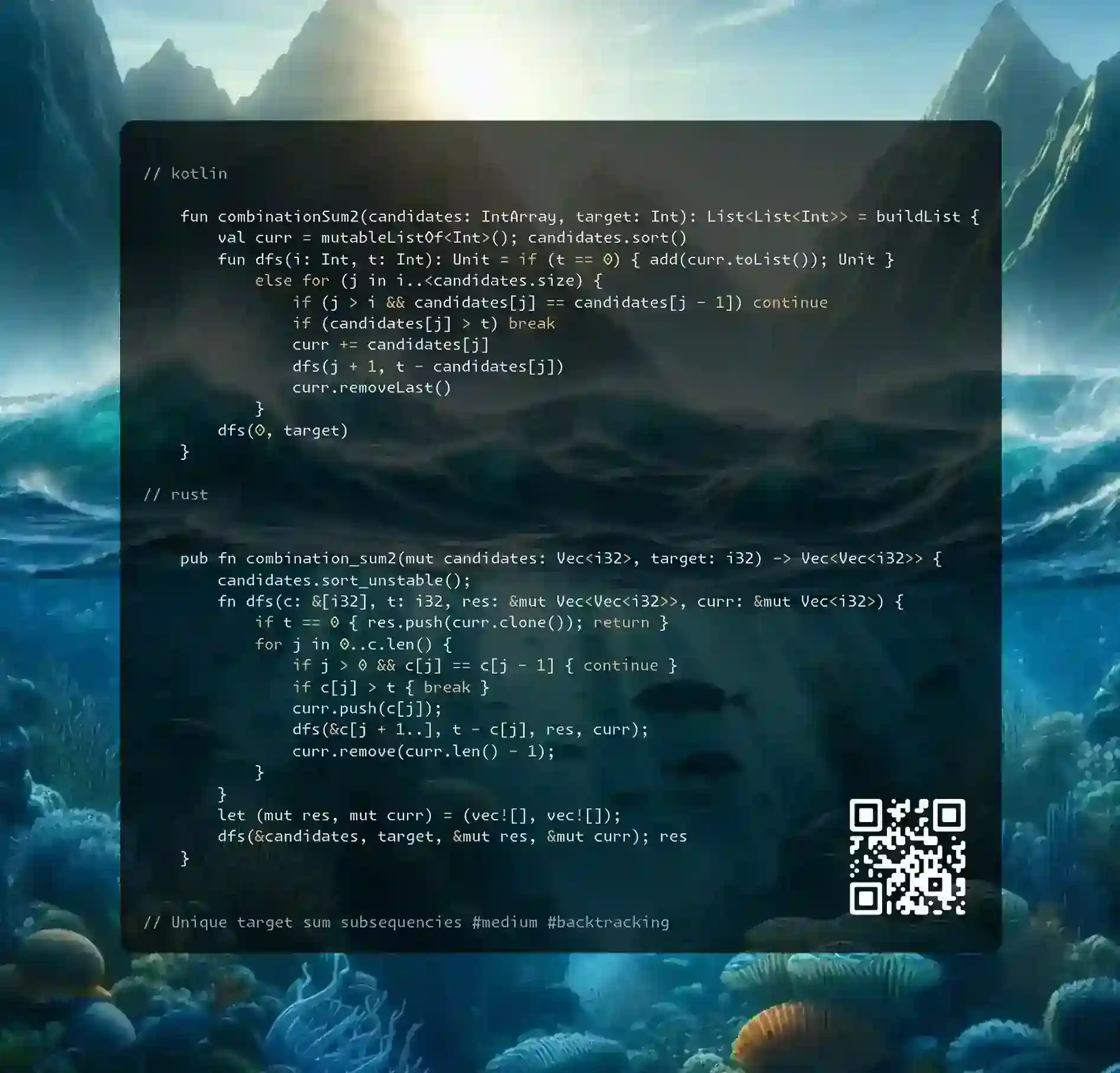
Unique target sum subsequences #medium #backtracking
Intuition
Let’s start from the brute force backtracking solution: start with some index and choose which index would be the next.
The interesting part is how to handle duplicates. Simple HashSet gives TLE.
Let’s look at the example 1 1 1 2: each 1 start the same sequence 1 2, so we can skip the second and the third 1’s.
Approach
- we can use slices in Rust instead of a pointer
- minor optimization is breaking early when the sum is overflown
Complexity
-
Time complexity: \(O(n^n)\)
-
Space complexity: \(O(n^n)\)
Code
    fun combinationSum2(candidates: IntArray, target: Int): List<List<Int>> = buildList {
        val curr = mutableListOf<Int>(); candidates.sort()
        fun dfs(i: Int, t: Int): Unit = if (t == 0) { add(curr.toList()); Unit }
            else for (j in i..<candidates.size) {
                if (j > i && candidates[j] == candidates[j - 1]) continue
                if (candidates[j] > t) break
                curr += candidates[j]
                dfs(j + 1, t - candidates[j])
                curr.removeLast()
            }
        dfs(0, target)
    }
    pub fn combination_sum2(mut candidates: Vec<i32>, target: i32) -> Vec<Vec<i32>> {
        candidates.sort_unstable();
        fn dfs(c: &[i32], t: i32, res: &mut Vec<Vec<i32>>, curr: &mut Vec<i32>) {
            if t == 0 { res.push(curr.clone()); return }
            for j in 0..c.len() {
                if j > 0 && c[j] == c[j - 1] { continue }
                if c[j] > t { break }
                curr.push(c[j]);
                dfs(&c[j + 1..], t - c[j], res, curr);
                curr.remove(curr.len() - 1);
            }
        }
        let (mut res, mut curr) = (vec![], vec![]);
        dfs(&candidates, target, &mut res, &mut curr); res
    }
Comments