LeetCode Entry
1140. Stone Game II
Max Alice price taking 1..2m piles optimally with Bob programming
1140. Stone Game II medium
blog post
substack
youtube
Join me on Telegram
https://t.me/leetcode_daily_unstoppable/708
Problem TLDR
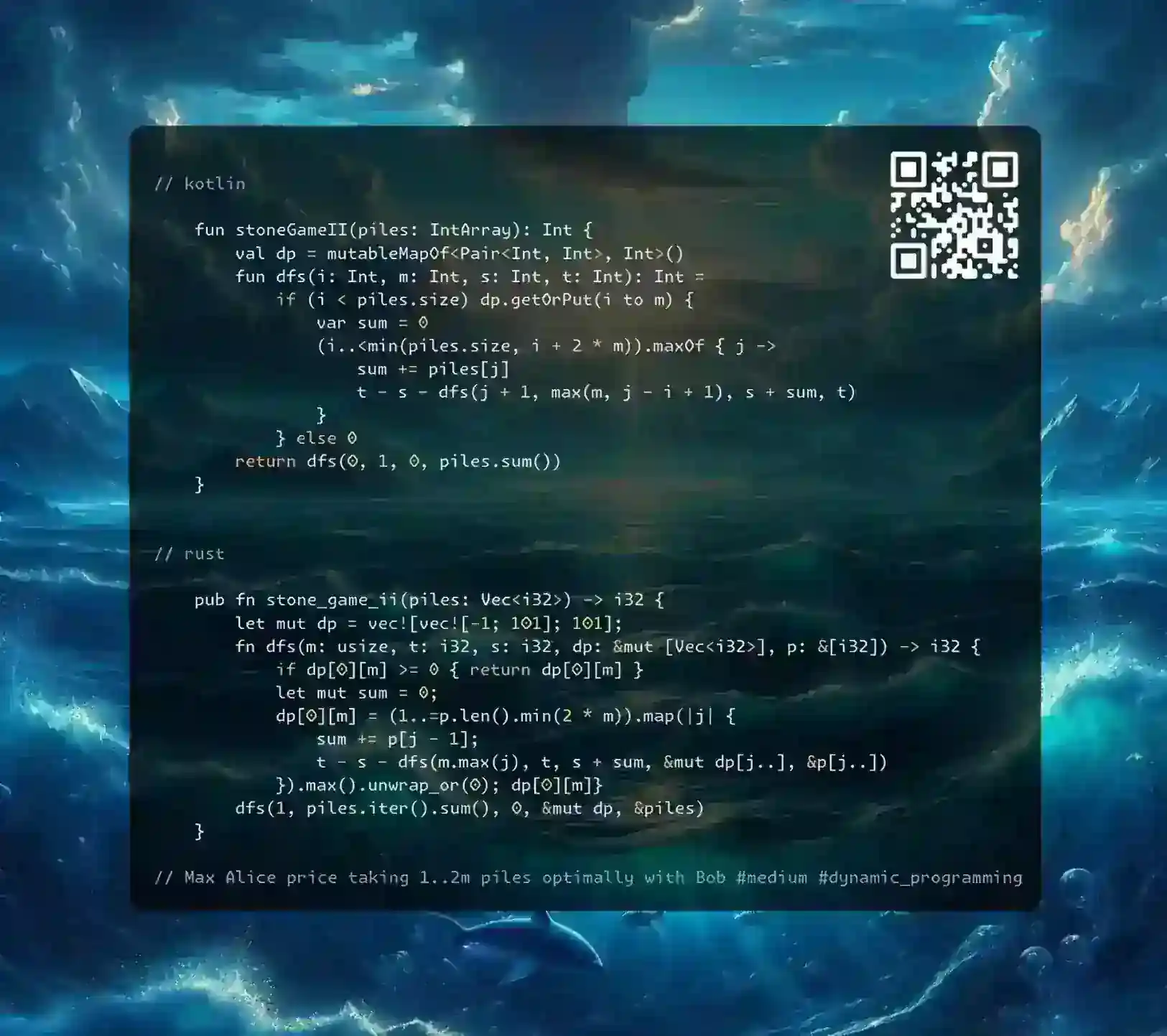
Max Alice price taking 1..2m piles optimally with Bob #medium #dynamic_programming
Intuition
Let’s do a full search with Depth-First Search, choosing how many piles to take to maximize the result. The catch is we should somehow consider the Bob results. One way is to return a pair of Alice and Bob result for the suffix. Anothe approach is some math: total_sum = Alice + Bob, and derive Alice’s next result.
Approach
- we can use slices in Rust
Complexity
-
Time complexity: \(O(n^2)\)
-
Space complexity: \(O(n^2)\)
Code
    fun stoneGameII(piles: IntArray): Int {
        val dp = mutableMapOf<Pair<Int, Int>, Int>()
        fun dfs(i: Int, m: Int, s: Int, t: Int): Int =
            if (i < piles.size) dp.getOrPut(i to m) {
                var sum = 0
                (i..<min(piles.size, i + 2 * m)).maxOf { j ->
                    sum += piles[j]
                    t - s - dfs(j + 1, max(m, j - i + 1), s + sum, t)
                }
            } else 0
        return dfs(0, 1, 0, piles.sum())
    }
    pub fn stone_game_ii(piles: Vec<i32>) -> i32 {
        let mut dp = vec![vec![-1; 101]; 101];
        fn dfs(m: usize, t: i32, s: i32, dp: &mut [Vec<i32>], p: &[i32]) -> i32 {
            if dp[0][m] >= 0 { return dp[0][m] }
            let mut sum = 0;
            dp[0][m] = (1..=p.len().min(2 * m)).map(|j| {
                sum += p[j - 1];
                t - s - dfs(m.max(j), t, s + sum, &mut dp[j..], &p[j..])
            }).max().unwrap_or(0); dp[0][m]}
        dfs(1, piles.iter().sum(), 0, &mut dp, &piles)
    }
Comments