LeetCode Entry
1942. The Number of the Smallest Unoccupied Chair
target's chair number when chairs reused by multiple [arrival, leave] times
1942. The Number of the Smallest Unoccupied Chair medium
blog post
substack
youtube
Join me on Telegram
https://t.me/leetcode_daily_unstoppable/765
Problem TLDR
target's chair number when chairs reused by multiple [arrival, leave] times #medium #sorting #heap
Intuition
Let’s observe what we can do with those intervals:
    // 3,10  1,5  2,6  6,7     t=3
    // 1 2 3 4 5 6 7 8 9 10
    //
    //     0 0 0 0 0 0 0 0   2
    // 1 1 1 1 1             0
    //   2 2 2 2 2           1
    //           3 3         0
The line sweep technique will work here: first sort split each interval into two events arrival and leave, then sort and iterate.
To keep track of the chairs, let’s use some sorted collection: TreeSet or Heap (PriorityQueue).
Approach
- no more than
times.sizechairs total - sort by the
leavefirst to free the chair before arrival at the same time
Complexity
-
Time complexity: \(O(nlog(n))\)
-
Space complexity: \(O(n)\)
Code
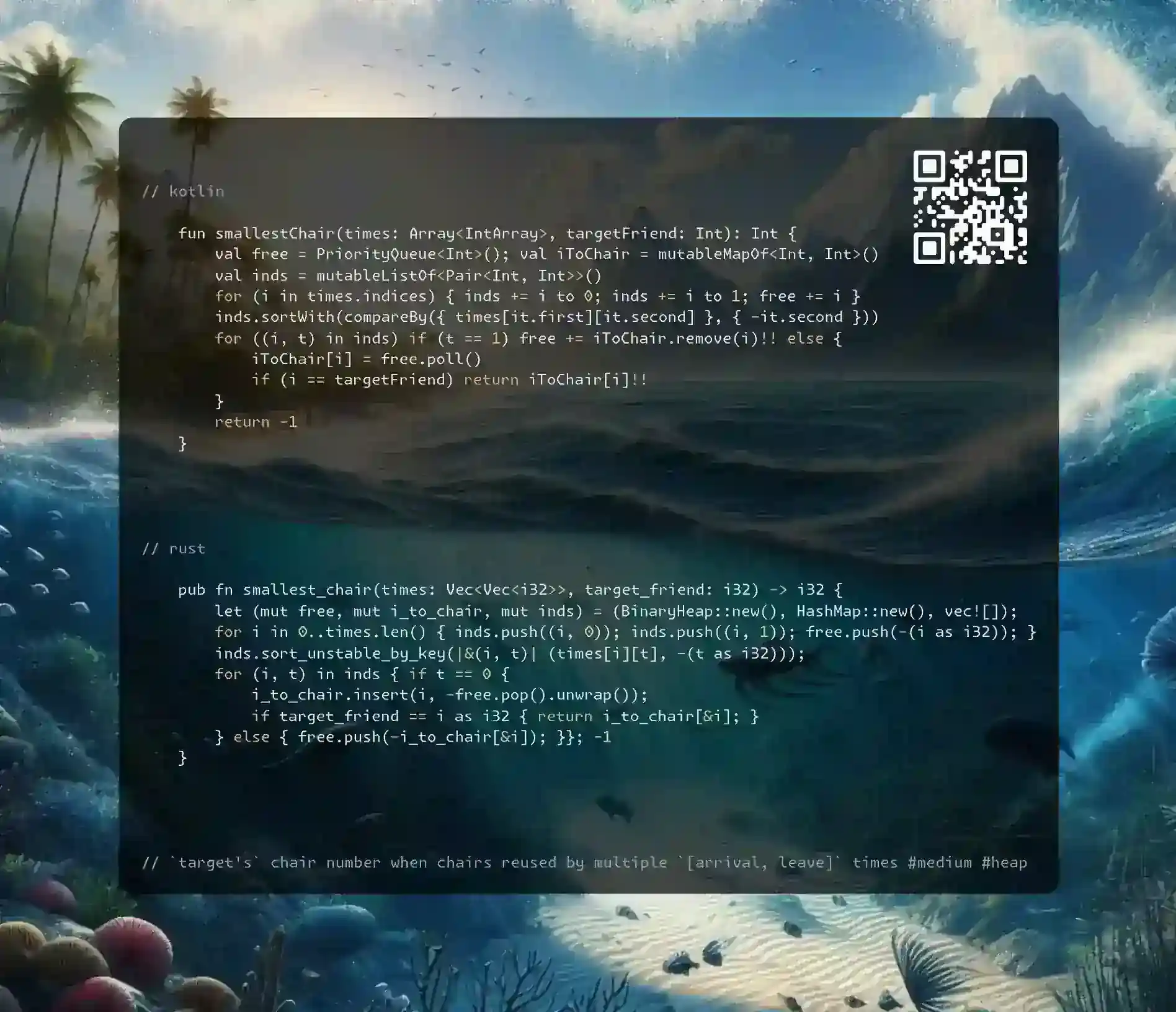
    fun smallestChair(times: Array<IntArray>, targetFriend: Int): Int {
        val free = PriorityQueue<Int>(); val iToChair = mutableMapOf<Int, Int>()
        val inds = mutableListOf<Pair<Int, Int>>()
        for (i in times.indices) { inds += i to 0; inds += i to 1; free += i }
        inds.sortWith(compareBy({ times[it.first][it.second] }, { -it.second }))
        for ((i, t) in inds) if (t == 1) free += iToChair.remove(i)!! else {
            iToChair[i] = free.poll()
            if (i == targetFriend) return iToChair[i]!!
        }
        return -1
    }
    pub fn smallest_chair(times: Vec<Vec<i32>>, target_friend: i32) -> i32 {
        let (mut free, mut i_to_chair, mut inds) = (BinaryHeap::new(), HashMap::new(), vec![]);
        for i in 0..times.len() { inds.push((i, 0)); inds.push((i, 1)); free.push(-(i as i32)); }
        inds.sort_unstable_by_key(|&(i, t)| (times[i][t], -(t as i32)));
        for (i, t) in inds { if t == 0 {
            i_to_chair.insert(i, -free.pop().unwrap());
            if target_friend == i as i32 { return i_to_chair[&i]; }
        } else { free.push(-i_to_chair[&i]); }}; -1
    }
    int smallestChair(vector<vector<int>>& times, int targetFriend) {
        vector<array<int, 3>> e; set<int> free; vector<int> seated(times.size());
        for (int i = 0; i < times.size(); ++i)
            e.push_back({times[i][0], 0, i}), e.push_back({times[i][1], -1, i}), free.insert(i);
        sort(e.begin(), e.end());
        for (auto [_, l, p] : e) if (l) free.insert(seated[p]); else {
            seated[p] = *free.begin();
            free.erase(free.begin());
            if (p == targetFriend) return seated[p];
        }
        return -1;
    }
Comments