LeetCode Entry
1593. Split a String Into the Max Number of Unique Substrings
Max count of unique split parts
1593. Split a String Into the Max Number of Unique Substrings medium
blog post
substack
youtube
deep-dive
Join me on Telegram
https://t.me/leetcode_daily_unstoppable/775
Problem TLDR
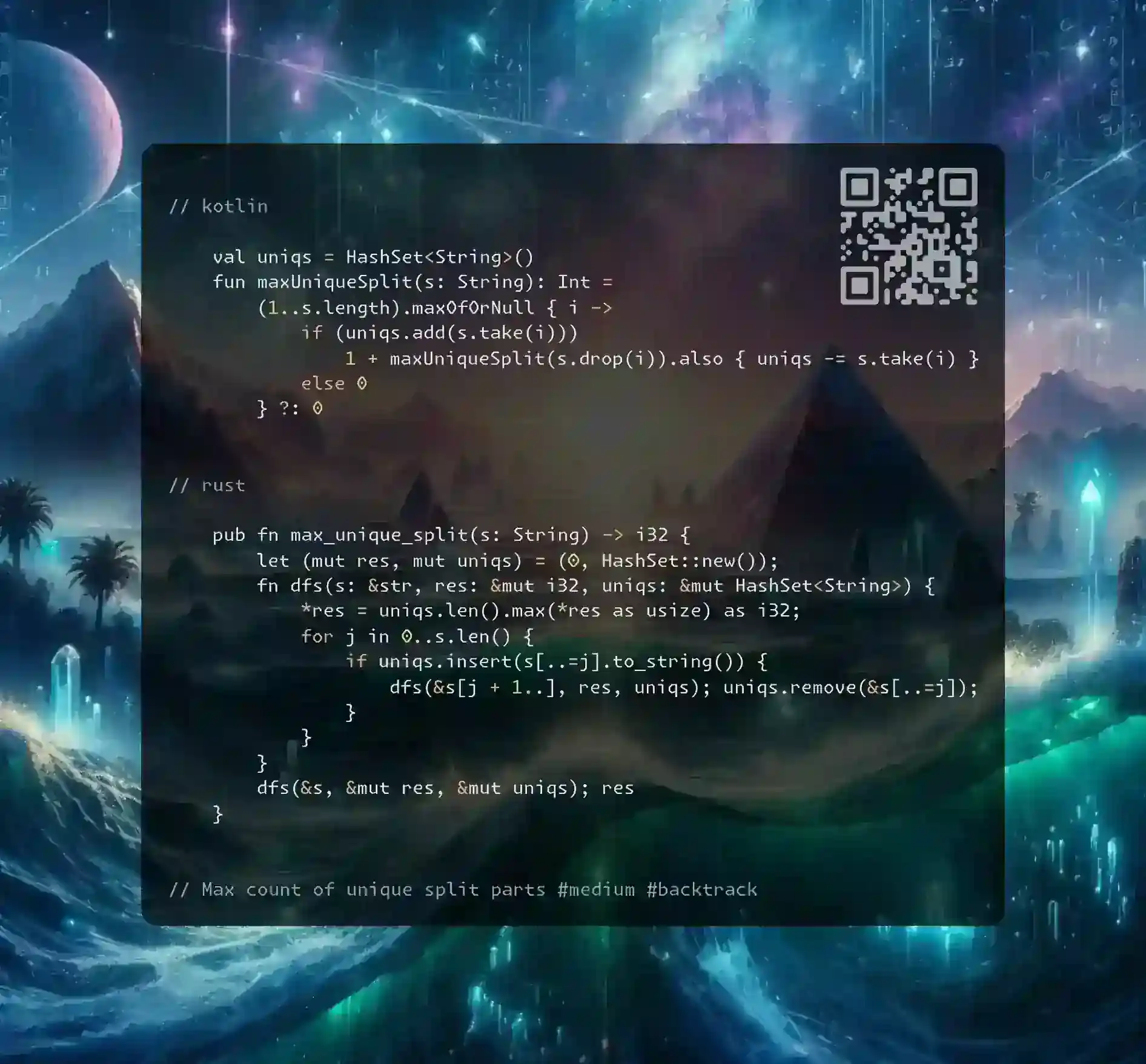
Max count of unique split parts #medium #backtrack
Intuition
The problem size is only 16 length max, so a full Depth-First Search is accepted. Store the current substrings in a HashSet and find a maximum size of it. Iterate on all substrings starting with the current position i.
Approach
- some code golf possible by reusing the function definition and storing uniqs separately (but it is not the production code)
- in Rust slices also action like a pointer
- notice how
&&and,operator in C++ make the code look clever
Complexity
-
Time complexity: \(O(n^n)\), iterating
ntimes on each depth, max depth isn -
Space complexity: \(O(n)\), for the recursion depth and a HashSet
Code
    val uniqs = HashSet<String>()
    fun maxUniqueSplit(s: String): Int =
        (1..s.length).maxOfOrNull { i ->
            if (uniqs.add(s.take(i)))
                1 + maxUniqueSplit(s.drop(i)).also { uniqs -= s.take(i) }
            else 0
        } ?: 0
    pub fn max_unique_split(s: String) -> i32 {
        let (mut res, mut uniqs) = (0, HashSet::new());
        fn dfs(s: &str, res: &mut i32, uniqs: &mut HashSet<String>) {
            *res = uniqs.len().max(*res as usize) as i32;
            for j in 0..s.len() {
                if uniqs.insert(s[..=j].to_string()) {
                    dfs(&s[j + 1..], res, uniqs); uniqs.remove(&s[..=j]);
                }
            }
        }
        dfs(&s, &mut res, &mut uniqs); res
    }
    int maxUniqueSplit(string s) {
        unordered_set<string> uniqs; int res = 0;
        function<void(int)>dfs = [&](int i) {
            res = max(res, (int) uniqs.size());
            for (int j = i; j < s.length(); ++j)
                uniqs.insert(s.substr(i, j - i + 1)).second &&
                    (dfs(j + 1), uniqs.erase(s.substr(i, j - i + 1)));
        }; dfs(0); return res;
    }
Comments