LeetCode Entry
2097. Valid Arrangement of Pairs
Hierholzer algorithm
2097. Valid Arrangement of Pairs hard
blog post
substack
youtube
deep-dive
Join me on Telegram
https://t.me/leetcode_daily_unstoppable/816
Problem TLDR
Hierholzer algorithm #hard #graph
Intuition
I doubt this can be invented on the fly, so this task is all about one algorithm that we have to know: Hierhoizer.
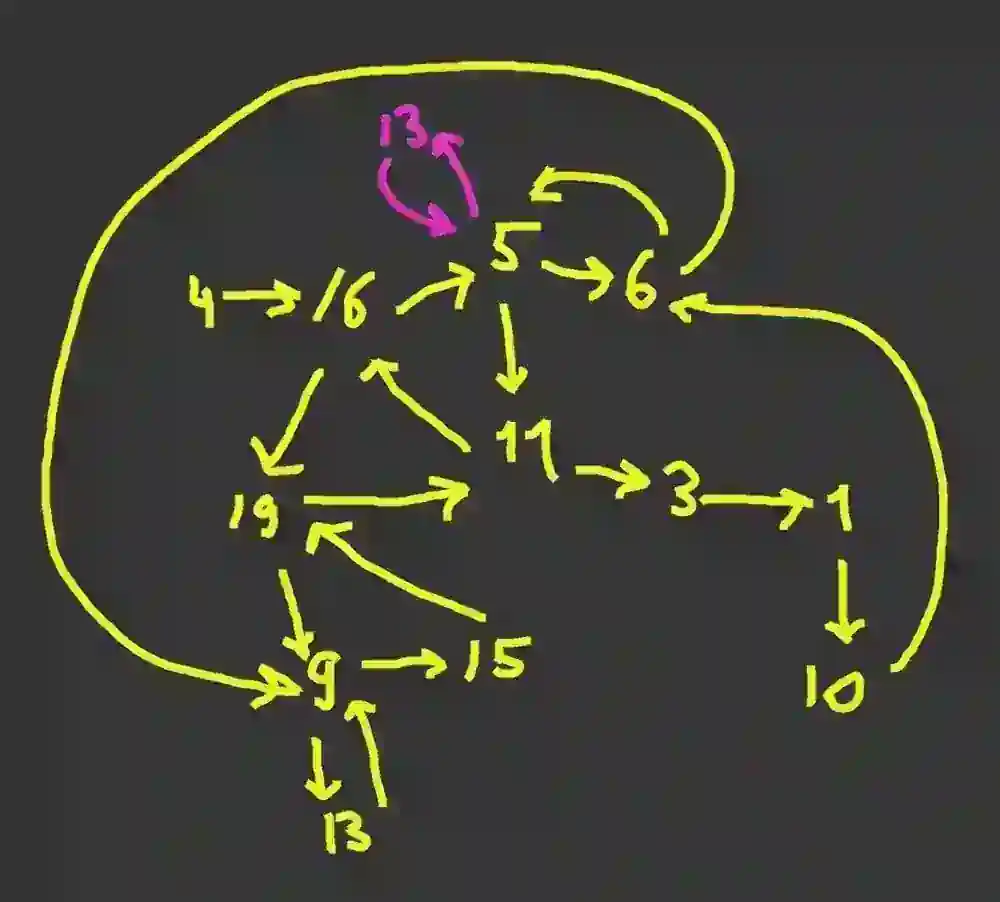
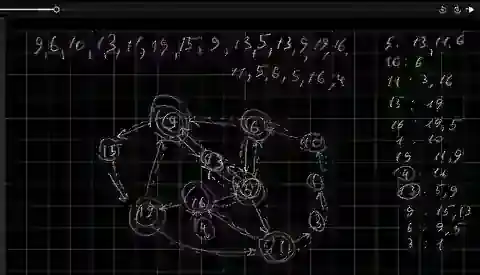
First, find the node that have more outgoing edges then incoming.
Next, greedily traverse all siblings in a DFS manner, removing the explored edges. Do this without backtracking. Store visited nodes in a path.
When all the reached nodes have no more siblings, we reached the end, so pop it from the path.
While doing the pop operation we can discover some previously undiscovered loops in the same manner.
Approach
- let’s try to learn something new
Complexity
-
Time complexity: \(O(EV)\)
-
Space complexity: \(O(E + V)\)
Code
    fun validArrangement(pairs: Array<IntArray>): Array<IntArray> {
        val m = mutableMapOf<Int, MutableList<Int>>()
        val f = mutableMapOf<Int, Int>()
        for ((a, b) in pairs) {
            m.getOrPut(a) { mutableListOf() } += b
            f[a] = 1 + (f[a] ?: 0)
            f[b] = -1 + (f[b] ?: 0)
        }
        val first = f.keys.firstOrNull { f[it]!! > 0 } ?: pairs[0][0]
        val stack = mutableListOf(first, -1); var prev = -1
        return Array(pairs.size) { i ->
            do {
                prev = stack.removeLast()
                while ((m[stack.last()]?.size ?: 0) > 0)
                    stack += m[stack.last()]!!.removeLast()
            } while (prev < 0)
            intArrayOf(stack.last(), prev)
        }.apply { reverse() }
    }
    pub fn valid_arrangement(pairs: Vec<Vec<i32>>) -> Vec<Vec<i32>> {
        let (mut m, mut f) = (HashMap::new(), HashMap::new());
        for p in &pairs {
            m.entry(p[0]).or_insert_with(Vec::new).push(p[1]);
            *f.entry(p[0]).or_insert(0) += 1;
            *f.entry(p[1]).or_insert(0) -= 1;
        }
        let first = f.iter().find(|&(_, &v)| v > 0).map(|(k, _)| *k)
            .unwrap_or_else(|| pairs[0][0]);
        let mut stack = vec![first, -1]; let mut prev = -1;
        let mut res = (0..pairs.len()).map(|i| {
            loop {
                prev = stack.pop().unwrap();
                while let Some(sibl) = m.get_mut(stack.last().unwrap())
                    { let Some(s) = sibl.pop() else { break }; stack.push(s) }
                if (prev >= 0) { break }
            }
            vec![*stack.last().unwrap(), prev]
        }).collect::<Vec<_>>(); res.reverse(); res
    }
    vector<vector<int>> validArrangement(vector<vector<int>>& pairs) {
        unordered_map<int, vector<int>> m; unordered_map<int, int> f;
        for (auto &p: pairs) {
            m[p[0]].push_back(p[1]), ++f[p[0]], --f[p[1]];
        }
        int first = pairs[0][0]; for (auto [k, v]: f) if (v > 0) first = k;
        vector<int> path, s{first}; vector<vector<int>> res;
        while (s.size()) {
            while (m[s.back()].size()) {
                int n = s.back(); s.push_back(m[n].back()); m[n].pop_back();
            }
            path.push_back(s.back()); s.pop_back();
        }
        for (int i = path.size() - 1; i; --i) res.push_back({path[i], path[i - 1]});
        return res;
    }
Comments