LeetCode Entry
2054. Two Best Non-Overlapping Events
Max two non-overlapping intervals search
2054. Two Best Non-Overlapping Events medium
blog post
substack
youtube
deep-dive
Join me on Telegram
https://t.me/leetcode_daily_unstoppable/826
Problem TLDR
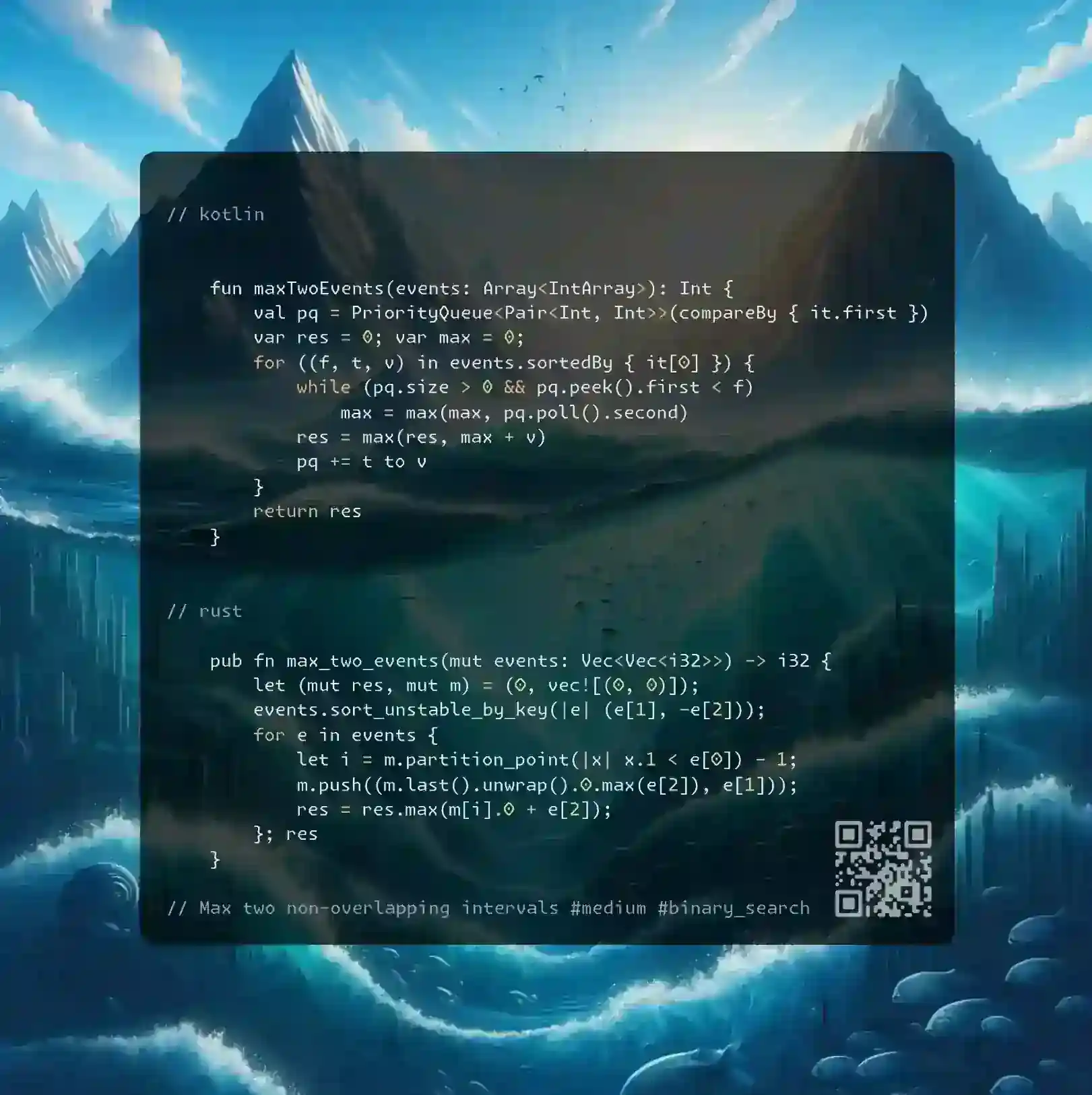
Max two non-overlapping intervals #medium #binary_search
Intuition
Let’s observe some rich example and try to invent an algorithm:
    // 0123456789111
    //    .      012
    // [.......7...]
    // [.3][.2]   .
    //  [.5][.3]  .
    //   [.4][.4] .
    //    [.2][.6].
    //    .[.1][.7]
    //    ..  .   .
    //    t.  .   .   t=3, v=3 maxV=3 maxT=3
    //     t  .   .   t=4, v=5,maxV=5 maxT=4
    //     .t .   .   t=5, v=4,
    //     . t.   .   t=6, v=2
    //     .  t   .   t=7, v=2
    //     .  t   .   t=7, v=1
    //     .  .t  .   t=8, v=3
    //     .  . t .   t=9, v=4
    //     .  .  t.   t=10,v=6, maxV=6, maxT=10
    //     .  .  .t   t=11,v=7, maxV=7, maxT=11
    //     .  .  . t  t=12,v=7
    //    3555555677  maxV
    //        *f  t   5+7
Some observations:
- for current interval we should find the maximum before it
- we can store the maximums as we go
- we should sort events by the
endtimes
Another two approaches:
- use a Heap, sort by start, pop from heap all non-intersecting previous and peek a max
- line sweep: put starts and ends in a timeline, sort by time, compute
maxafter ends, andreson start
Approach
- binary search approach have many subtle tricks: add (0, 0) as zero, sort also by bigger values first to make binary search work
Complexity
-
Time complexity: \(O(nlog(n))\)
-
Space complexity: \(O(n)\)
Code
    fun maxTwoEvents(events: Array<IntArray>): Int {
        val pq = PriorityQueue<Pair<Int, Int>>(compareBy { it.first })
        var res = 0; var max = 0;
        for ((f, t, v) in events.sortedBy { it[0] }) {
            while (pq.size > 0 && pq.peek().first < f)
                max = max(max, pq.poll().second)
            res = max(res, max + v)
            pq += t to v
        }
        return res
    }
    pub fn max_two_events(mut events: Vec<Vec<i32>>) -> i32 {
        let (mut res, mut m) = (0, vec![(0, 0)]);
        events.sort_unstable_by_key(|e| (e[1], -e[2]));
        for e in events {
            let i = m.partition_point(|x| x.1 < e[0]) - 1;
            m.push((m.last().unwrap().0.max(e[2]), e[1]));
            res = res.max(m[i].0 + e[2]);
        }; res
    }
    int maxTwoEvents(vector<vector<int>>& events) {
        vector<tuple<int, int, int>> t; int res = 0, m = 0;
        for (auto e: events)
            t.push_back({e[0], 1, e[2]}),
            t.push_back({e[1] + 1, 0, e[2]});
        sort(begin(t), end(t));
        for (auto [x, start, v]: t)
            start ? res = max(res, m + v) : m = max(m, v);
        return res;
    }
Comments