LeetCode Entry
3152. Special Array II
Queries is all adjucents parity differ [i..j] pointers
3152. Special Array II medium
blog post
substack
youtube
deep-dive
Join me on Telegram
https://t.me/leetcode_daily_unstoppable/827
Problem TLDR
Queries is all adjucents parity differ [i..j] #medium #two_pointers
Intuition
Let’s observe the data and build an intuition:
    // 1 1 2 3 4 4 5 6 6 7 7
    //  0 1 1 1 0 1 1 0 1 0
    //   j   i
    //           j i
    // [0]
    // [ 0 ]
    // [  0  ]
    //     [1]   >= j = 1
    //   [ 1 ]   >= j = 1
    // [  0  ]    < j = 0
    //   [             ]
    //   [           ]
    //   [         ]
    //   [       ]
    //   [     ]
    //   [   ]
The interesting observations:
- we can build a parity-diff array
- for each
endindex, thestartindex should be in the same island of1-ones in parity diff array
We can move two pointers, one for end border, second j for the start of the 1-island. All queries inside it would have start >= j.
Another, superior tactic is to enumerate all islands, giving them uniq index or key, and then just check if both start and end have the same key.
Approach
- two-pointer is more familar for those who solve too many leetcodes, but if you take a pause and think one step more you could spot the island-indexing tactic
Complexity
-
Time complexity: \(O(nlog(n))\), or O(n)
-
Space complexity: \(O(n)\)
Code
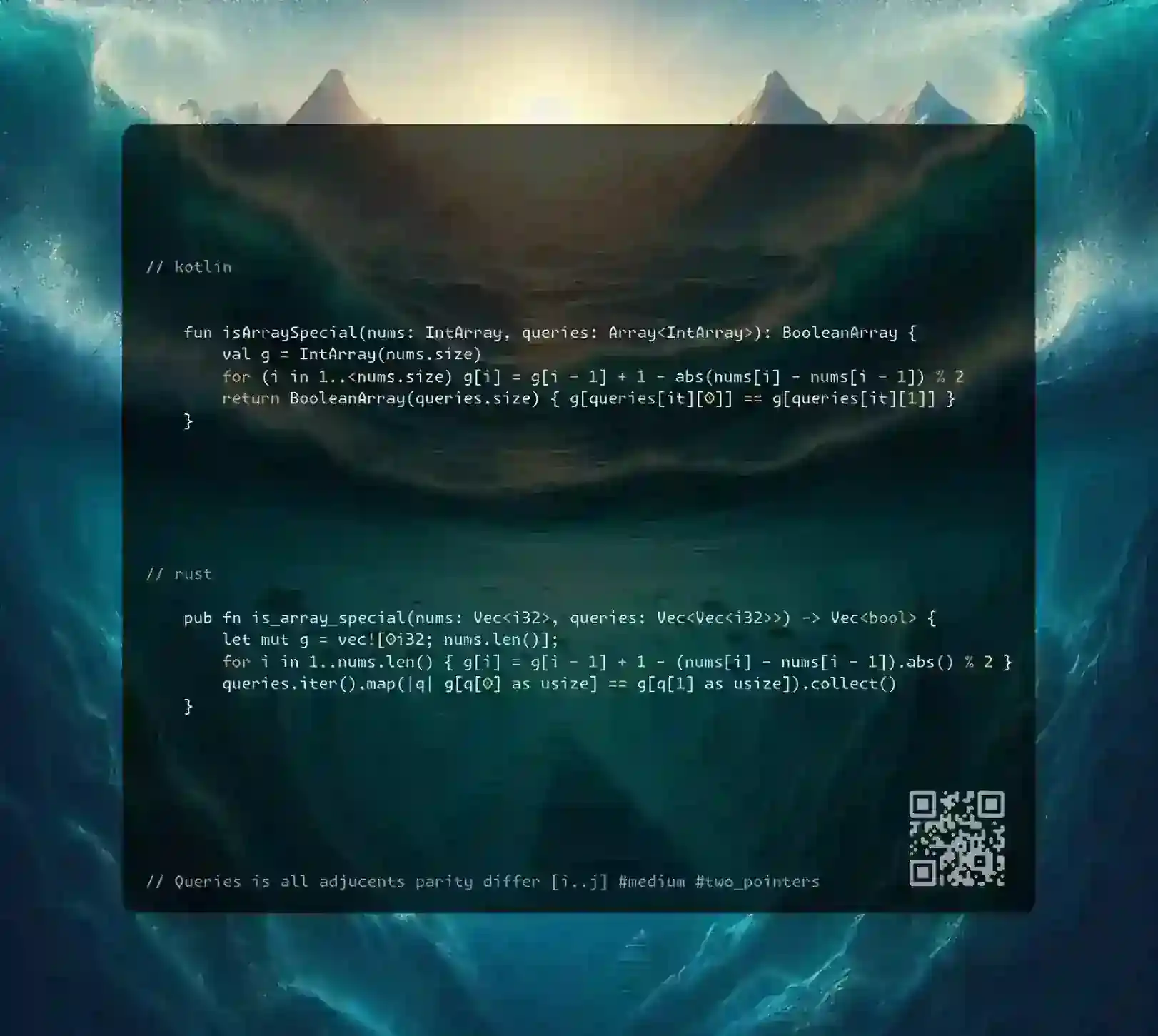
    fun isArraySpecial(nums: IntArray, queries: Array<IntArray>): BooleanArray {
        val g = IntArray(nums.size)
        for (i in 1..<nums.size) g[i] = g[i - 1] + 1 - abs(nums[i] - nums[i - 1]) % 2
        return BooleanArray(queries.size) { g[queries[it][0]] == g[queries[it][1]] }
    }
    fun isArraySpecial(nums: IntArray, queries: Array<IntArray>): BooleanArray {
        val inds = queries.indices.sortedBy { queries[it][1] }
        var j = 0; var k = 0; val res = BooleanArray(queries.size)
        for (i in nums.indices) {
            if (i > 0 && nums[i] % 2 == nums[i - 1] % 2) j = i
            while (k < queries.size && queries[inds[k]][1] <= i)
                    res[inds[k]] = queries[inds[k++]][0] >= j
        }
        return res
    }
    pub fn is_array_special(nums: Vec<i32>, queries: Vec<Vec<i32>>) -> Vec<bool> {
        let mut g = vec![0i32; nums.len()];
        for i in 1..nums.len() { g[i] = g[i - 1] + 1 - (nums[i] - nums[i - 1]).abs() % 2 }
        queries.iter().map(|q| g[q[0] as usize] == g[q[1] as usize]).collect()
    }
    vector<bool> isArraySpecial(vector<int>& nums, vector<vector<int>>& q) {
        vector<int> g(nums.size()); vector<bool> r(q.size());
        for (int i = 1; i < nums.size(); ++i)
            g[i] = g[i - 1] + 1 - abs(nums[i] - nums[i - 1]) % 2;
        for (int i = 0; i < q.size(); ++i)
            r[i] = g[q[i][0]] == g[q[i][1]];
        return r;
    }
Comments