LeetCode Entry
407. Trapping Rain Water II
Trap the water in 2D height matrix
407. Trapping Rain Water II hard
blog post
substack
youtube
Join me on Telegram
https://t.me/leetcode_daily_unstoppable/869
Problem TLDR
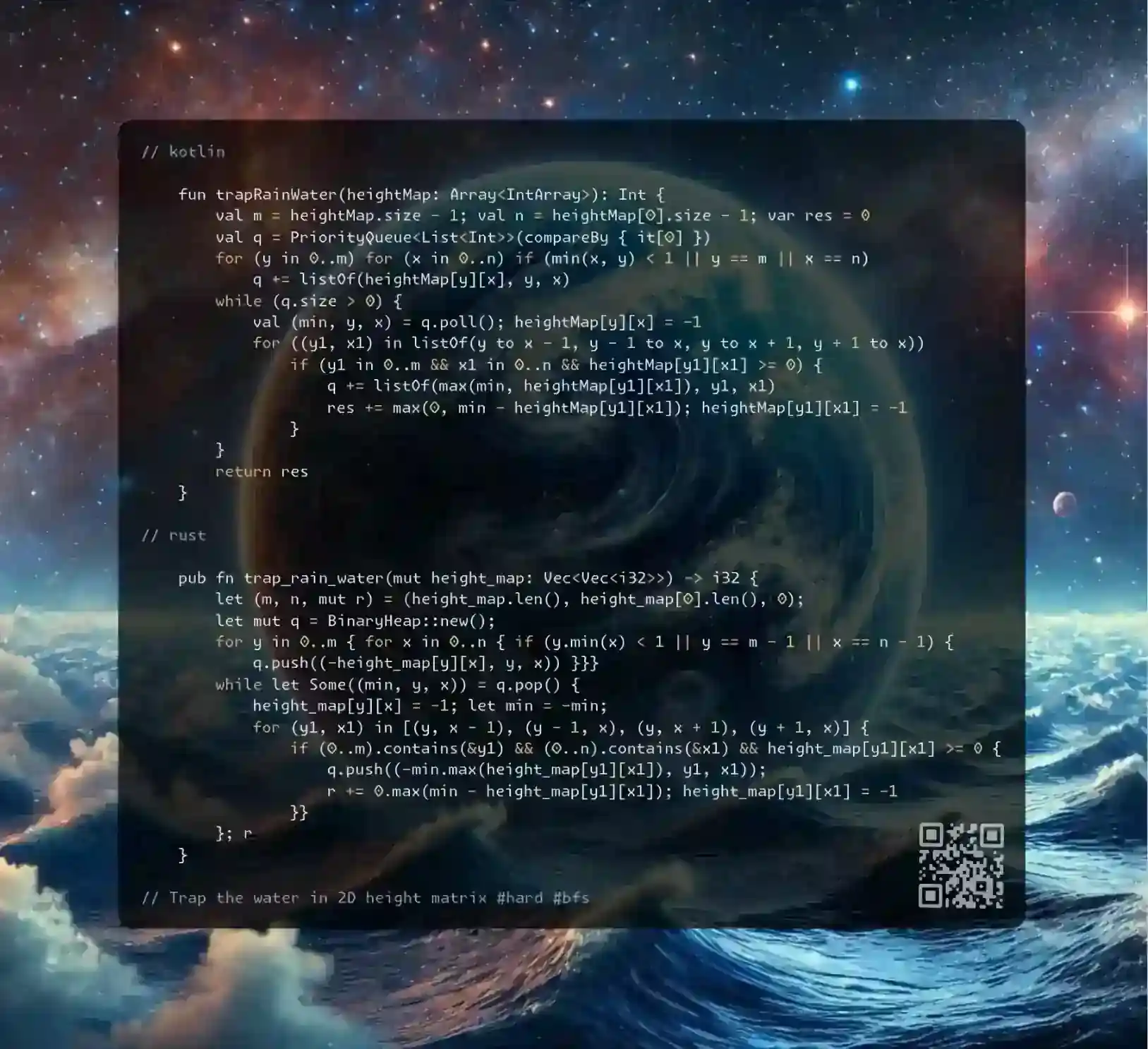
Trap the water in 2D height matrix #hard #bfs
Intuition
Didn’t solve this myself in 2 hours.
My naive approach was the brute-force (not accepted, but correct): go layer by layer increasing height, and calculate area with BFS less than current height, track min height difference.
The optimal solution: go from outside with BFS and add height difference, append to the Heap adjacents making them at least current height. Imagine water filling everything at the level of the current min.
Approach
- spending 2 hours on a wrong idea is ok
Complexity
-
Time complexity: \(O(nm)\)
-
Space complexity: \(O(nm)\)
Code
    fun trapRainWater(heightMap: Array<IntArray>): Int {
        val m = heightMap.size - 1; val n = heightMap[0].size - 1; var res = 0
        val q = PriorityQueue<List<Int>>(compareBy { it[0] })
        for (y in 0..m) for (x in 0..n) if (min(x, y) < 1 || y == m || x == n)
            q += listOf(heightMap[y][x], y, x)
        while (q.size > 0) {
            val (min, y, x) = q.poll(); heightMap[y][x] = -1
            for ((y1, x1) in listOf(y to x - 1, y - 1 to x, y to x + 1, y + 1 to x))
                if (y1 in 0..m && x1 in 0..n && heightMap[y1][x1] >= 0) {
                    q += listOf(max(min, heightMap[y1][x1]), y1, x1)
                    res += max(0, min - heightMap[y1][x1]); heightMap[y1][x1] = -1
                }
        }
        return res
    }
    pub fn trap_rain_water(mut height_map: Vec<Vec<i32>>) -> i32 {
        let (m, n, mut r) = (height_map.len(), height_map[0].len(), 0);
        let mut q = BinaryHeap::new();
        for y in 0..m { for x in 0..n { if (y.min(x) < 1 || y == m - 1 || x == n - 1) {
            q.push((-height_map[y][x], y, x)) }}}
        while let Some((min, y, x)) = q.pop() {
            height_map[y][x] = -1; let min = -min;
            for (y1, x1) in [(y, x - 1), (y - 1, x), (y, x + 1), (y + 1, x)] {
                if (0..m).contains(&y1) && (0..n).contains(&x1) && height_map[y1][x1] >= 0 {
                    q.push((-min.max(height_map[y1][x1]), y1, x1));
                    r += 0.max(min - height_map[y1][x1]); height_map[y1][x1] = -1
                }}
        }; r
    }
    int trapRainWater(vector<vector<int>>& g) {
        priority_queue<array<int,3>, vector<array<int,3>>, greater<>> q;
        int m = size(g), n = size(g[0]), r = 0, d[] = {0, 1, 0, -1, 0};
        for (int i = 0; i < m * n; ++i) if (i < n || i >= n * (m - 1) || i % n < 1 || i % n == n - 1)
            q.push({g[i / n][i % n], i / n, i % n });
        while (size(q)) {
            auto [v, y, x] = q.top(); q.pop(); g[y][x] = -1;
            for (int i = 0; i < 4; ++i)
                if (int y1 = y + d[i], x1 = x + d[i + 1]; min(y1, x1) >= 0 && y1 < m && x1 < n && g[y1][x1] >= 0)
                    q.push({max(v, g[y1][x1]), y1, x1}), r += max(0, v - g[y1][x1]), g[y1][x1] = -1;
        } return r;
    }
Comments