LeetCode Entry
802. Find Eventual Safe States
Nodes without cycles
802. Find Eventual Safe States medium
blog post
substack
youtube
Join me on Telegram
https://t.me/leetcode_daily_unstoppable/874
Problem TLDR
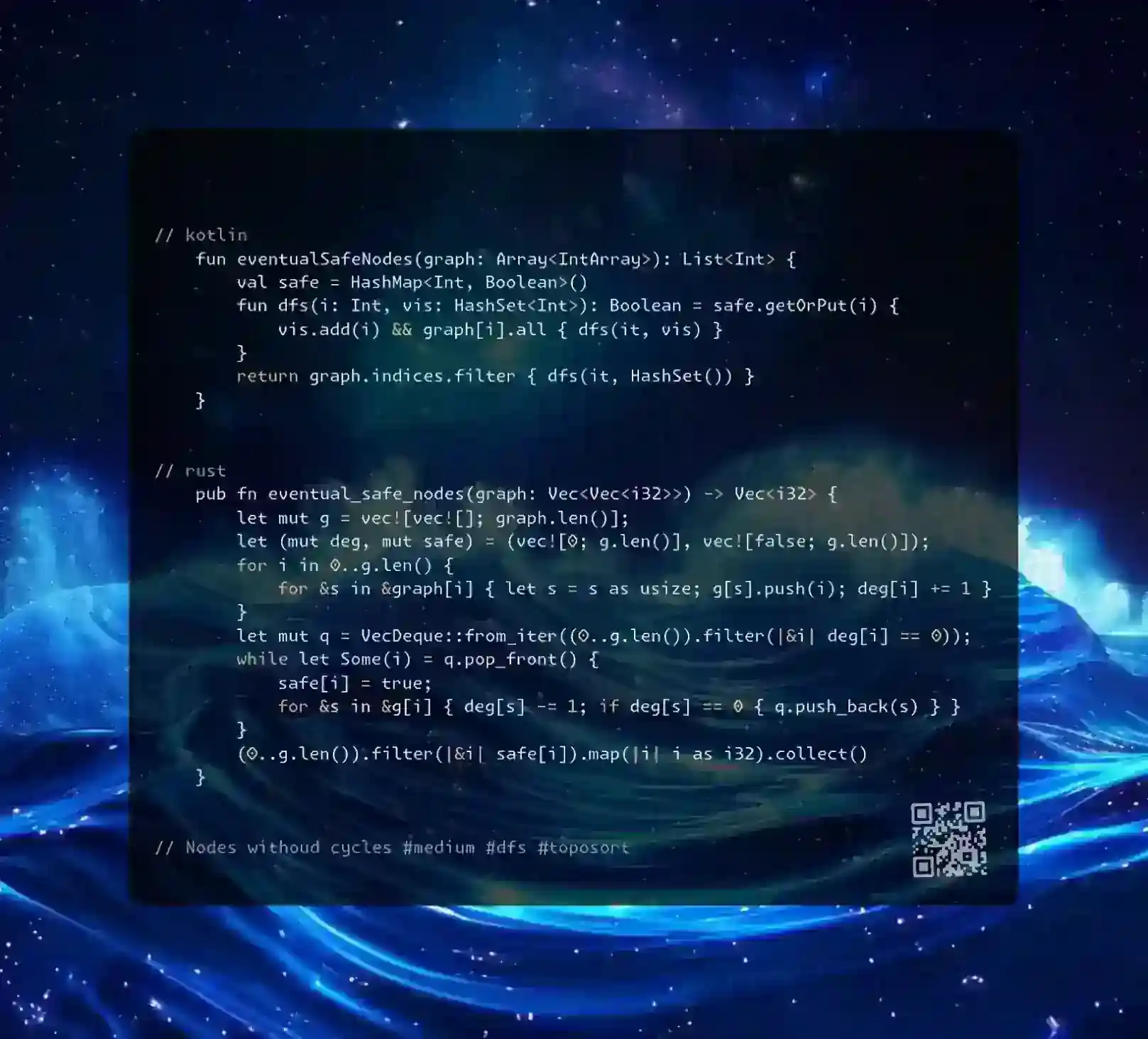
Nodes without cycles #medium #dfs #toposort
Intuition
The problem description was misleading. The actual task is to filter out cycles.
Simple DFS with memoization works.
Why does the Topological Sort work? Example:
// [2, 2] [0] [3] []  <-- not valid input, [2,2],
//                        graph [i] must be strictly increasing
// [1] [0] [3] []
// 0 -> 1
// 1 -> 0
// 2 -> 3
// 3 -> .        reverse: 3 -> [2], 2 -> [], 1 -> [0], 0 -> [1]
//        0 1 2 3
// deg:   1 1 1 0
// take 3->[2]
// deg:   1 1 0 0
// take 2->[] end
As we can see, in-degrees for cycles are always > 0.
Approach
- let’s implement both DFS and Toposort.
Complexity
-
Time complexity: \(O(EV)\)
-
Space complexity: \(O(E + V)\)
Code
    fun eventualSafeNodes(graph: Array<IntArray>): List<Int> {
        val safe = HashMap<Int, Boolean>()
        fun dfs(i: Int, vis: HashSet<Int>): Boolean = safe.getOrPut(i) {
            vis.add(i) && graph[i].all { dfs(it, vis) }
        }
        return graph.indices.filter { dfs(it, HashSet()) }
    }
    pub fn eventual_safe_nodes(graph: Vec<Vec<i32>>) -> Vec<i32> {
        let mut g = vec![vec![]; graph.len()];
        let (mut deg, mut safe) = (vec![0; g.len()], vec![false; g.len()]);
        for i in 0..g.len() {
            for &s in &graph[i] { let s = s as usize; g[s].push(i); deg[i] += 1 }
        }
        let mut q = VecDeque::from_iter((0..g.len()).filter(|&i| deg[i] == 0));
        while let Some(i) = q.pop_front() {
            safe[i] = true;
            for &s in &g[i] { deg[s] -= 1; if deg[s] == 0 { q.push_back(s) } }
        }
        (0..g.len()).filter(|&i| safe[i]).map(|i| i as i32).collect()
    }
    vector<int> eventualSafeNodes(vector<vector<int>>& g) {
        vector<int> s(size(g)), r;
        function<bool(int)> dfs = [&](int i) {
            if (s[i]) return s[i] == 2; s[i] = 1;
            for (int j: g[i]) if (!dfs(j)) return false;
            s[i] = 2; return true;
        };
        for (int i = 0; i < size(g); ++i) if (dfs(i)) r.push_back(i);
        return r;
    }
Comments