LeetCode Entry
1524. Number of Sub-arrays With Odd Sum
Count odd sum subarrays sum
1524. Number of Sub-arrays With Odd Sum medium
blog post
substack
youtube
Join me on Telegram
https://t.me/leetcode_daily_unstoppable/906
Problem TLDR
Count odd sum subarrays #medium #prefix_sum
Intuition
Didn’t solve without a hint.
First, how to count subarrays: append every num only once and check some condition in O(1). We can prepare prefix sums. The interesting part is how many odd/even prefix sums we have seen before:
    // 1 3 5     s  o     e     cnt
    // *         1  1           +1
    //   *       4  2     1     +1
    //     *     9  4           +2

    // 1 2 3 4 5 6 7    s    o     e    cnt
    // *                1    1          +1
    //   *              3    2     1    +1
    // 1 .o
    // 1 2o  2 is even, e++, prev o = 1, prev even = 0
    //   2                   new o = [1], [1 2] = 2
    // 1 2                   new even = [2] = 1
    //     *            6
    // 1   .o
    // 1 2 .o
    // 1 2 3e  3 is odd, odd++, prev o = [1][12] = 2, e = [2]
    //     3                    new o = [1][12]+[3][23], e=[2]+[123]
    //   2 3                                    (123-12)
    // 1 2 3                                       (123-1)
    //       *
    // 1     .o
    // 1 2   .o
    // 1 2 3 .e
    // 1 2 3 4e   4 is even,  e++, prev o=[1][12][3],e=[2][123]
    //       4  s - (1 2 3)e  new o=[1][12][3][23]+[234][34]      e=[2][123]+[4][1234]
    //     3 4  s - (1 2)o                         (1234-1)
    //   2 3 4  s - (1)o                                (1234-12)
For example 1 2 3 4, when we are adding the 4, the new subarrays are: [4], [34], [234], [1234]; each is a concatenation of the prefix: [123][4], [12][34], [1][234], [][1234]. The math for odd/even is [odd..][..odd4]=[even4], [even..][..odd4] = [odd4], [even..][..even4] = [even4]. So, if the current prefix is even we are adding all previous odd prefixes count on vice-versa.
However, that didn’t work :)
That 1 + cost me 1 hour and all the hints:
            if (s % 2 == 0) {
                // every odd prefix is odd suffix
                o += so
                se++
            } else {
                // every even prefix is odd suffix
                o += 1 + se
                so++
            }
Or in the other solutions the 1 is the starting condition for even count. Why so? (I still don’t “get” the intuition) Example: [21], we are adding 1, sum is 3 odd, total number of odds are: [1] and [21]. Let’s add another 2: [212], sum 5 odd, odds are [1][21] + [12],[212]. That’s probably a zero-condition: the previous evens count is never includes the full subarray 212, so, we have to consider it themselves with +1.
Approach
- you can understand and even get the
ideabut to solve the problem, all the corner cases must be solved; that’s a deeper understanding - sum can be stripped down to
0-1value ofsum % 2
Complexity
-
Time complexity: \(O(n)\)
-
Space complexity: \(O(1)\)
Code
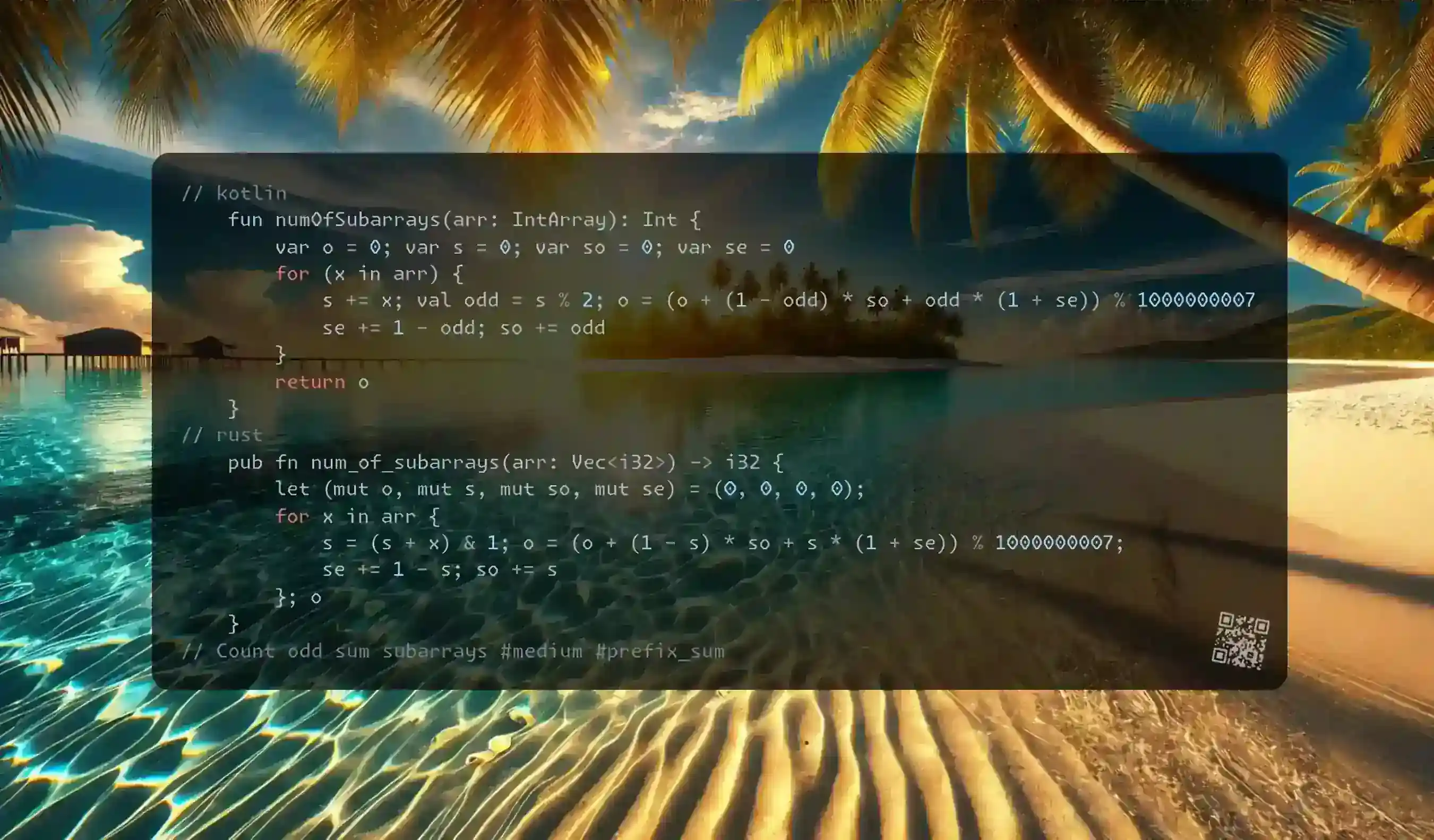
    fun numOfSubarrays(arr: IntArray): Int {
        var o = 0; var s = 0; var so = 0; var se = 0
        for (x in arr) {
            s += x; val odd = s % 2
            o = (o + (1 - odd) * so + odd * (1 + se)) % 1000000007
            se += 1 - odd; so += odd
        }
        return o
    }
    pub fn num_of_subarrays(arr: Vec<i32>) -> i32 {
        let (mut o, mut s, mut so, mut se) = (0, 0, 0, 0);
        for x in arr {
            s = (s + x) & 1;
            o = (o + (1 - s) * so + s * (1 + se)) % 1000000007;
            se += 1 - s; so += s
        }; o
    }
    int numOfSubarrays(vector<int>& arr) {
        int r = 0, s = 0, o = 0, e = 0, m = 1e9+7;
        for (int x: arr)
            s = (s + x) & 1,
            r = (r + (1 - s) * o + s * (1 + e)) % m,
            e += 1 - s, o += s;
        return r;
    }
Comments