LeetCode Entry
2999. Count the Number of Powerful Integers
Numbers in range start..finish, digits up to limit
2999. Count the Number of Powerful Integers hard
blog post
substack
youtube
Join me on Telegram
https://t.me/leetcode_daily_unstoppable/954
Problem TLDR
Numbers in range start..finish, digits up to limit #hard #dp #math
Intuition
Completely failed.
    // 200..12345 lim 3, s "33"
    // 33 133 | 233 333
    //   1133 2133 3133
    //        1233 2233 3233
    //            1333 2333 3333

    //
    // limit
    // limit^2
    // limit^3
    // ...
    // limit^(log10(finish) - s.length) - prefix - suffix
    //
I was able to write the generation code that prints out all numbers (TLE solution). After looking at generated numbers, I saw some pattern:
- the numbers count grows in
limit * previous, meaning after x steps we havelimit ^ xnumbers - the numbers digits are less than
limit, meaning we are in abase limit + 1system, like, for limit = 9, we are in decimal, for limit = 1 we are in a binary
After that I’ve looked at the hints and they tell me nothing.
After that I’ve looked for solutions.
So, for the base limit solution, we just have to convert start and finish to this base and count the diff: finish(base_limit) - start(base_limit).
The corner case is when digits are out of base. Then we have to make those digits as max as possible. And deal with tail suffix:
- if suffix is bigger than based tail, do
-1(why?)
Approach
- still solution from somebody
- the DFS + memo solution is more doable if you didn’t spot the
basesystem
Complexity
-
Time complexity: \(O(log(finish))\)
-
Space complexity: \(O(log(finish))\)
Code
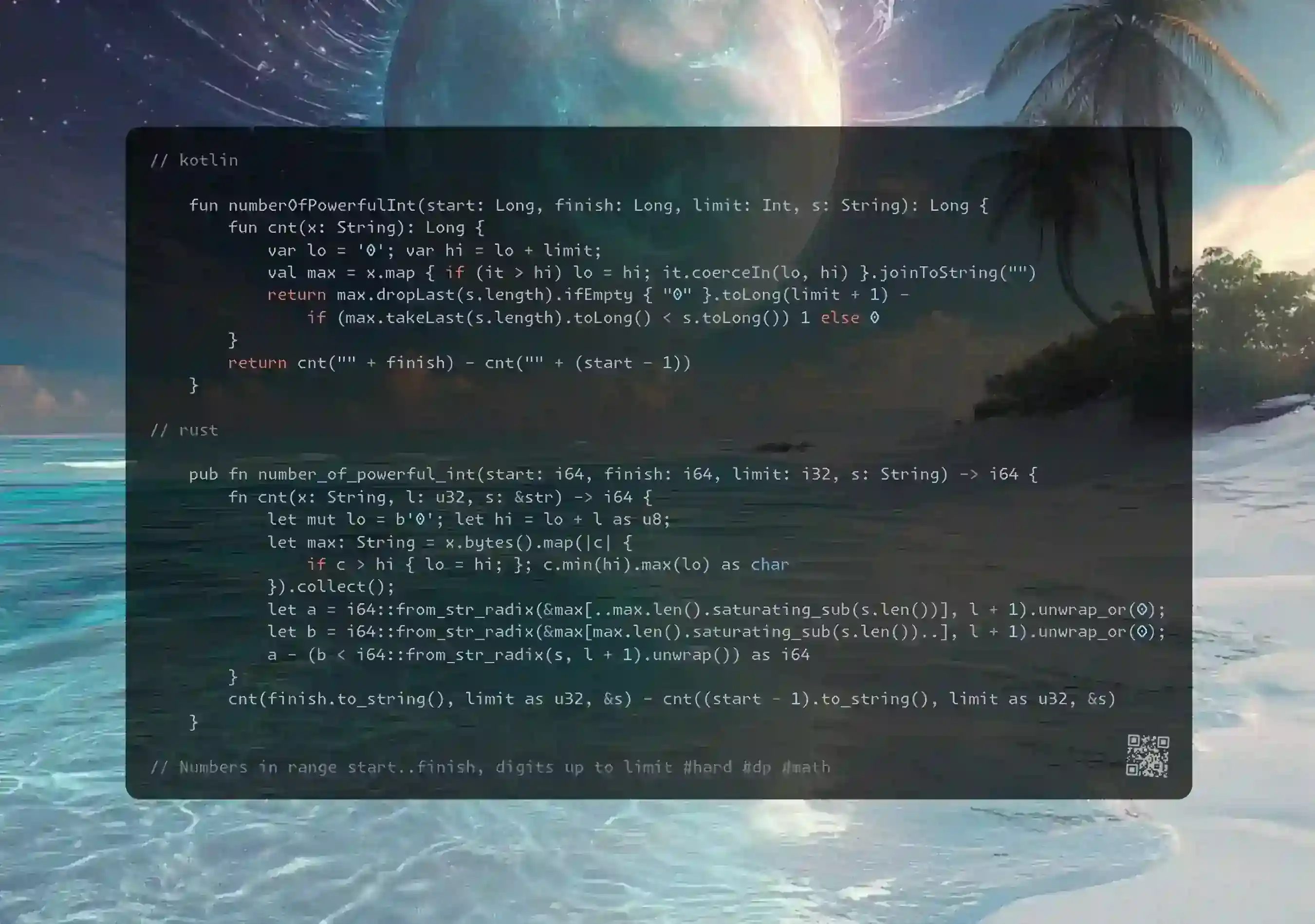
    fun numberOfPowerfulInt(start: Long, finish: Long, limit: Int, s: String): Long {
        fun cnt(x: String): Long {
            var lo = '0'; var hi = lo + limit;
            val max = x.map { if (it > hi) lo = hi; it.coerceIn(lo, hi) }.joinToString("")
            return max.dropLast(s.length).ifEmpty { "0" }.toLong(limit + 1) -
                if (max.takeLast(s.length).toLong() < s.toLong()) 1 else 0
        }
        return cnt("" + finish) - cnt("" + (start - 1))
    }
    fun numberOfPowerfulInt(start: Long, finish: Long, limit: Int, s: String): Long {
        fun cnt(x: String): Long {
            if (x.length < s.length) return 0
            if (x.length == s.length) return if (x >= s) 1 else 0
            var cnt = 0L; val plen = x.length - s.length
            for (i in 0..<plen) {
                if (x[i] - '0' > limit) return cnt + Math.pow(1.0 * limit + 1, 1.0 * plen - i).toLong()
                cnt += (x[i] - '0') * Math.pow(1.0 * limit + 1, 1.0 * plen - i - 1).toLong()
            }
            return if (x.takeLast(s.length) >= s) cnt + 1 else cnt
        }
        return cnt("" + finish) - cnt("" + (start - 1))
    }
    fun numberOfPowerfulInt(start: Long, finish: Long, limit: Int, s: String): Long {
        val dp = HashMap<Pair<Pair<Int, Boolean>, Boolean>, Long>()
        val hi = finish.toString(); val low = start.toString().padStart(hi.length, '0')
        fun dfs(i: Int, useLow: Boolean, useHi: Boolean): Long = if (i == low.length) 1
            else dp.getOrPut(i to useLow to useHi) {
                var l = if (useLow) low[i] - '0' else 0
                var h = if (useHi) hi[i] - '0' else 9
                if (i < hi.length - s.length) (l..min(h, limit)).sumOf { d ->
                    dfs(i + 1, useLow && d == l, useHi && d == h) }
                else {
                    var d = s[i - hi.length + s.length] - '0'
                    if (d !in l..min(h, limit)) 0L else
                        dfs(i + 1, useLow && d == l, useHi && d == h)
                }
            }
        return dfs(0, true, true)
    }
    pub fn number_of_powerful_int(start: i64, finish: i64, limit: i32, s: String) -> i64 {
        fn cnt(x: String, l: u32, s: &str) -> i64 {
            let mut lo = b'0'; let hi = lo + l as u8;
            let max: String = x.bytes().map(|c| {
                if c > hi { lo = hi; }; c.min(hi).max(lo) as char
            }).collect();
            let a = i64::from_str_radix(&max[..max.len().saturating_sub(s.len())], l + 1).unwrap_or(0);
            let b = i64::from_str_radix(&max[max.len().saturating_sub(s.len())..], l + 1).unwrap_or(0);
            a - (b < i64::from_str_radix(s, l + 1).unwrap()) as i64
        }
        cnt(finish.to_string(), limit as u32, &s) - cnt((start - 1).to_string(), limit as u32, &s)
    }
    long long numberOfPowerfulInt(long long start, long long finish, int limit, string s) {
        auto to_dec = [&](const std::string& t) {
            long long r = 0, b = limit + 1; for (char c : t) r = r * b + (c - '0');
            return r;
        };
        auto cnt = [&](std::string x) {
            char lo = '0', hi = lo + limit; int n = x.size(), m = s.size(), d = std::max(n - m, 0);
            for (char& c : x) { if (c > hi) lo = hi; c = std::clamp(c, lo, hi); }
            auto a = to_dec(d ? x.substr(0, d) : "0"); auto b = to_dec(x.substr(d));
            return a - (b < to_dec(s));
        };
        return cnt(std::to_string(finish)) - cnt(std::to_string(start - 1));
    }
Comments