LeetCode Entry
2537. Count the Number of Good Subarrays
Subarrays with at least k equal pairs window
2537. Count the Number of Good Subarrays medium
blog post
substack
youtube
Join me on Telegram
https://t.me/leetcode_daily_unstoppable/960
Problem TLDR
Subarrays with at least k equal pairs #medium #sliding_window #math
Intuition
Let’s observe sliding window:
    // [3,1,4,3,2,2,4], k = 2
    //                  freq
    //  i     j         3->2
    //  i         j     3->2 + 2->2          2
    //  i           j   3->2 + 2->2 + 4->2   3
    //    i         j   2->2 + 4->2          2
    //      i       j   2->2 + 4->2          2
    // when to move second pointer to shrink?
    // ****************
    //    i     j->     expand until good, + all before i count
    //     i->  j       shrink while good
Expand window until we get k equal pairs.
The hardest part is to reason about when to shrink the window.
The count & shrink technique is: we always freeze the right border and shrink left while we can. The prefix is all valid subarrays, so count all of them.
Now, how to increase and decrease the frequency?
    // freq = 4, (n - 1) * (n - 2) / 2
    // freq = 5, n * (n - 1) / 2 - (n - 1) * (n - 2) / 2
    //           (n - n + 2) * (n - 1) / 2
    //                    2 * (n - 1) / 2
    //                    n - 1
By looking at 1 1 1 1 1 example, the pairs count is p = f * (f - 1) / 2. So, the diff is p(n) - p(n - 1) = n - 1.
Approach
- we can shrink window up to the
invalidstate andnotcheck if it is valid to addj, asj = 0initially
Complexity
-
Time complexity: \(O(n)\)
-
Space complexity: \(O(n)\)
Code
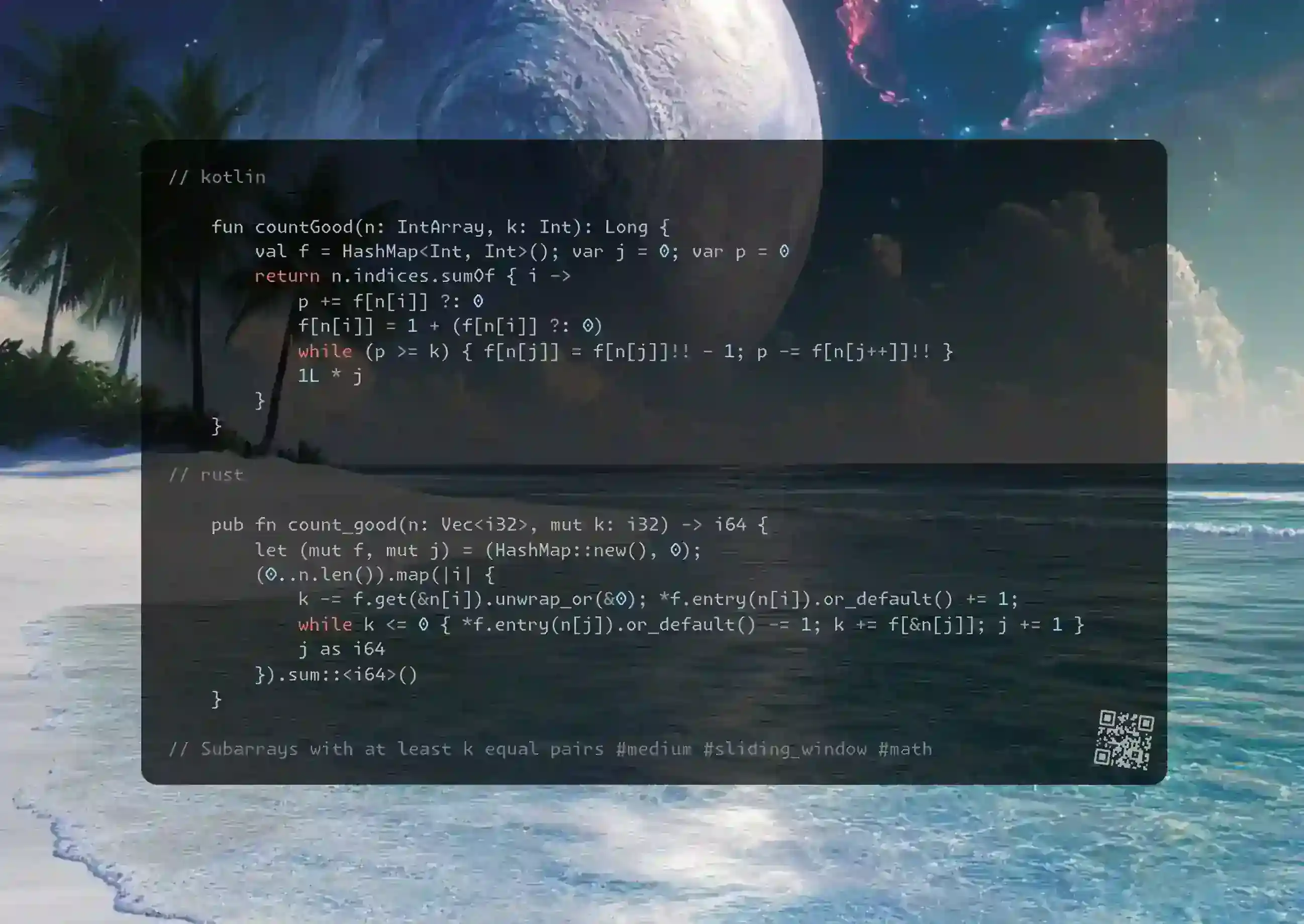
    fun countGood(n: IntArray, k: Int): Long {
        val f = HashMap<Int, Int>(); var j = 0; var p = 0
        return n.indices.sumOf { i ->
            p += f[n[i]] ?: 0
            f[n[i]] = 1 + (f[n[i]] ?: 0)
            while (p >= k) { f[n[j]] = f[n[j]]!! - 1; p -= f[n[j++]]!! }
            1L * j
        }
    }
    pub fn count_good(n: Vec<i32>, mut k: i32) -> i64 {
        let (mut f, mut j) = (HashMap::new(), 0);
        (0..n.len()).map(|i| {
            k -= f.get(&n[i]).unwrap_or(&0); *f.entry(n[i]).or_default() += 1;
            while k <= 0 { *f.entry(n[j]).or_default() -= 1; k += f[&n[j]]; j += 1 }
            j as i64
        }).sum::<i64>()
    }
    long long countGood(vector<int>& n, int k) {
        long long r = 0LL; unordered_map<int, int> f;
        for (int i = 0, j = 0; i < size(n); ++i, r += j) {
            k -= f[n[i]]++; while (k <= 0) k += --f[n[j++]];
        } return r;
    }
Comments