LeetCode Entry
75. Sort Colors
Sort 0,1,2 array pointers
75. Sort Colors medium
blog post
substack
youtube
Join me on Telegram
https://t.me/leetcode_daily_unstoppable/991
Problem TLDR
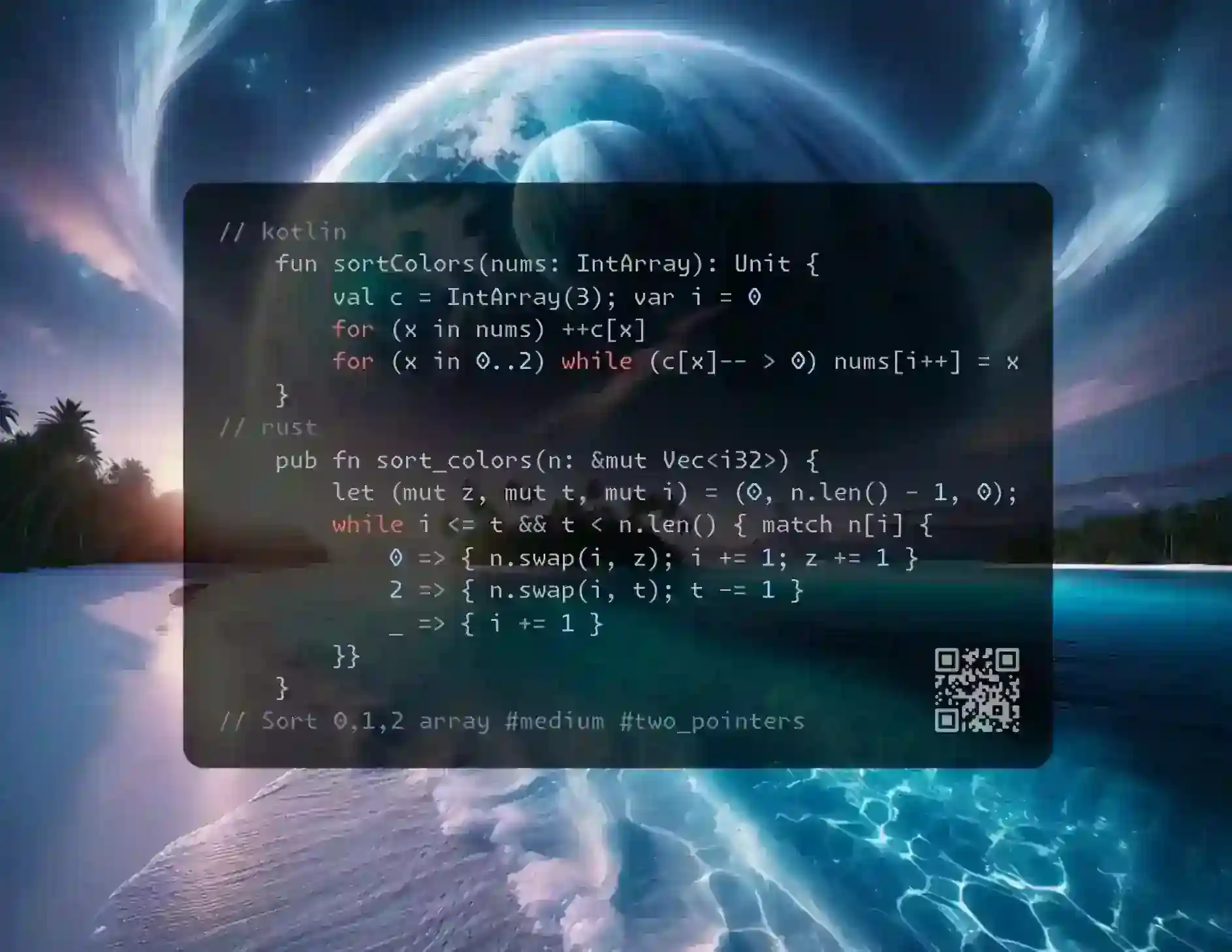
Sort 0,1,2 array #medium #two_pointers
Intuition
The two-pass solution is trivial: count, then write. Was very close to implement the single-pass solution:
    // 2,0,2,1,1,0
    // z         t
    // i
    // 0       t 2
    //   i
    //   z
    //     i
    //     1 t 2
    //
    // 0 0 1 1 2 2

    // 2 0 1
    // z   t
    // i
    //   t
    // 1 0 2
What was missing: the final check i == t to check if nums[t] is zero.
Approach
Single pass:
- fill prefix with
0and suffix with2 - skip
1 - the corner case is
10: swapnums[t]with prefix if it is0 - or, we can make the final check
i == t, then it is handled by thenums[i] == 0condition
Complexity
-
Time complexity: \(O(n)\)
-
Space complexity: \(O(1)\)
Code
    fun sortColors(nums: IntArray): Unit {
        val c = IntArray(3); var i = 0
        for (x in nums) ++c[x]
        for (x in 0..2) while (c[x]-- > 0) nums[i++] = x
    }
    fun sortColors(n: IntArray): Unit {
        var z = 0; var t = n.size - 1; var i = 0
        while (i <= t)
            if (n[i] == 2) { n[i] = n[t]; n[t--] = 2 }
            else if (n[i] == 0) { n[i++] = n[z]; n[z++] = 0 }
            else i++
    }
    pub fn sort_colors(n: &mut Vec<i32>) {
        let (mut z, mut t, mut i) = (0, n.len() - 1, 0);
        while i <= t && t < n.len() { match n[i] {
            0 => { n.swap(i, z); i += 1; z += 1 }
            2 => { n.swap(i, t); t -= 1 }
            _ => { i += 1 }
        }}
    }
    void sortColors(vector<int>& n) {
        for (int i = 0, z = 0, t = size(n) - 1; i <= t;)
            if (n[i] == 0) n[i++] = n[z], n[z++] = 0;
            else if (n[i] == 2) n[i] = n[t], n[t--] = 2;
            else i++;
    }
Comments