LeetCode Entry
1857. Largest Color Value in a Directed Graph
Max color freq path
1857. Largest Color Value in a Directed Graph hard
blog post
substack
youtube
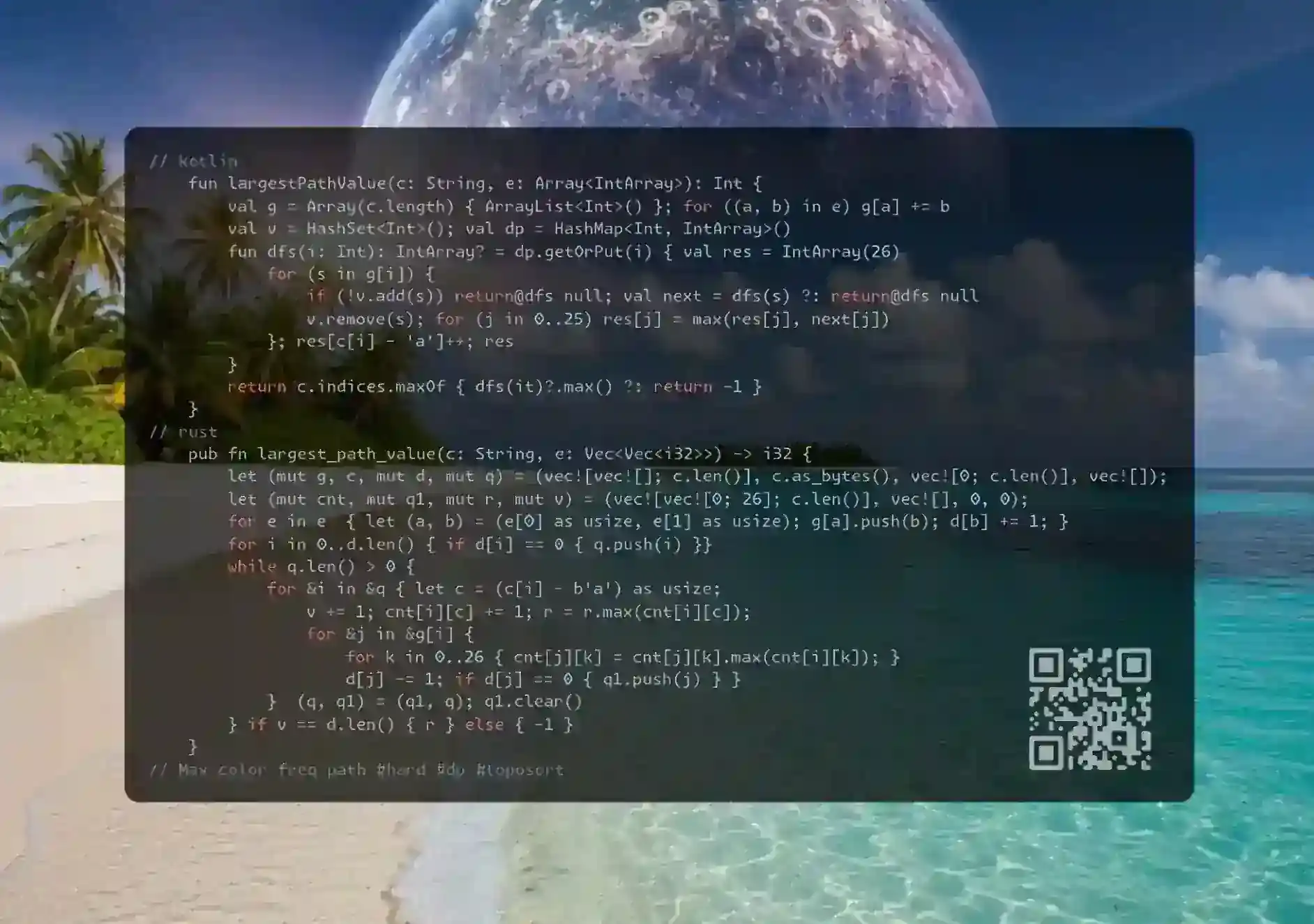
Join me on Telegram
https://t.me/leetcode_daily_unstoppable/1000
Problem TLDR
Max color freq path #hard #dp #toposort
Intuition
    // for every node
    // (freq of colors)
    // we want max(freq)
As graph is directed asyclic graph, we can assume each node has definite answer of top color frequencies of all path from it.
Walk those paths in DFS or BFS with toposort.
Approach
- to check cycle use a hashset, don’t forget to remove from it after we done, as we can have two different valid paths to the same node
- the toposort is: 1) count incoming nodes 2) always add to the queue
zeroincoming nodes
Complexity
-
Time complexity: \(O(VE)\)
-
Space complexity: \(O(V + E)\)
Code
// 1213ms
    fun largestPathValue(c: String, e: Array<IntArray>): Int {
        val g = Array(c.length) { ArrayList<Int>() }; for ((a, b) in e) g[a] += b
        val v = HashSet<Int>(); val dp = HashMap<Int, IntArray>()
        fun dfs(i: Int): IntArray? = dp.getOrPut(i) { val res = IntArray(26)
            for (s in g[i]) {
                if (!v.add(s)) return@dfs null; val next = dfs(s) ?: return@dfs null
                v.remove(s); for (j in 0..25) res[j] = max(res[j], next[j])
            }; res[c[i] - 'a']++; res
        }
        return c.indices.maxOf { dfs(it)?.max() ?: return -1 }
    }
// 802ms
    fun largestPathValue(c: String, e: Array<IntArray>): Int {
        val d = IntArray(c.length); val g = Array(d.size) { ArrayList<Int>() }
        val cnt = Array(d.size) { IntArray(26) }; for ((a, b) in e) { g[a] += b; ++d[b] }
        var q = ArrayList<Int>(); var q1 = ArrayList<Int>(); var r = 0; var v = 0;
        for (i in d.indices) if (d[i] == 0) q += i;
        while (q.size > 0) {
            for (i in q) {
                ++v; r = max(r, ++cnt[i][c[i] - 'a'])
                for (j in g[i]) {
                    for (k in 0..25) cnt[j][k] = max(cnt[j][k], cnt[i][k])
                    if (--d[j] == 0) q1 += j
                }
            }
            q = q1.also { q1 = q; q1.clear() }
        }
        return if (v == d.size) r else -1
    }
// 69ms
    pub fn largest_path_value(c: String, e: Vec<Vec<i32>>) -> i32 {
        let (mut g, c, mut d, mut q) = (vec![vec![]; c.len()], c.as_bytes(), vec![0; c.len()], vec![]);
        let (mut cnt, mut q1, mut r, mut v) = (vec![vec![0; 26]; c.len()], vec![], 0, 0);
        for e in e  { let (a, b) = (e[0] as usize, e[1] as usize); g[a].push(b); d[b] += 1; }
        for i in 0..d.len() { if d[i] == 0 { q.push(i) }}
        while q.len() > 0 {
            for &i in &q { let c = (c[i] - b'a') as usize;
                v += 1; cnt[i][c] += 1; r = r.max(cnt[i][c]);
                for &j in &g[i] {
                    for k in 0..26 { cnt[j][k] = cnt[j][k].max(cnt[i][k]); }
                    d[j] -= 1; if d[j] == 0 { q1.push(j) } }
            }  (q, q1) = (q1, q); q1.clear()
        } if v == d.len() { r } else { -1 }
    }
// 312ms
    int largestPathValue(string c, vector<vector<int>>& e) {
        int n = size(c), v = 0, r = 0; vector<array<int,26>> cnt(n);
        vector<vector<int>> g(n); vector<int> d(n); queue<int> q;
        for (auto& p : e) { g[p[0]].push_back(p[1]); ++d[p[1]]; }
        for (int i = 0; i < n; i++) if (!d[i]) q.push(i);
        while (!q.empty()) {
            int i = q.front(); q.pop(); ++v; r = max(r, ++cnt[i][c[i] - 'a']);
            for (int j: g[i]) {
                for (int k = 0; k < 26; k++) cnt[j][k] = max(cnt[j][k], cnt[i][k]);
                if (--d[j] == 0) q.push(j);
            }
        }
        return v == n ? r : -1;
    }
Comments