LeetCode Entry
2294. Partition Array Such That Maximum Difference Is K
k-narrow subsequences
2294. Partition Array Such That Maximum Difference Is K medium
blog post
substack
youtube
Join me on Telegram
https://t.me/leetcode_daily_unstoppable/1024
Problem TLDR
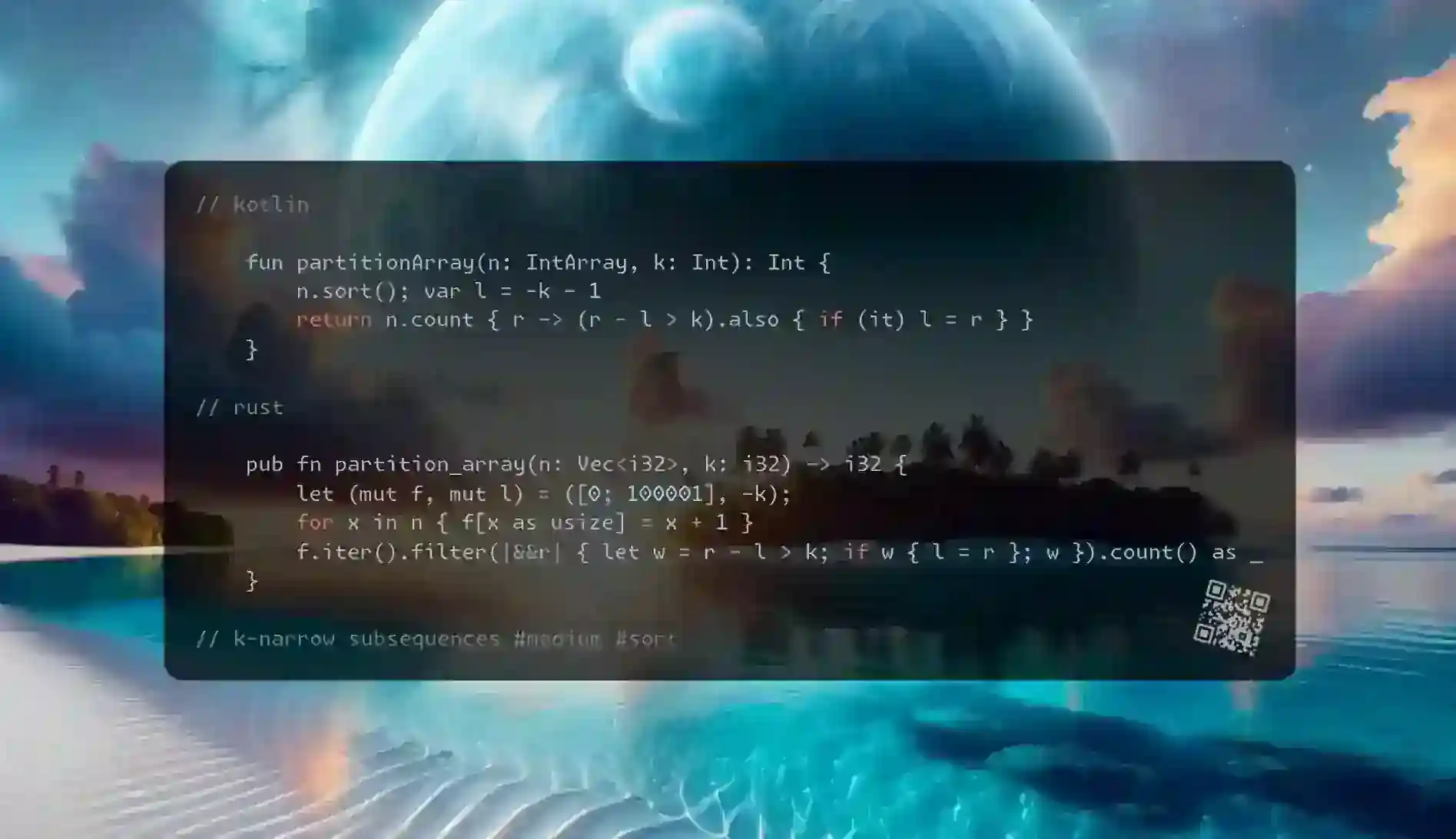
k-narrow subsequences #medium #sort
Intuition
Sort, then expand each subsequence as much as possible, the tail with thank you.
Approach
- we can use bucket sort or a bitset
Complexity
-
Time complexity: \(O(nlogn)\)
-
Space complexity: \(O(n)\)
Code
// 61ms
    fun partitionArray(n: IntArray, k: Int): Int {
        n.sort(); var l = -k - 1
        return n.count { r -> (r - l > k).also { if (it) l = r } }
    }
// 9ms
    fun partitionArray(n: IntArray, k: Int): Int {
        val f = java.util.BitSet(100001); for (x in n) f.set(x)
        var cnt = 0; var l = -k-1; var r = f.nextSetBit(0)
        while (r >= 0) {
            if (r - l > k) { l = r; ++cnt }
            r = f.nextSetBit(r + 1)
        }
        return cnt
    }
// 8ms
    fun partitionArray(n: IntArray, k: Int): Int {
        val f = IntArray(100001); for (x in n) f[x] = x + 1
        var cnt = 0; var l = -k
        for (r in f) if (r - l > k) { l = r; ++cnt }
        return cnt
    }
// 1ms
    pub fn partition_array(n: Vec<i32>, k: i32) -> i32 {
        let (mut f, mut l) = ([0; 100001], -k);
        for x in n { f[x as usize] = x + 1 }
        f.iter().filter(|&&r| { let w = r - l > k; if w { l = r }; w }).count() as _
    }
// 4ms
    int partitionArray(vector<int>& n, int k) {
        bitset<100001>f; int l = -k-1, c = 0;
        for (int x: n) f[x] = 1;
        for (int r = 0; r < 100001; ++r) if (f[r] && r - l > k) ++c, l = r;
        return c;
    }
Comments