LeetCode Entry
2044. Count Number of Maximum Bitwise-OR Subsets
Subsequencies with max OR
2044. Count Number of Maximum Bitwise-OR Subsets medium
blog post
substack
youtube
Join me on Telegram
https://t.me/leetcode_daily_unstoppable/1063
Problem TLDR
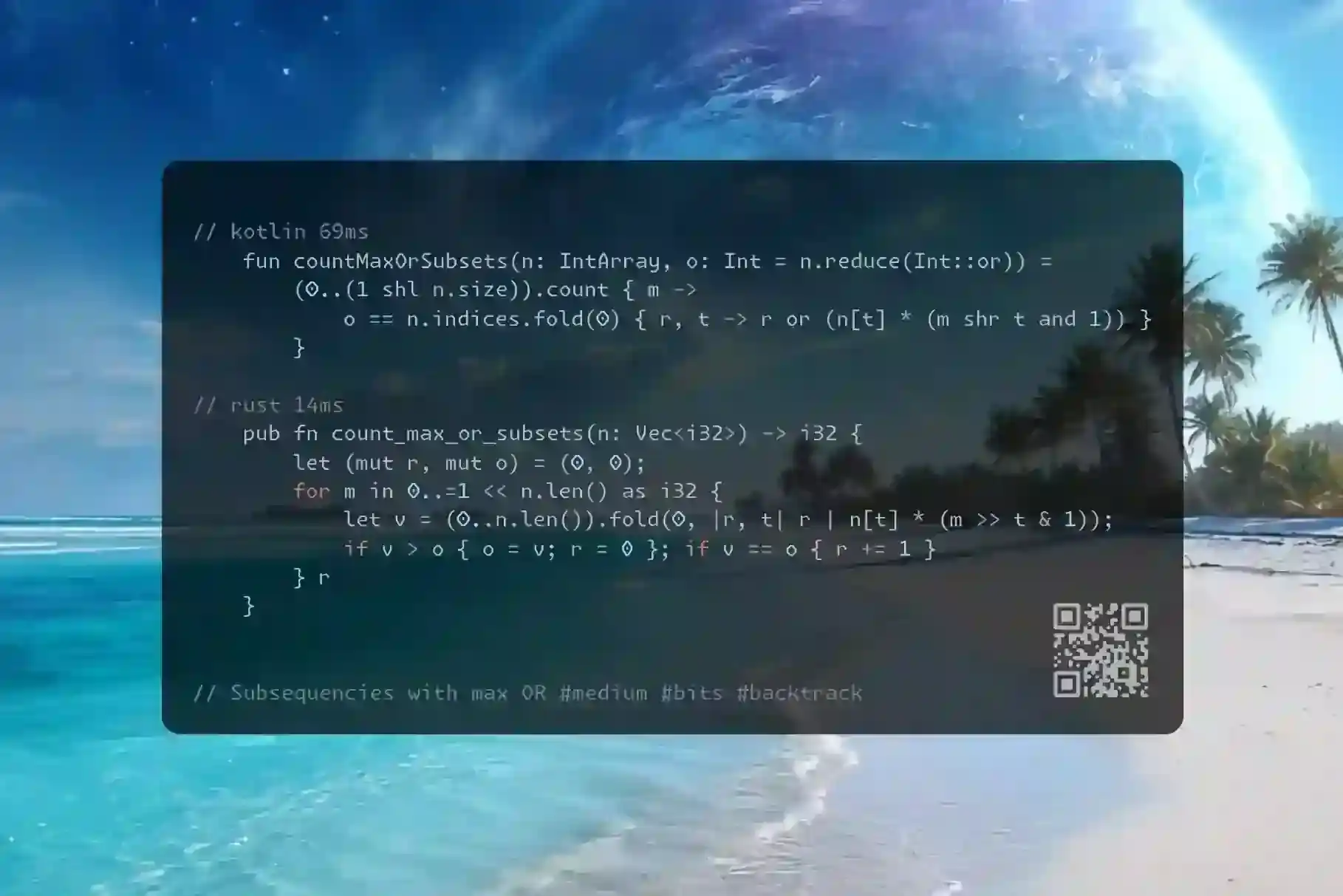
Subsequencies with max OR #medium #bits #backtrack
Intuition
Problem size is small - 16, traverse all subsequencies.
| The dp solution: dp[or] - number of subsets, dp[x | or_prev] += dp[or_prev] |
Approach
- 0..2^16 are all possible bitmasks
- the brute-force is slower than backtracking, every time goes from start: n2^n vs 2^n
- calculate max on the go
Complexity
-
Time complexity: \(O(n2^n)\)
-
Space complexity: \(O(1)\)
Code
// 69ms
    fun countMaxOrSubsets(n: IntArray, o: Int = n.reduce(Int::or)) =
        (0..(1 shl n.size)).count { m ->
            o == n.indices.fold(0) { r, t -> r or (n[t] * (m shr t and 1)) }
        }
// 53ms
    fun countMaxOrSubsets(n: IntArray): Int {
        var res = 0; var max = 0
        for (m in 0..(1 shl n.size)) {
            val v = n.indices.fold(0) { r, t -> r or (n[t] * (m shr t and 1)) }
            if (v > max) { max = v; res = 1 } else if (v == max) ++res
        }
        return res
    }
// 14ms
    pub fn count_max_or_subsets(n: Vec<i32>) -> i32 {
        let (mut r, mut o) = (0, 0);
        for m in 0..=1 << n.len() as i32 {
            let v = (0..n.len()).fold(0, |r, t| r | n[t] * (m >> t & 1));
            if v > o { o = v; r = 0 }; if v == o { r += 1 }
        } r
    }
// 86ms
    int countMaxOrSubsets(vector<int>& n) {
        int max = 0, dp[1<<17]={1};
        for (int x: n) {
            for (int i = max; i >= 0; --i) dp[i | x] += dp[i];
            max |= x;
        } return dp[max];
    }
// 14ms
 def countMaxOrSubsets(self, n: List[int]) -> int:
        return (f:=cache(lambda i,v,o=reduce(or_,n):n[i:] and f(i+1,v)+f(i+1,v|n[i]) or v==o))(0,0)
Comments