LeetCode Entry
3347. Maximum Frequency of an Element After Performing Operations II
Max frequency after changing +k..-k ops elements window
3347. Maximum Frequency of an Element After Performing Operations II hard blog post substack youtube
Join me on Telegram
https://t.me/leetcode_daily_unstoppable/1150
Problem TLDR
Max frequency after changing +k..-k ops elements #medium #sliding_window
Intuition
    // its like yesterday problem
    // so we have two numbers 5,11     the k=5 but ops=1
    //                                 we can't change both
    // can we have same situation for 3 numbers?
    //           5,5,11   k=5 ops=2     the strategy min(o,2)*k didn't work
Solve two separate problems:
- choose every number as baseline, window b-k..b+k
- no baseline, just 2k window
Approach
- the first is the frequency of baseline plus all opeations restricted by the window size
- the second is the entire window restricted by the number of operations
Complexity
-
Time complexity: \(O(nlog(n))\)
-
Space complexity: \(O(n)\)
Code
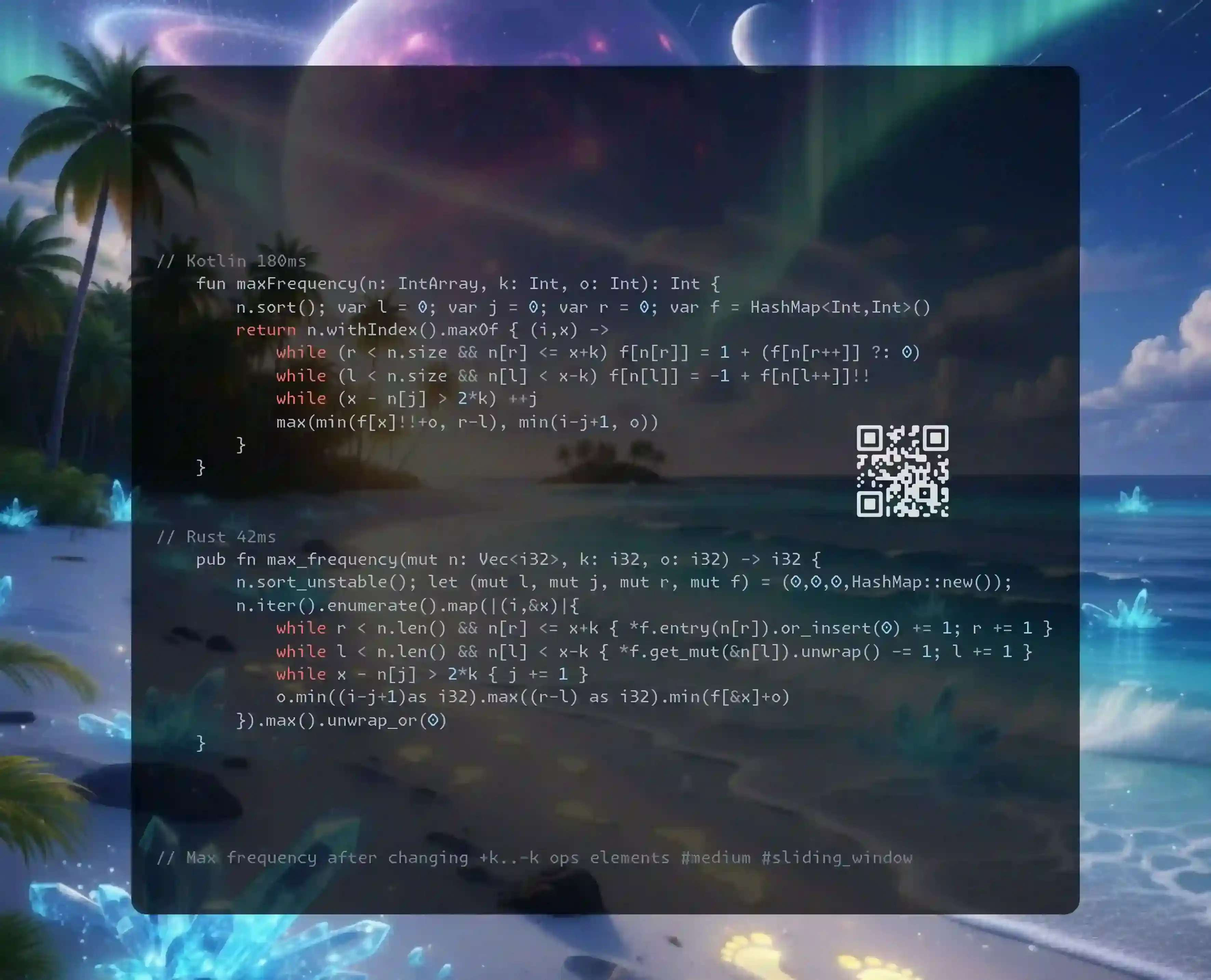
// 180ms
    fun maxFrequency(n: IntArray, k: Int, o: Int): Int {
        n.sort(); var l = 0; var j = 0; var r = 0; var f = HashMap<Int,Int>()
        return n.withIndex().maxOf { (i,x) ->
            while (r < n.size && n[r] <= x+k) f[n[r]] = 1 + (f[n[r++]] ?: 0)
            while (l < n.size && n[l] < x-k) f[n[l]] = -1 + f[n[l++]]!!
            while (x - n[j] > 2*k) ++j
            max(min(f[x]!!+o, r-l), min(i-j+1, o))
        }
    }
// 42ms
    pub fn max_frequency(mut n: Vec<i32>, k: i32, o: i32) -> i32 {
        n.sort_unstable(); let (mut l, mut j, mut r, mut f) = (0,0,0,HashMap::new());
        n.iter().enumerate().map(|(i,&x)|{
            while r < n.len() && n[r] <= x+k { *f.entry(n[r]).or_insert(0) += 1; r += 1 }
            while l < n.len() && n[l] < x-k { *f.get_mut(&n[l]).unwrap() -= 1; l += 1 }
            while x - n[j] > 2*k { j += 1 }
            o.min((i-j+1)as i32).max((r-l) as i32).min(f[&x]+o)
        }).max().unwrap_or(0)
    }
Comments