LeetCode Entry
3660. Jump Game IX
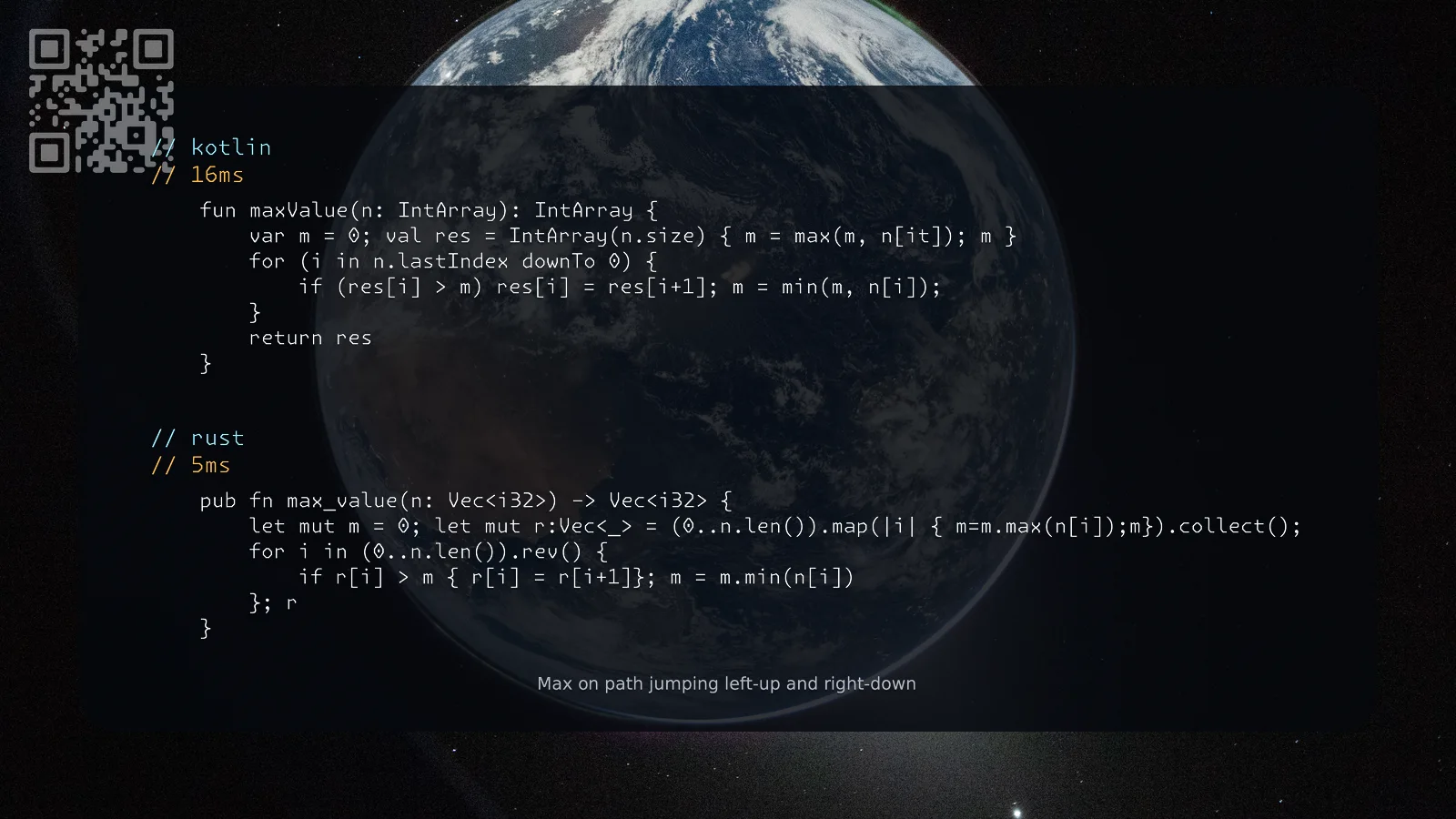
Max on path jumping left-up and right-down
3660. Jump Game IX medium substack youtube
https://dmitrysamoylenko.com/leetcode/
Join me on Telegram
https://t.me/leetcode_daily_unstoppable/1352
Problem TLDR
Max on path jumping left-up and right-down
Intuition
    // 2 3 1
    // *        decreasing sequence 3 1
    //
    // 1 2 3 4 3 2 1 2 3 4
    // *                       4 3 2 1
    //       j         i
    // ok maybe jump only to the left in one pass, then only to the right in second
    // 2 3 1
    // 2
    //   3
    //     3
    //   3
    // 3
    //
    // 2 1 3
    // 2 2 3
    //     3
    //   3?
    //
    // 3  1 5 6  4  2
    //*i  j         j
    // j* i
    //*     i    j  j
    //*       i
    //      j j* i  j
    //      j j* j  i
    //             how many jumps possible? is it possible for valid path have 3 jumps?
    //              i*
    //           i  j*  for backwards pass with want to track first lower
    //        i     j*
    //      i       j*
    //    i
    // i            j*
    //
    // 3  1 5 6  2  4
    // i
    // j  i
    //      i
    //        i
    //        j  i
    //        j     i    for forward pass only the max
    //              i
    //           i
    //        i     j
    //      i       j   override with max(n[i],n[j])
    //    i
    // i         j      have to find j = set.lower(3)
    //              can we do monotonic stack/queue? - no, we don't know what useful
    //
    // 29minute wrong answer: nums = [30,21,5,35,24]
    // my [35,30,30,35,35] Expected [35,35,35,35,35]
    //
    //  0  1 2  3  4
    // 30 21 5 35 24    max 0
    //  i                   30
    //  j  i                30
    //  j    i              30
    //          i           35
    //          j i         35
    //            i     set 24=4
    //          i j         35=3    ok my mistake was: i was taking lower, but need max distance
    //                              and second mistake: it can be more than two jumps
    // at this point let's go to hints: graph
    // 61 minute wrong answer:  989 / 1002 testcases passed,
    // nums = [11,18,11] Output [18,18,18] Expected [11,18,18]
O(nlogn):
- first pass left-up jumps make increasing running max array
- second pass backwards: find the rightmost position with value less than current and use its best left-up jump res[j]
- we can use monotonic decreasing queue and binary search it O(n): The clever iddea is based on proove: instead of finding rightmost-less, we can just use res[i+1], if we can jump right (minSoFar < res[i]).
- res[i] - means best jump left-up
- min < res[i] - means we can jump right-down to this min
- no reason to jump ahead of res[i+1] because he is also sees this min’s position
Approach
- or we can watch several examples and see that results are always perfectly sorted
Complexity
-
Time complexity: \(O(n)\)
-
Space complexity: \(O(n)\)
Code
    fun maxValue(n: IntArray): IntArray {
        var m = 0; val res = IntArray(n.size) { m = max(m, n[it]); m }
        for (i in n.lastIndex downTo 0) {
            if (res[i] > m) res[i] = res[i+1]; m = min(m, n[i]);
        }
        return res
    }
    pub fn max_value(n: Vec<i32>) -> Vec<i32> {
        let mut m = 0; let mut r:Vec<_> = (0..n.len()).map(|i| { m=m.max(n[i]);m}).collect();
        for i in (0..n.len()).rev() {
            if r[i] > m { r[i] = r[i+1]}; m = m.min(n[i])
        }; r
    }
Comments