LeetCode Entry
1665. Minimum Initial Energy to Finish Tasks
Energy for all tasks (spend, limit)
1665. Minimum Initial Energy to Finish Tasks hard substack youtube
https://dmitrysamoylenko.com/leetcode/
Join me on Telegram
https://t.me/leetcode_daily_unstoppable/1357
Problem TLDR
Energy for all tasks (spend, limit)
Intuition
    // we can do binary search
    // but how to optimally use the energy?
    // do we know that order is always decrease t[][1]?
    //
    // i don't have any better idea, let's write bs

    // 32
    // 10-12, 10-11, 8-9, 2-4, 1-3
    //        22     12   4    2     so this is the corner case
    //
    // 1-3 2-4 10-11 10-12 8-9
    // 32  31  29    19    9       this is the optimal order
    //
    // 26 minute, hints: Figure a sorting pattern
    //                   is exactly what i can't do
    //
    // so this is a brainteaser about sorting
    //
Didn’t solve without a hint. Sort by (spend-limit). Then do a binary search with forward pass and energy consumption or just a backward pass and energy max(spend, limit). The intuition behind (spend-limit): it is a greedy assumption that minimizing the consumption works. Why the pair of (spend,-limit) or (-limit, spend) doesn’t work? Because we want to maximize the “refund” (what was required - what was returned back).
Approach
- rust itertools allows one-liner
Complexity
-
Time complexity: \(O(nlogn)\)
-
Space complexity: \(O(1)\)
Code
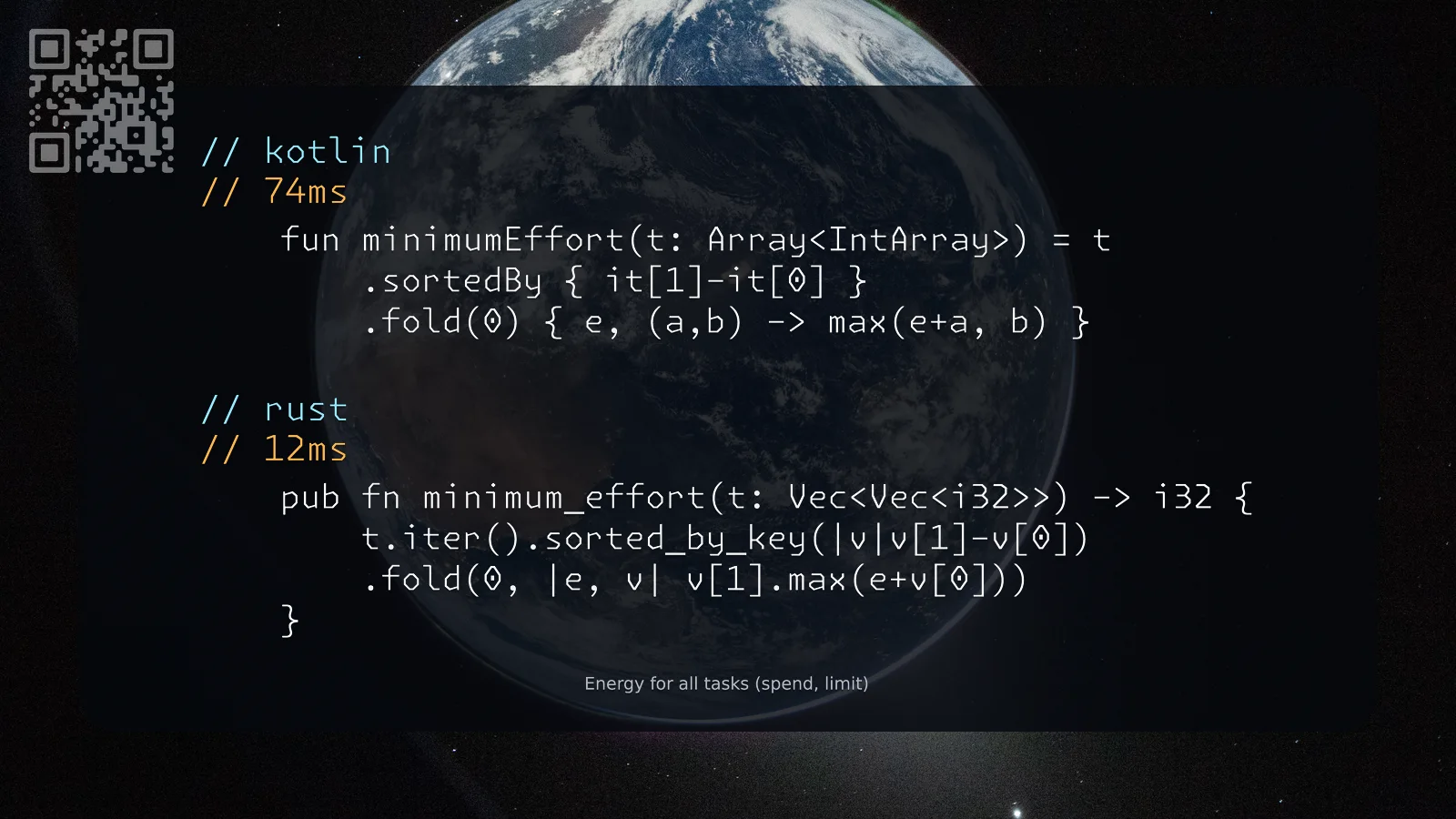
    fun minimumEffort(t: Array<IntArray>) = t
        .sortedBy { it[1]-it[0] }
        .fold(0) { e, (a,b) -> max(e+a, b) }
    pub fn minimum_effort(t: Vec<Vec<i32>>) -> i32 {
        t.iter().sorted_by_key(|v|v[1]-v[0])
        .fold(0, |e, v| v[1].max(e+v[0]))
    }
Comments