LeetCode Entry
1674. Minimum Moves to Make Array Complementary
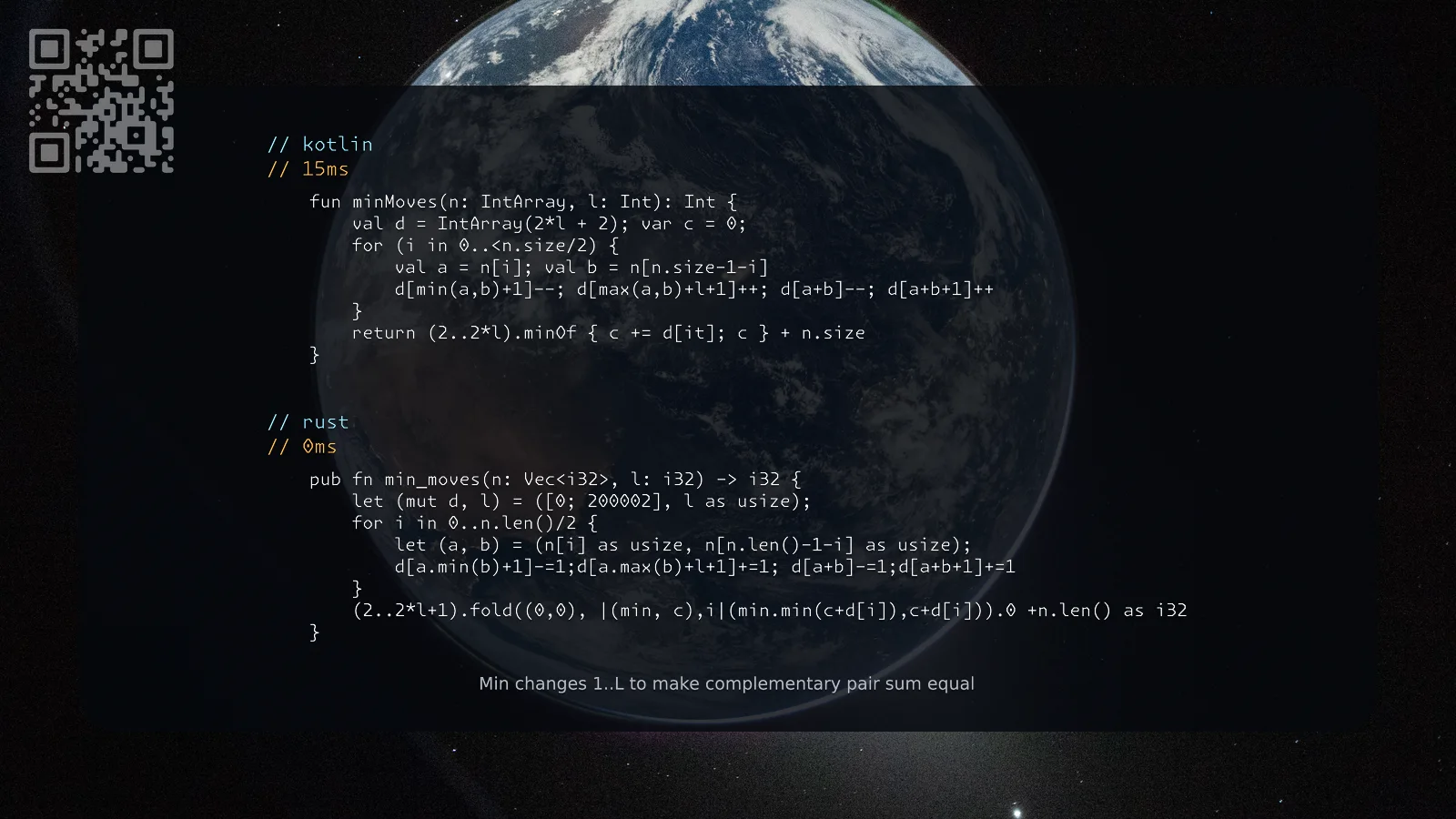
Min changes 1..L to make complementary pair sum equal
1674. Minimum Moves to Make Array Complementary medium substack youtube
https://dmitrysamoylenko.com/leetcode/
Join me on Telegram
https://t.me/leetcode_daily_unstoppable/1358
Problem TLDR
Min changes 1..L to make complementary pair sum equal
Intuition
    // brainteaser
    // max: we can convert all numbers to the same number
    // track pairs sums, peek the most common
    // each pair is a sum of ranges 1..l + 1..l
    // common sum should be within 2..2l
    // llll
    // aa
    //   bbbb
    //         s
    // aaaaaa
    //       bbb
    //        s
    // aa
    //   bb
    //  s
    // 28 minute wrong answer
    // 34 minute wrong answer
    // use hints: no help, difference array?
    // so looks like intersection of the intervals
Each value pair (a,b) forms a range of possible targets: 2..2L full range of targets where both ‘a’ and ‘b’ got changed; min(a,b)+1..max(a,b)+L is a range of single change either ‘a’ or ‘b’ a+b - is a single point where no change required, because target == a+b.
Merge all ranges then scan them to find maximum changes required.
Approach
- some computations can be extracted out of line sweep
Complexity
-
Time complexity: \(O(L+N)\)
-
Space complexity: \(O(L)\)
Code
    fun minMoves(n: IntArray, l: Int): Int {
        val d = IntArray(2*l + 2); var c = 0;
        for (i in 0..<n.size/2) {
            val a = n[i]; val b = n[n.size-1-i]
            d[min(a,b)+1]--; d[max(a,b)+l+1]++; d[a+b]--; d[a+b+1]++
        }
        return (2..2*l).minOf { c += d[it]; c } + n.size
    }
    pub fn min_moves(n: Vec<i32>, l: i32) -> i32 {
        let (mut d, l) = ([0; 200002], l as usize);
        for i in 0..n.len()/2 {
            let (a, b) = (n[i] as usize, n[n.len()-1-i] as usize);
            d[a.min(b)+1]-=1;d[a.max(b)+l+1]+=1; d[a+b]-=1;d[a+b+1]+=1
        }
        (2..2*l+1).fold((0,0), |(min, c),i|(min.min(c+d[i]),c+d[i])).0 +n.len() as i32
    }
Comments