LeetCode Entry
3534. Path Existence Queries in a Graph II
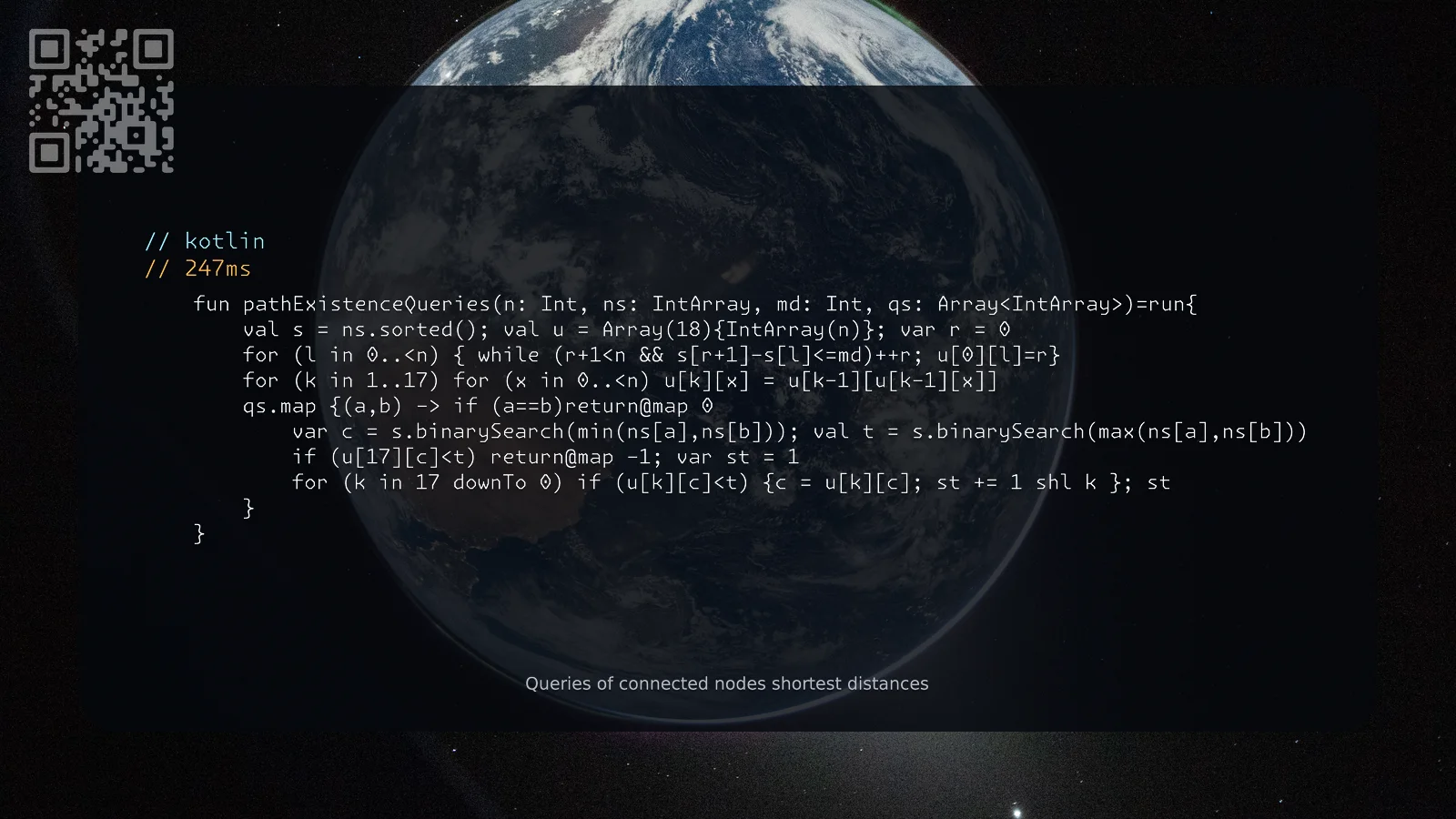
Queries of connected nodes shortest distances
3534. Path Existence Queries in a Graph II hard substack youtube
https://dmitrysamoylenko.com/leetcode/
Join me on Telegram
https://t.me/leetcode_daily_unstoppable/1416
Problem TLDR
Queries of connected nodes shortest distances
Intuition
Didn’t solved.
    // 1 1  1 1 1  1 1  1 1 1 1 from every node to every node dist = 1
    // 1 2 . 4 5 6 7 8 9 md=2
    // * * .
    // 1 1 .
    //   * . *
    // 2 1 . 0
    //     . * *
    // 2 2 . 1 0
    //     . * * *
    // 2 2 . 1 1 0
    // 3 2 . 2 1 1 0
    // 3 3 . 2 2 1 1 0
    // 3 3 . 2 2 2 1 1 0
    // 4 3 . 3 2 2 2 1 1 0
    //     ^
    //     can be removed, distances stay the same
    //     so the distance is (a-b)/md

    // 1 hr mark: wrong answer: 91, 92, 127, 173, 179, 182 md=51, 91-182 my 2, correct 3
    //                          so this simple formula doesnt work
    //                          182-91=91; 91/51 = 2
    //                          but 91+51 = 142, so we go to 127
    //                          127+51 = 178, we have to go to 173
    //                          173+51=200+ we arrive at 182 at 3 steps
    //                          that means for each number we should track next reachable
    //                          or do dp[current_position][steps_required]=reachable_position
    //                          but this is O(n^2), so let's give up
    // hints: binary jumping (?)
- sort the numbers
- use sliding window to find the rightmost jump for every cell: left goest +1, right goes until diff is bigger than max
- prepare binary lifting jump table: u[k][x] = u[k-1][Y] where Y = u[k-1][x]; for each x we prepare all 2^k (0..31) jumps by reusing previous;
- in query: find the left ‘c’ pointer and the right ‘t’ pointer positions
- by moving the left ‘c’ pointer with jump table count the jumps st += 2^k if it is not overshoot the right ‘t’ pointer u[k][c]<t
Approach
- learn the binary lifting
Complexity
-
Time complexity: \(O(nlogn)\)
-
Space complexity: \(O(n)\)
Code
    fun pathExistenceQueries(n: Int, ns: IntArray, md: Int, qs: Array<IntArray>)=run{
        val s = ns.sorted(); val u = Array(18){IntArray(n)}; var r = 0
        for (l in 0..<n) { while (r+1<n && s[r+1]-s[l]<=md)++r; u[0][l]=r}
        for (k in 1..17) for (x in 0..<n) u[k][x] = u[k-1][u[k-1][x]]
        qs.map {(a,b) -> if (a==b)return@map 0
            var c = s.binarySearch(min(ns[a],ns[b])); val t = s.binarySearch(max(ns[a],ns[b]))
            if (u[17][c]<t) return@map -1; var st = 1
            for (k in 17 downTo 0) if (u[k][c]<t) {c = u[k][c]; st += 1 shl k }; st
        }
    }
Comments