LeetCode Entry
3947. Maximum Number of Items From Sale II
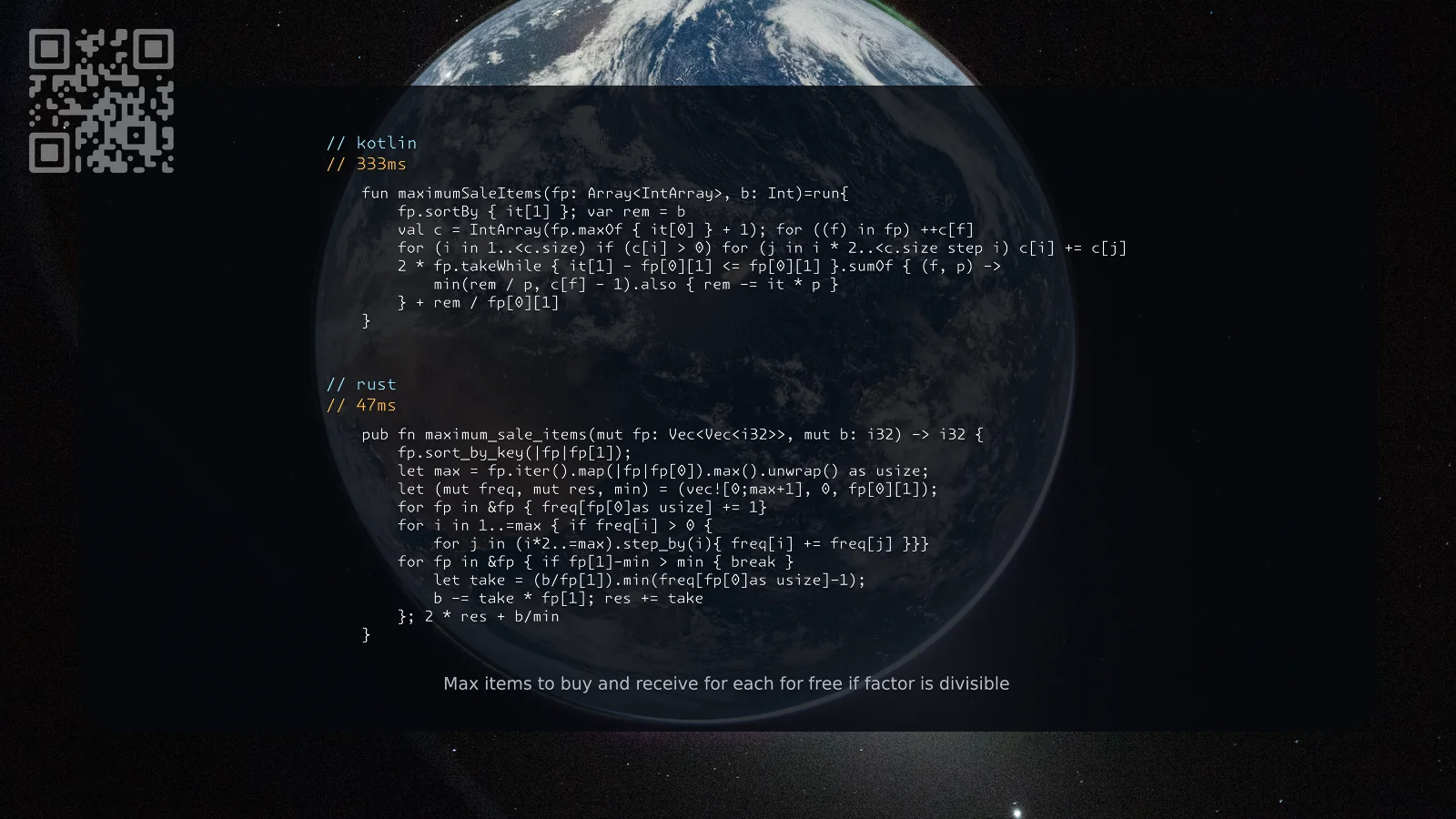
Max items to buy and receive for each for free if factor is divisible
3947. Maximum Number of Items From Sale II medium substack youtube
https://dmitrysamoylenko.com/leetcode/
Join me on Telegram
https://t.me/leetcode_daily_unstoppable/1556
Problem TLDR
Max items to buy and receive for each for free if factor is divisible
Intuition
    // you can't even collect factors in O(n^2) because problem is 10^5
    // 7 minute use hints
    // 28 minute: give up, it is greedy with some clever reasoning
Didn’t solve.
Greedy idea: take as much items with bonuses as possible. Start with lowest price to be greedily optimal. Each item give a signel bonus, so total +2 for each. The leftovers are filled with lowest cost item b/min_price. If item with bonus is worse than just buying to lowest cost items then we can stop.
Approach
- to count factors in less than O(n^2) iterate over factors frequencies multiples from lower to higher and aggregate
Complexity
-
Time complexity: \(O(nlogn)\)
-
Space complexity: \(O(n)\)
Code
    fun maximumSaleItems(fp: Array<IntArray>, b: Int)=run{
        fp.sortBy { it[1] }; var rem = b
        val c = IntArray(fp.maxOf { it[0] } + 1); for ((f) in fp) ++c[f]
        for (i in 1..<c.size) if (c[i] > 0) for (j in i * 2..<c.size step i) c[i] += c[j]
        2 * fp.takeWhile { it[1] - fp[0][1] <= fp[0][1] }.sumOf { (f, p) ->
            min(rem / p, c[f] - 1).also { rem -= it * p }
        } + rem / fp[0][1]
    }
    pub fn maximum_sale_items(mut fp: Vec<Vec<i32>>, mut b: i32) -> i32 {
        fp.sort_by_key(|fp|fp[1]);
        let max = fp.iter().map(|fp|fp[0]).max().unwrap() as usize;
        let (mut freq, mut res, min) = (vec![0;max+1], 0, fp[0][1]);
        for fp in &fp { freq[fp[0]as usize] += 1}
        for i in 1..=max { if freq[i] > 0 {
            for j in (i*2..=max).step_by(i){ freq[i] += freq[j] }}}
        for fp in &fp { if fp[1]-min > min { break }
            let take = (b/fp[1]).min(freq[fp[0]as usize]-1);
            b -= take * fp[1]; res += take
        }; 2 * res + b/min
    }
Comments