LeetCode Entry
1569. Number of Ways to Reorder Array to Get Same BST
Count permutations of an array with identical Binary Search Tree
1569. Number of Ways to Reorder Array to Get Same BST hard
blog post
substack
Join me on Telegram Leetcode_daily
https://t.me/leetcode_daily_unstoppable/247
Problem TLDR
Count permutations of an array with identical Binary Search Tree
Intuition
First step is to build a Binary Search Tree by adding the elements one by one.
Let’s observe what enables the permutations in [34512]:
 Left child
 [12] don’t have permutations, as 1 must be followed by 2. Same for the right [45]. However, when we’re merging left and right, they can be merged in different positions.
Let’s observe the pattern for merging ab x cde, ab x cd, ab x c, a x b:
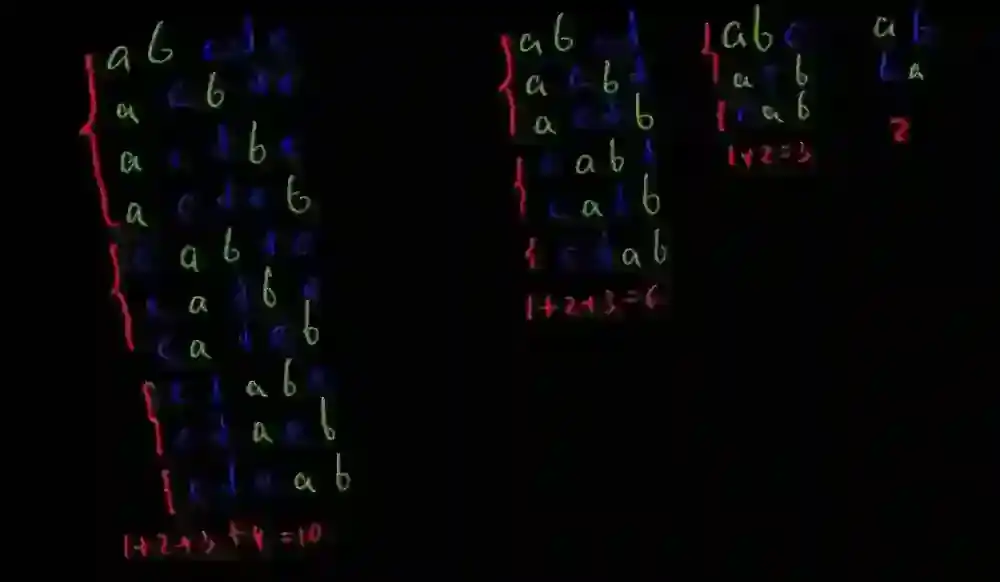 And another,
 abc x def:
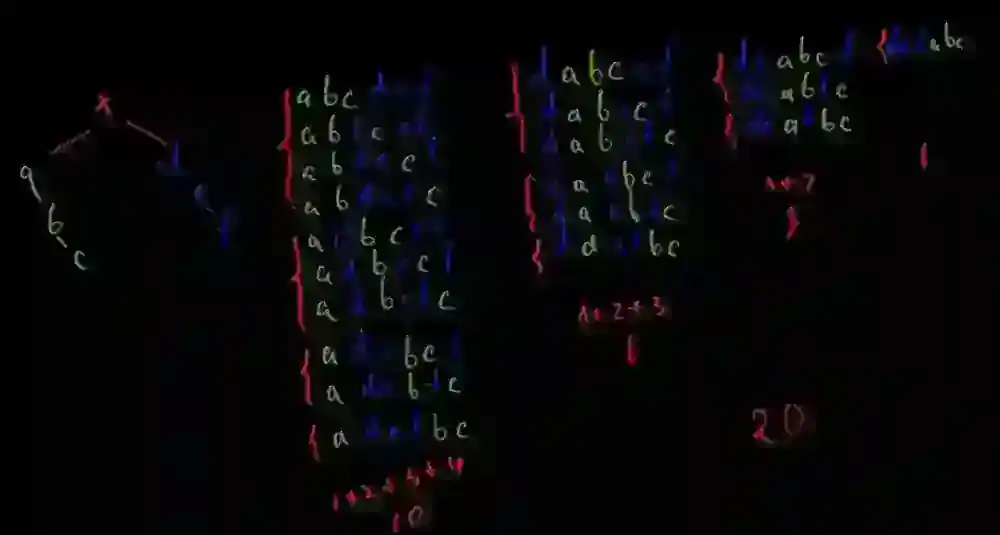 For each
 length of a left len1 and right len2 subtree, we can derive the equation for permutations p:
\(p(len1, len2) = p(len1 - 1, len2) + p(len1, len2 - 1)\)
Also, when left or right subtree have several permutations, like abc, acb, cab, and right def, dfe, the result will be multiplied 3 x 2.
Approach
Build the tree, then compute the p = left.p * right.p * p(left.len, right.len) in a DFS.
Complexity
- Time complexity:
\(O(n^2)\), n for tree walk, and n^2 for
f - Space complexity: \(O(n^2)\)
Code
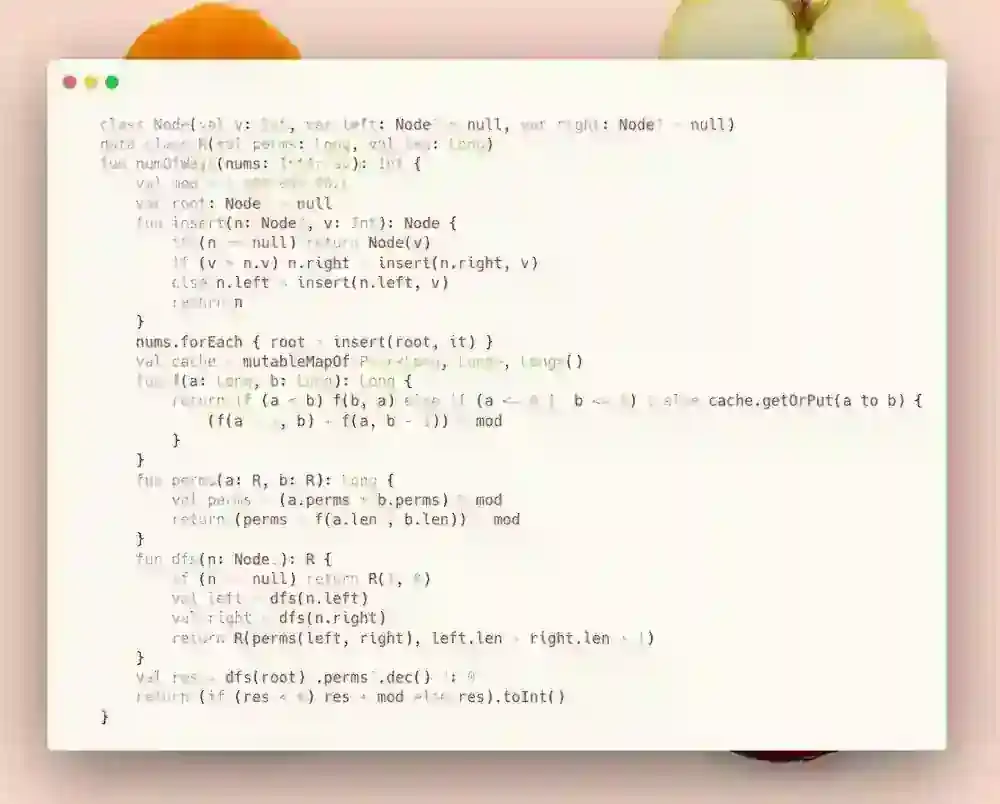
class Node(val v: Int, var left: Node? = null, var right: Node? = null)
data class R(val perms: Long, val len: Long)
fun numOfWays(nums: IntArray): Int {
    val mod = 1_000_000_007L
    var root: Node? = null
    fun insert(n: Node?, v: Int): Node {
        if (n == null) return Node(v)
        if (v > n.v) n.right = insert(n.right, v)
        else n.left = insert(n.left, v)
        return n
    }
    nums.forEach { root = insert(root, it) }
    val cache = mutableMapOf<Pair<Long, Long>, Long>()
    fun f(a: Long, b: Long): Long {
        return if (a < b) f(b, a) else if (a <= 0 || b <= 0) 1 else cache.getOrPut(a to b) {
            (f(a - 1, b) + f(a, b - 1)) % mod
        }
    }
    fun perms(a: R, b: R): Long {
        val perms = (a.perms * b.perms) % mod
        return (perms * f(a.len , b.len)) % mod
    }
    fun dfs(n: Node?): R {
        if (n == null) return R(1, 0)
        val left = dfs(n.left)
        val right = dfs(n.right)
        return R(perms(left, right), left.len + right.len + 1)
    }
    val res = dfs(root)?.perms?.dec() ?: 0
    return (if (res < 0) res + mod else res).toInt()
}
Comments