LeetCode Entry
894. All Possible Full Binary Trees
All possible Full Binary Trees with n nodes, each have both children
894. All Possible Full Binary Trees medium
blog post
substack
Join me on Telegram
https://t.me/leetcode_daily_unstoppable/284
Problem TLDR
All possible Full Binary Trees with n nodes, each have both children
Intuition
First, if count of nodes is even, BFT is not possible.
Let’s observe how the Trees are growing:
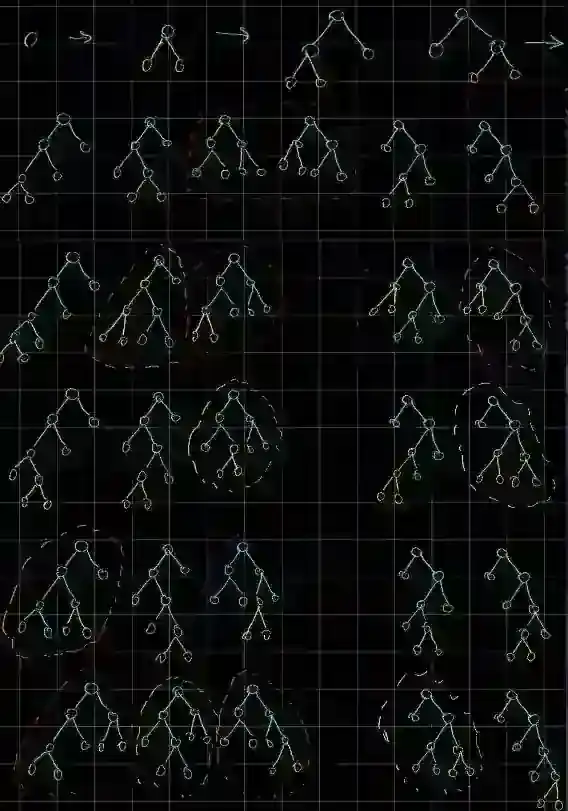
There are n / 2 rounds of adding a new pair of nodes to each leaf of each Tree in the latest generation.
Some duplicate trees occur, so we need to calculate a hash.
Approach
Let’s implement it in a BFS manner.
- to avoid collision of the
hash, add some symbols to indicate a level[...]
Complexity
-
Time complexity: \(O(n^4 2^n)\), n generations, queue size grows in 2^n manner, count of leafs grows by 1 each generation, so it’s x + (x + 1) + .. + (x + n), giving n^2, another n for collection leafs, and another for hash and clone
-
Space complexity: \(O(n^3 2^n)\)
Code
    fun clone(curr: TreeNode): TreeNode = TreeNode(0).apply {
      curr.left?.let { left = clone(it) }
      curr.right?.let { right = clone(it) }
    }
    fun hash(curr: TreeNode): String =
      "[${curr.`val`} ${ curr.left?.let { hash(it) } } ${ curr.right?.let { hash(it) } }]"
    fun collectLeafs(curr: TreeNode): List<TreeNode> =
      if (curr.left == null && curr.right == null) listOf(curr)
      else collectLeafs(curr.left!!) + collectLeafs(curr.right!!)
    fun allPossibleFBT(n: Int): List<TreeNode?> = if (n % 2 == 0) listOf() else
      with (ArrayDeque<TreeNode>().apply { add(TreeNode(0)) }) {
        val added = HashSet<String>()
        repeat (n / 2) { rep ->
          repeat(size) {
            val root = poll()
            collectLeafs(root).forEach {
              it.left = TreeNode(0)
              it.right = TreeNode(0)
              if (added.add(hash(root))) add(clone(root))
              it.left = null
              it.right = null
            }
          }
        }
        toList()
      }
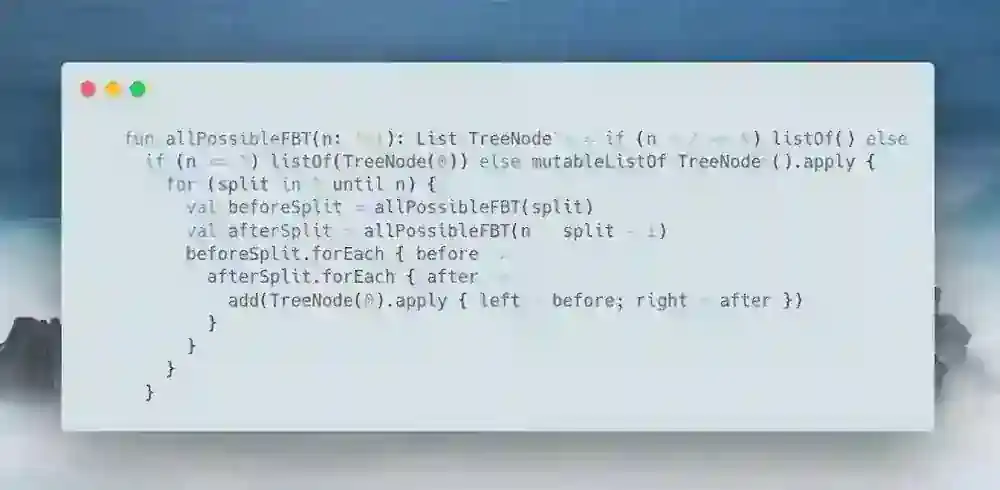
effective solution. It can be described as “for every N generate every possible split of [0..i] [i+1..N]”. Subtrees are also made of all possible combinations.
Comments