LeetCode Entry
2962. Count Subarrays Where Max Element Appears at Least K Times
Count subarrays with at least k array max in
2962. Count Subarrays Where Max Element Appears at Least K Times medium
blog post
substack
youtube
Join me on Telegram
https://t.me/leetcode_daily_unstoppable/553
Problem TLDR
Count subarrays with at least k array max in #medium
Intuition
Let’s observe an example 1 3 3:
    // inverse the problem
    // [1], [3], [3], [1 3], [1 3 3], [3 3] // 6
    // 1 3 3     ck  c
    // j .
    // i .           1
    //   i        1  3
    //     i      2
    //   j
    //     j      1  4
    //                          6-4=2
The problem is more simple if we invert it: count subarrays with less than k maximums. Then it is just a two-pointer problem: increase by one, then shrink until condition < k met.
Another way, is to solve problem at face: left border is the count we need - all subarrays before our j..i will have k max elements if j..i have them.
Approach
Let’s implement both.
Complexity
-
Time complexity: \(O(n)\)
-
Space complexity: \(O(1)\)
Code
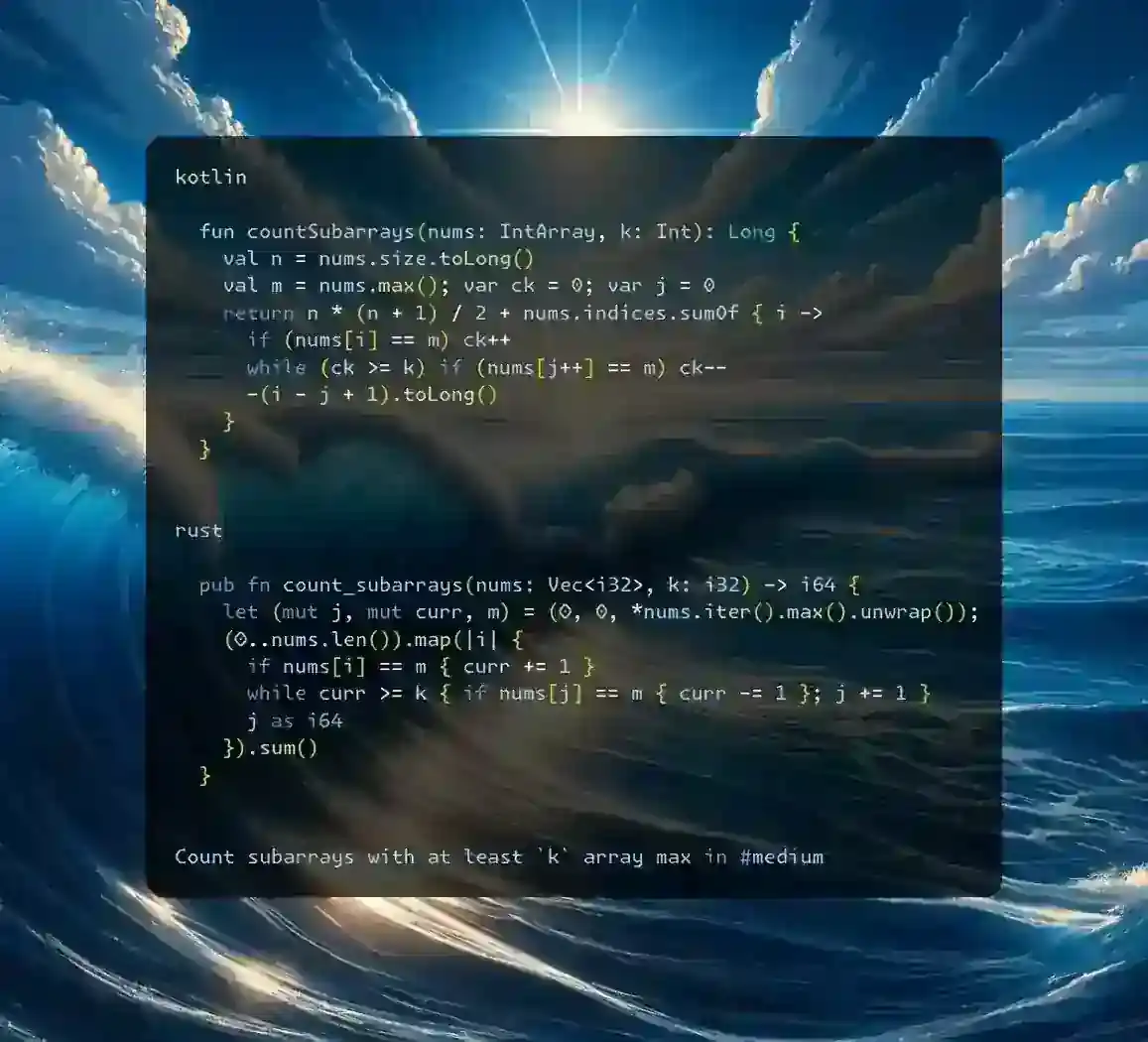
  fun countSubarrays(nums: IntArray, k: Int): Long {
    val n = nums.size.toLong()
    val m = nums.max(); var ck = 0; var j = 0
    return n * (n + 1) / 2 + nums.indices.sumOf { i ->
      if (nums[i] == m) ck++
      while (ck >= k) if (nums[j++] == m) ck--
      -(i - j + 1).toLong()
    }
  }
  pub fn count_subarrays(nums: Vec<i32>, k: i32) -> i64 {
    let (mut j, mut curr, m) = (0, 0, *nums.iter().max().unwrap());
    (0..nums.len()).map(|i| {
      if nums[i] == m { curr += 1 }
      while curr >= k { if nums[j] == m { curr -= 1 }; j += 1 }
      j as i64
    }).sum()
  }
Comments