LeetCode Entry
1530. Number of Good Leaf Nodes Pairs
Count at most distance paths between leaves
1530. Number of Good Leaf Nodes Pairs medium
blog post
substack
youtube
Join me on Telegram
https://t.me/leetcode_daily_unstoppable/674
Problem TLDR
Count at most distance paths between leaves #medium #tree
Intuition
Let’s move up from leaves and see what information we should preserve:
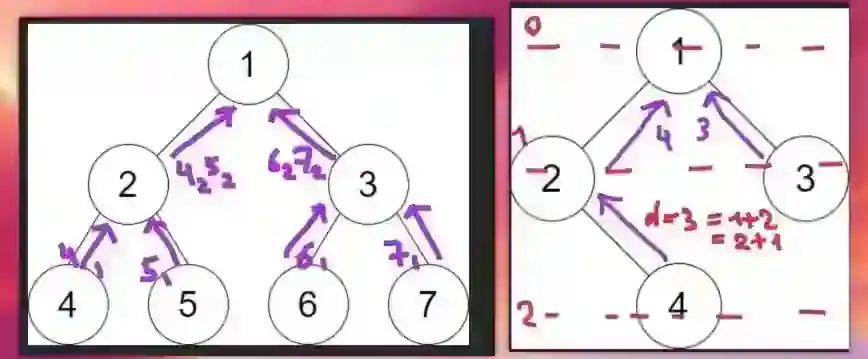
- there are at most 10 levels for the given problem set
- we should compare the
leftnode levels counts with therightnode - we should check all levels combinations 1..10 for the left, and 1..10 for the right
- individual leaves are irrelevant, all the distances are equal to their level
Approach
- We can use a HashMap, or just an array.
- The
levelparameter is not required, just move one level up from the left and right results.
Complexity
-
Time complexity: \(O(nlog^2(n))\)
-
Space complexity: \(O(log^2(n))\), log(n) for the call stack, and at each level we hold log(n) array of the result
Code
    fun countPairs(root: TreeNode?, distance: Int): Int {
        var res = 0
        fun dfs(n: TreeNode?): IntArray = IntArray(11).apply {
            if (n != null)
            if (n.left == null && n.right == null) this[1] = 1 else {
                val l = dfs(n.left); val r = dfs(n.right)
                for (i in 1..10) for (j in 1..distance - i) res += l[i] * r[j]
                for (i in 1..9) this[i + 1] = l[i] + r[i]
        }}
        dfs(root)
        return res
    }
    pub fn count_pairs(root: Option<Rc<RefCell<TreeNode>>>, distance: i32) -> i32 {
        fn dfs(n: &Option<Rc<RefCell<TreeNode>>>, res: &mut i32, d: usize) -> Vec<i32> {
            let mut arr = vec![0; 11]; let Some(n) = n else { return arr };
            let n = n.borrow();
            if n.left.is_none() && n.right.is_none() { arr[1] = 1 } else {
                let l = dfs(&n.left, res, d); let r = dfs(&n.right, res, d);
                for i in 1..11 { for j in 1..11 { if i + j <= d { *res += l[i] * r[j] }}}
                for i in 1..10 { arr[i + 1] = l[i] + r[i] }
            }; arr
        }
        let mut res = 0; dfs(&root, &mut res, distance as usize); res
    }
Comments