LeetCode Entry
2458. Height of Binary Tree After Subtree Removal Queries
n new heights by cutting nodes in a Tree
2458. Height of Binary Tree After Subtree Removal Queries hard
blog post
substack
youtube
deep-dive
Join me on Telegram
https://t.me/leetcode_daily_unstoppable/780
Problem TLDR
n new heights by cutting nodes in a Tree #hard #dfs
Intuition
After cutting, check the sibling: if it has the bigger depth, we are good, otherwise update and go up. This will take O(log(n)) for each call.
We can speed it up by tracking the level from the node upwards to the root.
The catch is the siblings of each level: there can be more than one of them. Check if the cutting node is the current level maximum depth, and if so, take the second maximum of the depth.
Approach
- can be done in a single DFS traversal
- in Rust
let m = ld[lvl]makes acopy, do&mut ld[lvl]instead (silent bug) - arrays are faster than HashMap (in the leetcode tests runner)
Complexity
-
Time complexity: \(O(n + q)\)
-
Space complexity: \(O(n + q)\)
Code
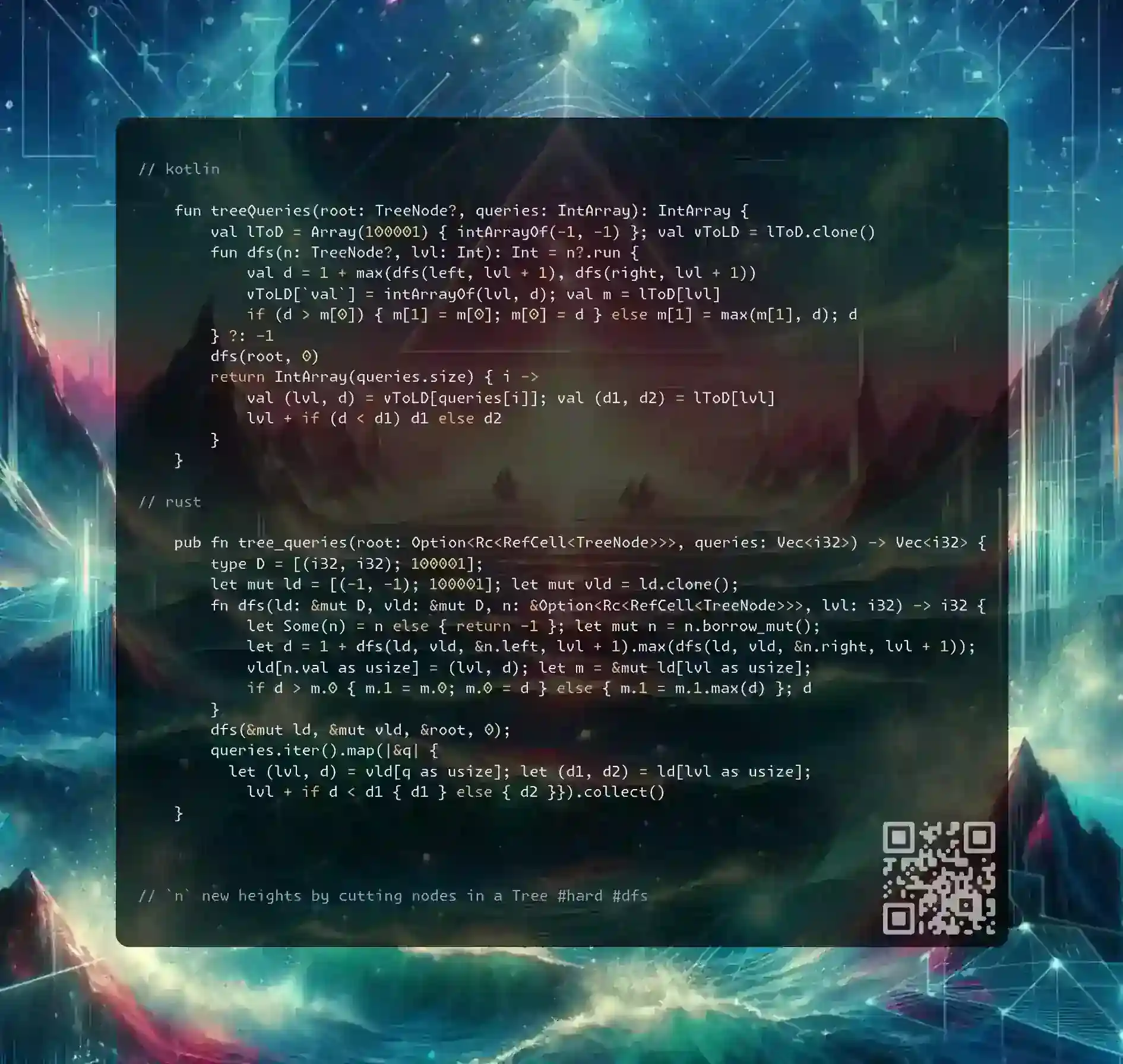
    fun treeQueries(root: TreeNode?, queries: IntArray): IntArray {
        val lToD = Array(100001) { intArrayOf(-1, -1) }; val vToLD = lToD.clone()
        fun dfs(n: TreeNode?, lvl: Int): Int = n?.run {
            val d = 1 + max(dfs(left, lvl + 1), dfs(right, lvl + 1))
            vToLD[`val`] = intArrayOf(lvl, d); val m = lToD[lvl]
            if (d > m[0]) { m[1] = m[0]; m[0] = d } else m[1] = max(m[1], d); d
        } ?: -1
        dfs(root, 0)
        return IntArray(queries.size) { i ->
            val (lvl, d) = vToLD[queries[i]]; val (d1, d2) = lToD[lvl]
            lvl + if (d < d1) d1 else d2
        }
    }
    pub fn tree_queries(root: Option<Rc<RefCell<TreeNode>>>, queries: Vec<i32>) -> Vec<i32> {
        type D = [(i32, i32); 100001];
        let mut ld = [(-1, -1); 100001]; let mut vld = ld.clone();
        fn dfs(ld: &mut D, vld: &mut D, n: &Option<Rc<RefCell<TreeNode>>>, lvl: i32) -> i32 {
            let Some(n) = n else { return -1 }; let mut n = n.borrow_mut();
            let d = 1 + dfs(ld, vld, &n.left, lvl + 1).max(dfs(ld, vld, &n.right, lvl + 1));
            vld[n.val as usize] = (lvl, d); let m = &mut ld[lvl as usize];
            if d > m.0 { m.1 = m.0; m.0 = d } else { m.1 = m.1.max(d) }; d
        }
        dfs(&mut ld, &mut vld, &root, 0);
        queries.iter().map(|&q| {
          let (lvl, d) = vld[q as usize]; let (d1, d2) = ld[lvl as usize];
            lvl + if d < d1 { d1 } else { d2 }}).collect()
    }
    vector<int> treeQueries(TreeNode* root, vector<int>& queries) {
        array<pair<int, int>, 100001> ld{}, vld = ld;
        function<int(TreeNode*,int)> f = [&](TreeNode* n, int l) {
            if (!n) return 0;
            int d = 1 + max(f(n->left, l + 1), f(n->right, l + 1));
            vld[n->val] = {l, d}; auto& [d1, d2] = ld[l];
            if (d > d1) d2 = d1, d1 = d; else d2 = max(d2, d);
            return d;
        };
        f(root,0);
        transform(begin(queries), end(queries), begin(queries), [&](int q){
            auto [l, d] = vld[q]; auto [d1, d2] = ld[l]; return l - 1 + (d < d1 ? d1 : d2);
        });
        return queries;
    }
Comments