LeetCode Entry
2762. Continuous Subarrays
Count subarrays with difference <= 2 queue set
2762. Continuous Subarrays medium
blog post
substack
youtube
deep-dive
Join me on Telegram
https://t.me/leetcode_daily_unstoppable/832
Problem TLDR
Count subarrays with difference <= 2 #medium #monotonic_queue #tree_set
Intuition
Observe the example, let’s use two pointers sliding window:
    // 5 4 2 4  min max   iq    dq
    // i         5   5    5     5
    // j
    //   i       4   5    4     5 4
    //     i     2   5    2     5 4 2 shrink
    //   j       2   4    2     4 2   new max
After we shrink the window by moving j, we should update min and max of the window. To keep all potential next maximums and minimums we can use a monotonic queue technique: remove all non-increasing/non-decreasing values.
Another approach is to use a TreeSet: it naturally would give us updated min and max.
Approach
- if we drop the duplicates, the max queue size would be 4
- to use Kotlin’s TreeSet, we should also preserve duplicates by storing the indices
Complexity
-
Time complexity: \(O(n)\) or O(nlog(n))
-
Space complexity: \(O(1)\) or O(n)
Code
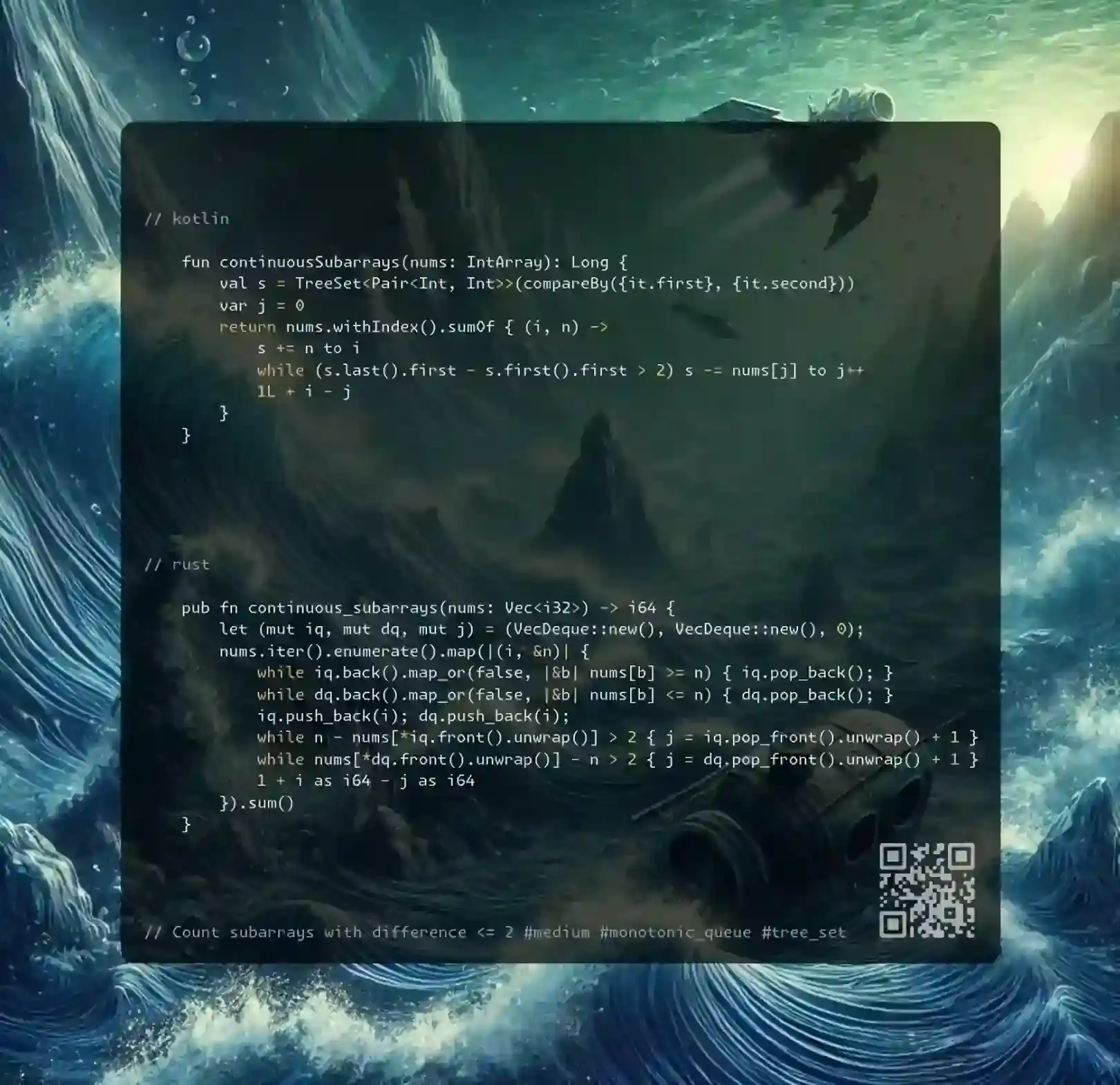
    fun continuousSubarrays(nums: IntArray): Long {
        val s = TreeSet<Pair<Int, Int>>(compareBy({it.first}, {it.second}))
        var j = 0
        return nums.withIndex().sumOf { (i, n) ->
            s += n to i
            while (s.last().first - s.first().first > 2) s -= nums[j] to j++
            1L + i - j
        }
    }
    pub fn continuous_subarrays(nums: Vec<i32>) -> i64 {
        let (mut iq, mut dq, mut j) = (VecDeque::new(), VecDeque::new(), 0);
        nums.iter().enumerate().map(|(i, &n)| {
            while iq.back().map_or(false, |&b| nums[b] >= n) { iq.pop_back(); }
            while dq.back().map_or(false, |&b| nums[b] <= n) { dq.pop_back(); }
            iq.push_back(i); dq.push_back(i);
            while n - nums[*iq.front().unwrap()] > 2 { j = iq.pop_front().unwrap() + 1 }
            while nums[*dq.front().unwrap()] - n > 2 { j = dq.pop_front().unwrap() + 1 }
            1 + i as i64 - j as i64
        }).sum()
    }
    long long continuousSubarrays(vector<int>& n) {
        long long r = 0; multiset<int> s;
        for (int i = 0, j = 0; i < n.size(); ++i) {
            s.insert(n[i]);
            while (s.size() && *s.rbegin() - *s.begin() > 2)
                s.erase(s.find(n[j++]));
            r += i - j + 1;
        }; return r;
    }
Comments