LeetCode Entry
1123. Lowest Common Ancestor of Deepest Leaves
Lowest common ancestor of deepest tree nodes
1123. Lowest Common Ancestor of Deepest Leaves medium
blog post
substack
youtube
Join me on Telegram
https://t.me/leetcode_daily_unstoppable/948
Problem TLDR
Lowest common ancestor of deepest tree nodes #medium #recursion
Intuition
Solve the problem for the left and right subtrees. Update ancestor of both left and right have equal depths.
Approach
- provide examples of several deepest nodes to better understand what is asked
Complexity
-
Time complexity: \(O(n)\)
-
Space complexity: \(O(log(n))\) recursion depth
Code
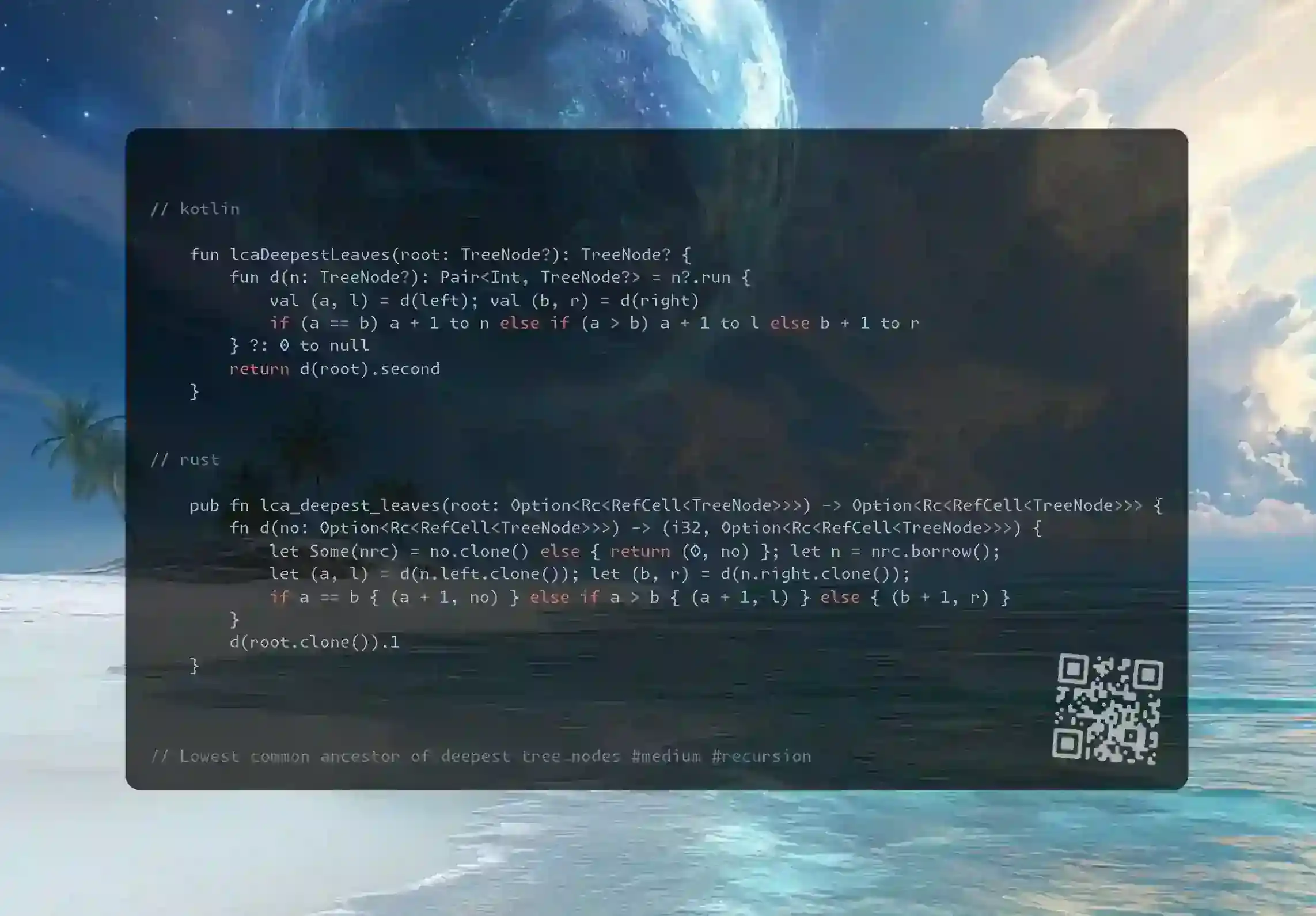
    fun lcaDeepestLeaves(root: TreeNode?): TreeNode? {
        fun d(n: TreeNode?): Pair<Int, TreeNode?> = n?.run {
            val (a, l) = d(left); val (b, r) = d(right)
            if (a == b) a + 1 to n else if (a > b) a + 1 to l else b + 1 to r
        } ?: 0 to null
        return d(root).second
    }
    fun lcaDeepestLeaves(root: TreeNode?): TreeNode? {
        var max = 0; var res = root
        fun d(n: TreeNode?, lvl: Int): Int {
            max = max(lvl, max); n ?: return lvl
            val l = d(n.left, lvl + 1); val r = d(n.right, lvl + 1)
            if (l == max && l == r) res = n
            return max(l, r)
        }
        d(root, 0)
        return res
    }
    pub fn lca_deepest_leaves(root: Option<Rc<RefCell<TreeNode>>>) -> Option<Rc<RefCell<TreeNode>>> {
        fn d(no: Option<Rc<RefCell<TreeNode>>>) -> (i32, Option<Rc<RefCell<TreeNode>>>) {
            let Some(nrc) = no.clone() else { return (0, no) }; let n = nrc.borrow();
            let (a, l) = d(n.left.clone()); let (b, r) = d(n.right.clone());
            if a == b { (a + 1, no) } else if a > b { (a + 1, l) } else { (b + 1, r) }
        }
        d(root.clone()).1
    }
    TreeNode* lcaDeepestLeaves(TreeNode* root) {
        auto d = [&](this const auto& d, TreeNode* n) -> pair<int, TreeNode*> {
            if (!n) return {0, n}; auto [a, l] = d(n->left); auto [b, r] = d(n->right);
            if (a == b) return {a + 1, n}; if (a > b) return {a + 1, l}; return {b + 1, r};
        };
        return d(root).second;
    }
Comments