LeetCode Entry
3559. Number of Ways to Assign Edge Weights II
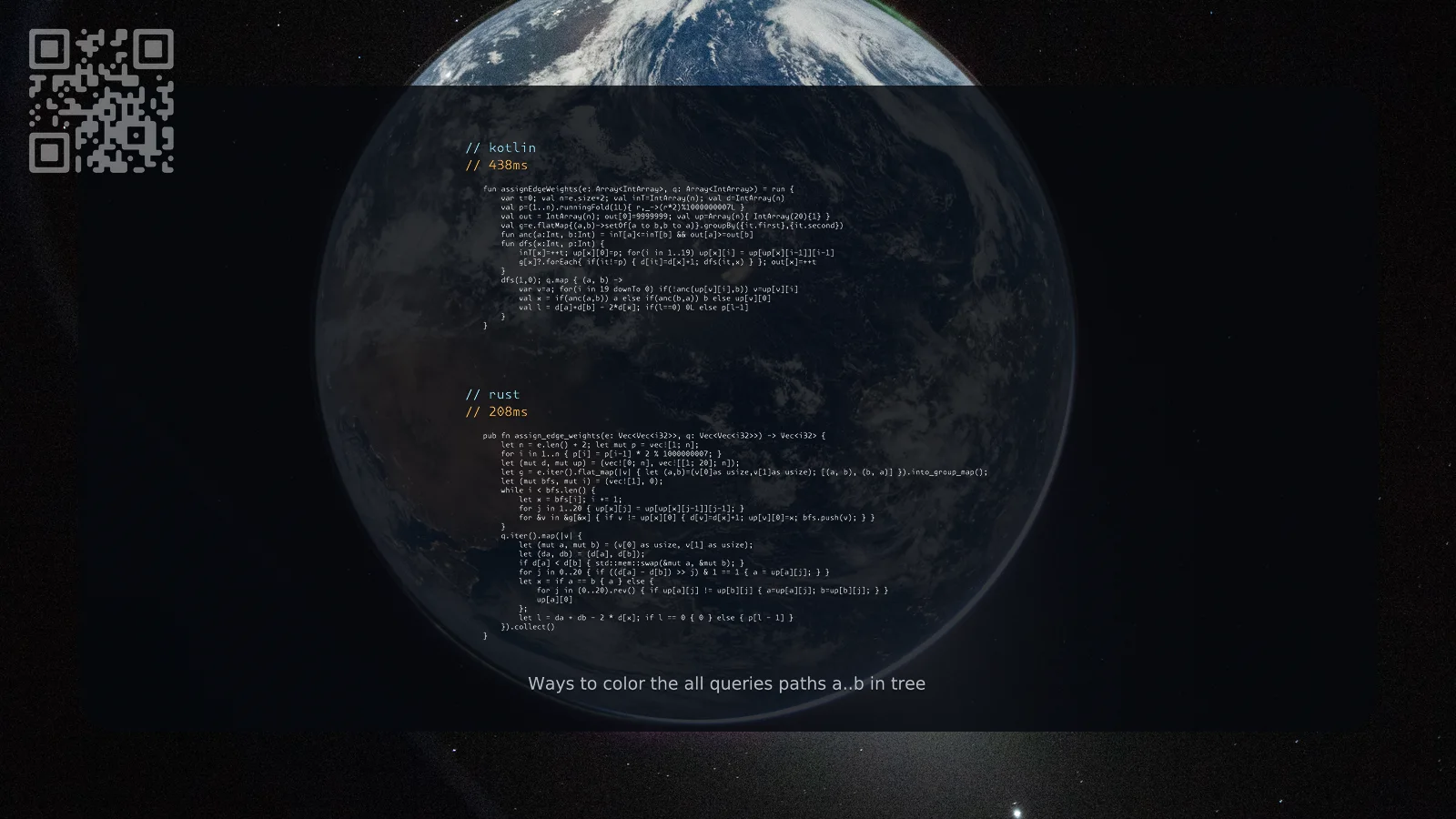
Ways to color the all queries paths a..b in tree
3559. Number of Ways to Assign Edge Weights II hard substack youtube
https://dmitrysamoylenko.com/leetcode/
Join me on Telegram
https://t.me/leetcode_daily_unstoppable/1388
Problem TLDR
Ways to color the all queries paths a..b in tree
Intuition
Didn’t solved myself
    // how to know path from each to each in less than O(n^2)?
    // use hints: LCA, DP of parity
    // TLE, probably because of my LCA
- construct the tree
- DFS: mark time for enter / exit for each node, later use to compare times to check for ancestor
- BFS: track depth of each node, later go to parent until depth is smaller
- the number of two-color the path is 2^len
- binary lifting: go up by powers of two jumps, this allows to precompute up[x][i]=up[up[x][i-1]][i-1], because i-1 is a half-jump https://cp-algorithms.com/graph/lca_binary_lifting.html
Approach
- don’t forget to precompute powers of two
Complexity
-
Time complexity: \(O(nlogn)\)
-
Space complexity: \(O(nlogn)\)
Code
    fun assignEdgeWeights(e: Array<IntArray>, q: Array<IntArray>) = run {
        var t=0; val n=e.size+2; val inT=IntArray(n); val d=IntArray(n)
        val p=(1..n).runningFold(1L){ r,_->(r*2)%1000000007L }
        val out = IntArray(n); out[0]=9999999; val up=Array(n){ IntArray(20){1} }
        val g=e.flatMap{(a,b)->setOf(a to b,b to a)}.groupBy({it.first},{it.second})
        fun anc(a:Int, b:Int) = inT[a]<=inT[b] && out[a]>=out[b]
        fun dfs(x:Int, p:Int) {
            inT[x]=++t; up[x][0]=p; for(i in 1..19) up[x][i] = up[up[x][i-1]][i-1]
            g[x]?.forEach{ if(it!=p) { d[it]=d[x]+1; dfs(it,x) } }; out[x]=++t
        }
        dfs(1,0); q.map { (a, b) ->
            var v=a; for(i in 19 downTo 0) if(!anc(up[v][i],b)) v=up[v][i]
            val x = if(anc(a,b)) a else if(anc(b,a)) b else up[v][0]
            val l = d[a]+d[b] - 2*d[x]; if(l==0) 0L else p[l-1]
        }
    }
    pub fn assign_edge_weights(e: Vec<Vec<i32>>, q: Vec<Vec<i32>>) -> Vec<i32> {
        let n = e.len() + 2; let mut p = vec![1; n];
        for i in 1..n { p[i] = p[i-1] * 2 % 1000000007; }
        let (mut d, mut up) = (vec![0; n], vec![[1; 20]; n]);
        let g = e.iter().flat_map(|v| { let (a,b)=(v[0]as usize,v[1]as usize); [(a, b), (b, a)] }).into_group_map();
        let (mut bfs, mut i) = (vec![1], 0);
        while i < bfs.len() {
            let x = bfs[i]; i += 1;
            for j in 1..20 { up[x][j] = up[up[x][j-1]][j-1]; }
            for &v in &g[&x] { if v != up[x][0] { d[v]=d[x]+1; up[v][0]=x; bfs.push(v); } }
        }
        q.iter().map(|v| {
            let (mut a, mut b) = (v[0] as usize, v[1] as usize);
            let (da, db) = (d[a], d[b]);
            if d[a] < d[b] { std::mem::swap(&mut a, &mut b); }
            for j in 0..20 { if ((d[a] - d[b]) >> j) & 1 == 1 { a = up[a][j]; } }
            let x = if a == b { a } else {
                for j in (0..20).rev() { if up[a][j] != up[b][j] { a=up[a][j]; b=up[b][j]; } }
                up[a][0]
            };
            let l = da + db - 2 * d[x]; if l == 0 { 0 } else { p[l - 1] }
        }).collect()
    }
Comments